Chemical Bonding
NIOS · Class 12 · Chemistry
Most important questions from Chemical Bonding for NIOS Class 12 Chemistry board exam 2026. MCQs, short answer, and long answer questions with marks.
Interactive on Super Tutor
Studying Chemical Bonding? Get the full interactive chapter.
Quizzes, flashcards, AI doubt-solver and a step-by-step study plan — built for important questions and more.
1,000+ Class 12 students started this chapter today
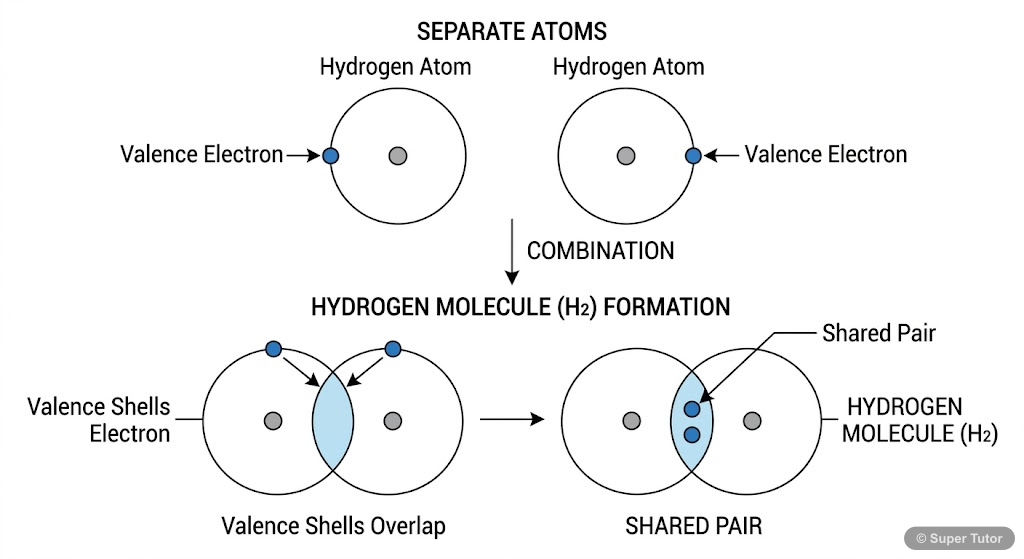
Learn better with visuals Super Tutor has hundreds of illustrations like this across every chapter — all free to try.
Get startedSample Questions
The resonance hybrid of ozone (O₃) has equal bond lengths of 128 pm. The O=O double bond length is 121 pm and O-O single bond length is 148 pm. What does this tell us about the bond order in O₃?
Show answer
Bond order is exactly 1.5, confirmed because 128 pm lies between 121 pm and 148 pm
Step 1: Ozone has two canonical structures — one with O=O (double bond, 121 pm) on the left, and one with O=O on the right. Each structure has one double and one single bond. Step 2: The resonance hybrid is not one structure rapidly switching — it is a SINGLE stable structure that is an average of all canonical structures. Step 3: The average bond order = (1 + 2)/2 = 1.5. This means each O-O bond in O₃ has characteristics intermediate between single and double bond. Step 4: The experimental bond length 128 pm lies between 121 pm (double) and 148 pm (single), confirming bond order ≈ 1.5. Step 5
Which of the following molecules has ZERO dipole moment despite having polar bonds?
Show answer
BF₃
Step 1: Dipole moment is a vector quantity — it has both magnitude and direction. The NET dipole moment of a molecule depends on the vectorial sum of all individual bond dipoles. Step 2: NH₃ has a pyramidal shape (3 bond pairs + 1 lone pair). The three N-H bond dipoles do NOT cancel, and the lone pair adds its orbital dipole — net dipole = 1.47 D (non-zero). Step 3: H₂O is bent/V-shaped (2 bond pairs + 2 lone pairs). The two O-H bond dipoles point in similar directions and don't cancel — net dipole = 1.85 D (non-zero). Step 4: HCl is a diatomic polar molecule with electronegativity difference
In ethyne (C₂H₂), each carbon atom undergoes sp hybridisation. How many sigma (σ) bonds and pi (π) bonds are present in one molecule of ethyne?
Show answer
3 sigma bonds and 2 pi bonds
Step 1: In ethyne (H-C≡C-H), each carbon is sp hybridised. sp hybridisation means one 2s orbital mixes with one 2p orbital to give 2 sp hybrid orbitals, leaving 2 unhybridised p orbitals on each carbon. Step 2: Bond 1 — C-H sigma bond on the left carbon: sp hybrid orbital of C overlaps with 1s of H (σ bond). Step 3: Bond 2 — C-C sigma bond: sp hybrid orbital of C₁ overlaps with sp hybrid orbital of C₂ along the internuclear axis (σ bond). Step 4: Bond 3 — C-H sigma bond on the right carbon (σ bond). So total sigma bonds = 3. Step 5: The 2 unhybridised p orbitals on each carbon (say p_y and p_z
The MO electronic configuration of N₂ molecule is σ1s², σ*1s², σ2s², σ*2s², π2p²(x), π2p²(y), σ2p². What is the bond order of N₂ and why does N₂ show diamagnetic behaviour?
Show answer
Bond order = 3; diamagnetic because all electrons in MOs are paired
Step 1: N₂ has 14 electrons total (7 from each N). Full MO configuration: σ1s², σ*1s², σ2s², σ*2s², π2p²(x), π2p²(y), σ2p². Step 2: Count bonding electrons (in σ1s, σ2s, π2p_x, π2p_y, σ2p) = 2+2+2+2+2 = 10. Count antibonding electrons (in σ*1s, σ*2s) = 2+2 = 4. Step 3: Bond order = ½(bonding - antibonding) = ½(10 - 4) = ½(6) = 3. This confirms the triple bond N≡N. Step 4: For magnetic behaviour: look at ALL molecular orbitals. Every orbital has 2 electrons (completely filled, paired). There are NO singly occupied (half-filled) MOs. Step 5: Since all electrons are paired, there are no unpaired
+41 more questions available
Practice AllFrequently Asked Questions
What are the important topics in Chemical Bonding for NIOS Class 12 Chemistry?
How to score full marks in Chemical Bonding — NIOS Class 12 Chemistry?
How many important questions are there in Chemical Bonding?
Sources & Official References
Content is aligned to the official syllabus. Refer to the board website for the latest curriculum.
More resources for Chemical Bonding
Practice Quiz
Test yourself with a quick quiz
Revision Notes
Key points for last-minute revision
Formula Sheet
All formulas in one place
Chapter Summary
Understand the chapter at a glance
Concept Maps
See how topics connect visually
Study Plan
Step-by-step plan to ace this chapter
Flashcards
Quick-fire cards for active recall
Syllabus
What topics to cover
NCERT Solutions
Every textbook question solved step by step
For serious students
Get the full Chemical Bonding chapter — for free.
Quizzes, flashcards, AI doubt-solver and a step-by-step study plan for NIOS Class 12 Chemistry.