The Gaseous And Liquid State
NIOS · Class 12 · Chemistry
Most important questions from The Gaseous And Liquid State for NIOS Class 12 Chemistry board exam 2026. MCQs, short answer, and long answer questions with marks.
Interactive on Super Tutor
Studying The Gaseous And Liquid State? Get the full interactive chapter.
Quizzes, flashcards, AI doubt-solver and a step-by-step study plan — built for important questions and more.
1,000+ Class 12 students started this chapter today
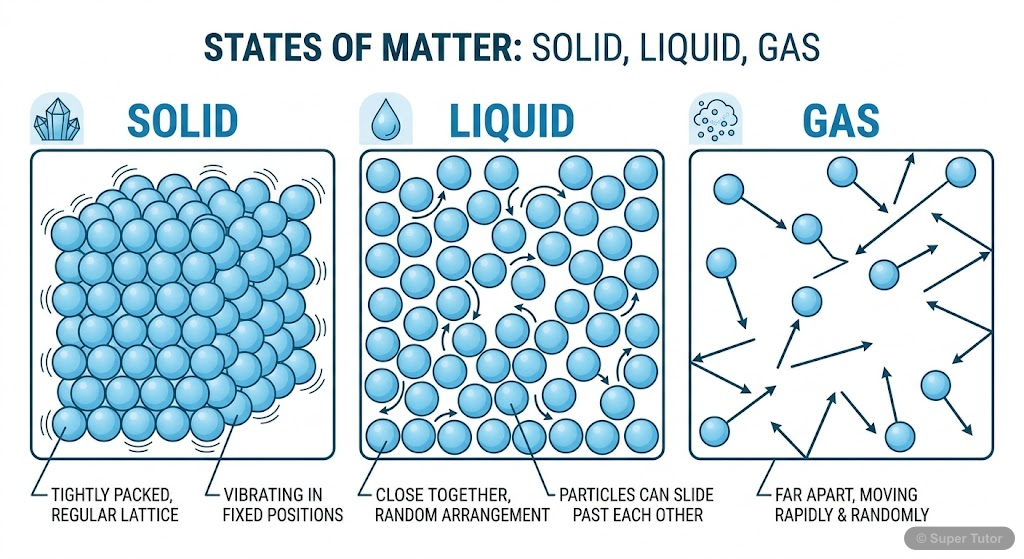
Super Tutor has 5+ illustrations like this for The Gaseous And Liquid State alone — flashcards, concept maps, and step-by-step visuals.
See them allSample Questions
A mixture of gases contains 2.74 mol of N₂ and 0.725 mol of O₂ at a total pressure of 1 atm. What is the partial pressure of O₂?
Show answer
0.209 atm
Step 1: Apply Dalton's Law of Partial Pressures: pA = XA × pTotal. Step 2: Total moles = 2.74 + 0.725 = 3.465 mol. Step 3: Mole fraction of O₂ = 0.725 / 3.465 = 0.209. Step 4: Partial pressure of O₂ = 0.209 × 1 atm = 0.209 atm. Option B (0.791 atm) is the partial pressure of N₂, not O₂ – a common mix-up. Option C uses number of moles directly as pressure. Option D incorrectly assumes equal mole fractions.
Which of the following correctly explains why NH₃ has an abnormally high boiling point compared to PH₃, AsH₃, and SbH₃?
Show answer
NH₃ molecules form intermolecular hydrogen bonds due to the high electronegativity of N
Step 1: In group 15 hydrides, boiling points should increase with molar mass going down the group (PH₃ → SbH₃). NH₃ breaks this trend. Step 2: Nitrogen is highly electronegative (3.0) and has a lone pair. The N–H bond is highly polar, allowing N…H–N hydrogen bonding between molecules. Step 3: Hydrogen bonding is much stronger than ordinary van der Waals forces, requiring more energy (higher temperature) to break – hence higher boiling point. Step 4: Option B is wrong because NH₃ has LOWER molar mass (17) than PH₃ (34), yet boils higher. Option C is wrong because London forces increase with mas
The rates of diffusion of CO₂ and an unknown gas X were found to be in the ratio 1 : 0.5. What is the molar mass of gas X? (Molar mass of CO₂ = 44 g/mol)
Show answer
176 g/mol
Step 1: Graham's Law states: rate_A / rate_B = √(M_B / M_A). Step 2: rate_CO₂ / rate_X = √(M_X / M_CO₂) → 1/0.5 = √(M_X / 44). Step 3: 2 = √(M_X / 44) → squaring both sides: 4 = M_X / 44. Step 4: M_X = 4 × 44 = 176 g/mol. Option B (11 g/mol) comes from dividing instead of multiplying. Option C (88 g/mol) results from squaring 2 and multiplying by 22 (using half of M_CO₂). Option D comes from not squaring the ratio at all.
For a real gas, the van der Waals equation is written as (p + an²/V²)(V − nb) = nRT. What does the term 'an²/V²' correct for?
Show answer
Intermolecular attractive forces between gas molecules
Step 1: Ideal gas assumes no intermolecular attractive forces. Real gases have attraction between molecules, especially at high pressure. Step 2: Due to these attractive forces, molecules are pulled back from the walls, reducing the actual pressure exerted on the walls compared to ideal pressure. Step 3: So: p_ideal = p_real + an²/V². The term an²/V² is the pressure correction that accounts for these attractive forces ('a' is van der Waals constant related to attraction). Step 4: The term 'nb' corrects for the finite volume of molecules (Option B is the explanation for 'nb', not 'an²/V²'). Opt
+41 more questions available
Practice AllFrequently Asked Questions
What are the important topics in The Gaseous And Liquid State for NIOS Class 12 Chemistry?
How to score full marks in The Gaseous And Liquid State — NIOS Class 12 Chemistry?
How many important questions are there in The Gaseous And Liquid State?
Sources & Official References
Content is aligned to the official syllabus. Refer to the board website for the latest curriculum.
More resources for The Gaseous And Liquid State
Practice Quiz
Test yourself with a quick quiz
Revision Notes
Key points for last-minute revision
Formula Sheet
All formulas in one place
Chapter Summary
Understand the chapter at a glance
Concept Maps
See how topics connect visually
Study Plan
Step-by-step plan to ace this chapter
Flashcards
Quick-fire cards for active recall
Syllabus
What topics to cover
NCERT Solutions
Every textbook question solved step by step
For serious students
Get the full The Gaseous And Liquid State chapter — for free.
Quizzes, flashcards, AI doubt-solver and a step-by-step study plan for NIOS Class 12 Chemistry.