Transition and Inner Transition Elements
Tamil Nadu Board · Class 12 · Chemistry
Most important questions from Transition and Inner Transition Elements for Tamil Nadu Board Class 12 Chemistry board exam 2026. MCQs, short answer, and long answer questions with marks.
Interactive on Super Tutor
Studying Transition and Inner Transition Elements? Get the full interactive chapter.
Quizzes, flashcards, AI doubt-solver and a step-by-step study plan — built for important questions and more.
1,000+ Class 12 students started this chapter today
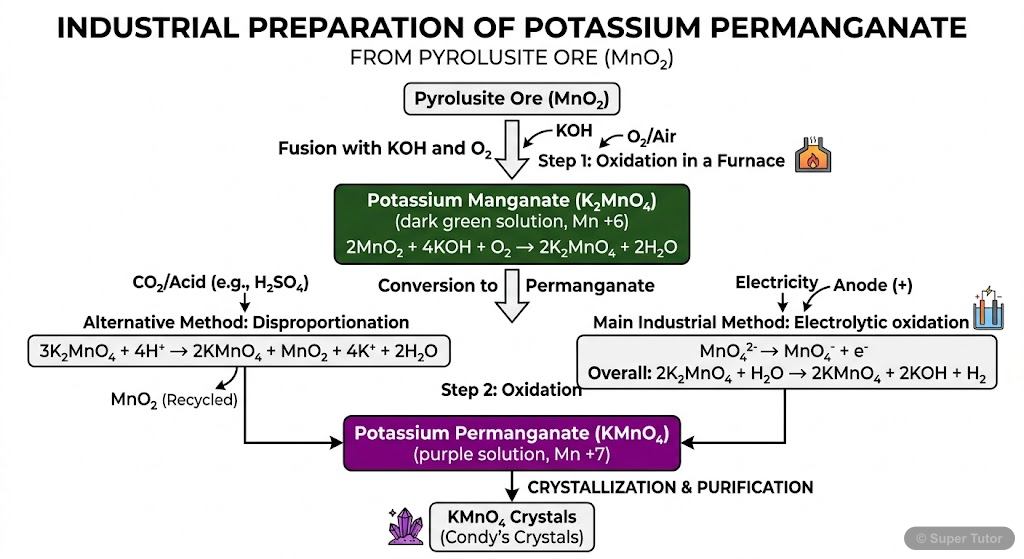
Super Tutor has 5+ illustrations like this for Transition and Inner Transition Elements alone — flashcards, concept maps, and step-by-step visuals.
See them allSample Questions
What is the oxidation state of Manganese in KMnO₄?
Show answer
+7
Step 1: To find the oxidation state of Mn in KMnO₄, apply the rule that the sum of all oxidation states equals zero for a neutral compound. Step 2: Assign known oxidation states: K = +1, each O = -2. Step 3: Let oxidation state of Mn = x. Then: (+1) + x + 4(-2) = 0. Step 4: 1 + x - 8 = 0, so x = +7. Step 5: This is the highest oxidation state of Mn. It is because Mn can lose all 7 valence electrons (2 from 4s and 5 from 3d). This high oxidation state makes KMnO₄ a strong oxidizing agent. The +4 state corresponds to MnO₂, +6 corresponds to MnO₄²⁻ (manganate ion).
The spin-only magnetic moment formula is μ = √n(n+2) BM. What is the spin-only magnetic moment of Fe³⁺ (Z=26)?
Show answer
5.91 BM
Step 1: Find the electronic configuration of Fe³⁺. Fe has configuration [Ar] 3d⁶ 4s². Step 2: Fe³⁺ loses 3 electrons (2 from 4s and 1 from 3d): Fe³⁺ = [Ar] 3d⁵. Step 3: In the 3d⁵ configuration, all 5 d-electrons are unpaired (half-filled, one in each orbital by Hund's rule). So n = 5. Step 4: Apply formula: μ = √n(n+2) = √5(5+2) = √35 = 5.91 BM. Step 5: Options A (1.73 BM) corresponds to n=1 (d¹), B (3.87 BM) to n=3 (d³), and D (4.89 BM) to n=4 (d⁴). Fe³⁺ has d⁵ configuration (same as Mn²⁺), giving the highest magnetic moment in the 3d series.
K₂Cr₂O₇ acts as an oxidizing agent in acidic medium. In the reaction, Cr₂O₇²⁻ oxidizes Fe²⁺ to Fe³⁺. Which product is formed from the dichromate ion?
Show answer
Cr³⁺
Step 1: In K₂Cr₂O₇, chromium is in the +6 oxidation state. When it acts as an oxidizing agent, it gets reduced. Step 2: The half-reaction in acidic medium is: Cr₂O₇²⁻ + 14H⁺ + 6e⁻ → 2Cr³⁺ + 7H₂O. Step 3: Chromium is reduced from +6 to +3 (gains 3 electrons per Cr atom, total 6 electrons for 2 Cr atoms). Step 4: The complete reaction is: Cr₂O₇²⁻ + 6Fe²⁺ + 14H⁺ → 2Cr³⁺ + 6Fe³⁺ + 7H₂O. Step 5: CrO₄²⁻ is chromate (Cr is +6, not a reduction product). Cr²⁺ would require reduction to +2, which needs even stronger reducing conditions. CrO₃ is an oxidized form, not a product of reduction.
What is Baeyer's reagent and what type of organic compound does it detect?
Show answer
Cold dilute alkaline KMnO₄; detects unsaturation (C=C bonds)
Step 1: Baeyer's reagent is specifically cold dilute alkaline potassium permanganate (KMnO₄) solution. Step 2: When an alkene (compound with C=C double bond) is treated with Baeyer's reagent, the purple/violet color of KMnO₄ is decolorized. Step 3: The reaction converts alkenes to diols (vicinal diols): C=C + KMnO₄ (alk.) → CHOH-CHOH (diol). Step 4: The decolorization of the purple KMnO₄ solution confirms the presence of unsaturation (C=C or C≡C). Step 5: Hot concentrated KMnO₄ cleaves the double bond entirely (different reaction), so 'hot' and 'cold' conditions give different products. K₂Cr₂O
+41 more questions available
Practice AllFrequently Asked Questions
What are the important topics in Transition and Inner Transition Elements for Tamil Nadu Board Class 12 Chemistry?
How to score full marks in Transition and Inner Transition Elements — Tamil Nadu Board Class 12 Chemistry?
How many important questions are there in Transition and Inner Transition Elements?
Sources & Official References
Content is aligned to the official syllabus. Refer to the board website for the latest curriculum.
More resources for Transition and Inner Transition Elements
Practice Quiz
Test yourself with a quick quiz
Revision Notes
Key points for last-minute revision
Formula Sheet
All formulas in one place
Chapter Summary
Understand the chapter at a glance
Concept Maps
See how topics connect visually
Study Plan
Step-by-step plan to ace this chapter
Flashcards
Quick-fire cards for active recall
Syllabus
What topics to cover
NCERT Solutions
Every textbook question solved step by step
For serious students
Get the full Transition and Inner Transition Elements chapter — for free.
Quizzes, flashcards, AI doubt-solver and a step-by-step study plan for Tamil Nadu Board Class 12 Chemistry.