Human Reproduction — Syllabus
Tamil Nadu Board · Class 12 · Zoology
What Human Reproduction covers in Tamil Nadu Board Class 12 Zoology: 4 topics, for the 2026-27 session. Topics include 1 Human Reproductive System, 2.
Interactive on Super Tutor
Studying Human Reproduction? Get the full interactive chapter.
Quizzes, flashcards, AI doubt-solver and a step-by-step study plan — built for syllabus and more.
Free trial, no card needed.
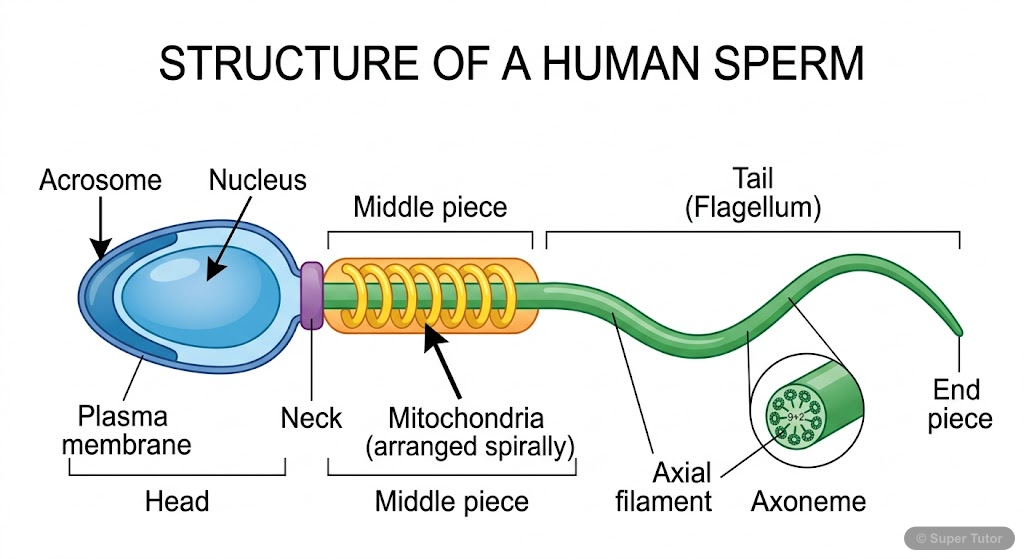
One of 2 illustrations for Human Reproduction in Super Tutor — alongside flashcards, concept maps and practice questions.
Topics in Human Reproduction
2.1 Human Reproductive System
- The reproductive system has four main functions: produce gametes (sperms and ova), transport and sustain gametes, nurture developing offspring, and produce hormones.
- Primary reproductive organs are testes (in males) and ovaries (in females) — they produce gametes and hormones.
- Testes are located in the scrotum outside the abdominal cavity because viable sperms need a temperature 2–3°C lower than normal body temperature.
2.2 Gametogenesis – Spermatogenesis and Oogenesis
- Gametogenesis = formation of gametes (sperms and ova) from primary sex organs through meiosis.
- Spermatogenesis occurs in seminiferous tubules; produces sperms continuously from puberty throughout life.
- Spermatogonia (2n) → (mitosis + growth) → Primary spermatocytes (2n, 46 chromosomes) → (Meiosis I) → 2 Secondary spermatocytes (n, 23 chromosomes) → (Meiosis II) → 4 Spermatids (n) → (Spermiogenesis)
2.3 Menstrual Cycle
- Menstrual cycle: cyclic changes in the female reproductive system occurring approximately every 28–29 days, from menarche (puberty) to menopause, except during pregnancy.
- Cyclic menstruation is an indicator of normal reproductive phase.
- The menstrual cycle has 4 phases: Menstrual Phase → Follicular Phase → Ovulatory Phase → Luteal Phase.
2.4 Menstrual Disorders and Menstrual Hygiene
- Amenorrhoea = absence of menstruation; Primary amenorrhoea = menarche not appearing by age 18; Secondary amenorrhoea = absence of menstruation for 3+ consecutive months.
- Polymenorrhoea = menstrual cycle shorter than 21 days; due to hyperactive anterior pituitary, psychological disturbances, malnutrition or STDs like chlamydiasis/gonorrhoea.
- Dysmenorrhoea = painful menstruation (most commonly reported disorder); Primary dysmenorrhoea caused by prostaglandins; Secondary dysmenorrhoea caused by endometriosis or uterine fibroids.
Key Concepts
Work through every topic in Human Reproduction with notes and quizzes
Start This ChapterFrequently Asked Questions
What are the important topics in Human Reproduction for Tamil Nadu Board Class 12 Zoology?
How should I revise Human Reproduction for the Tamil Nadu Board Class 12 board exam?
Sources & Official References
Content is aligned to the official syllabus. Refer to the board website for the latest curriculum.
More resources for Human Reproduction
Practice Quiz
Test yourself with a quick quiz
Important Questions
Exam-style questions with answers
Revision Notes
Key points for last-minute revision
Formula Sheet
The chapter's formulas in one place
Chapter Summary
Understand the chapter at a glance
Concept Maps
See how topics connect
Flashcards
Quick-fire cards for active recall
For serious students
Get the full Human Reproduction chapter — start free.
Quizzes, flashcards, an AI doubt solver and a study plan for Tamil Nadu Board Class 12 Zoology. Free to start, no card needed.