Chapter 8 of 10
Revision Notes
Sound — Revision Notes
Tamil Nadu Board · Class 9 · Science
Sound revision notes for Tamil Nadu Board Class 9 Science: 4 topics in quick points. Part of the Tamil Nadu Board Class 9 Science syllabus.
43 questions40 flashcards5 concepts
Interactive on Super Tutor
Studying Sound? Get the full interactive chapter.
Quizzes, flashcards, AI doubt-solver and a step-by-step study plan — built for revision notes and more.
Free trial, no card needed.
Super Tutor
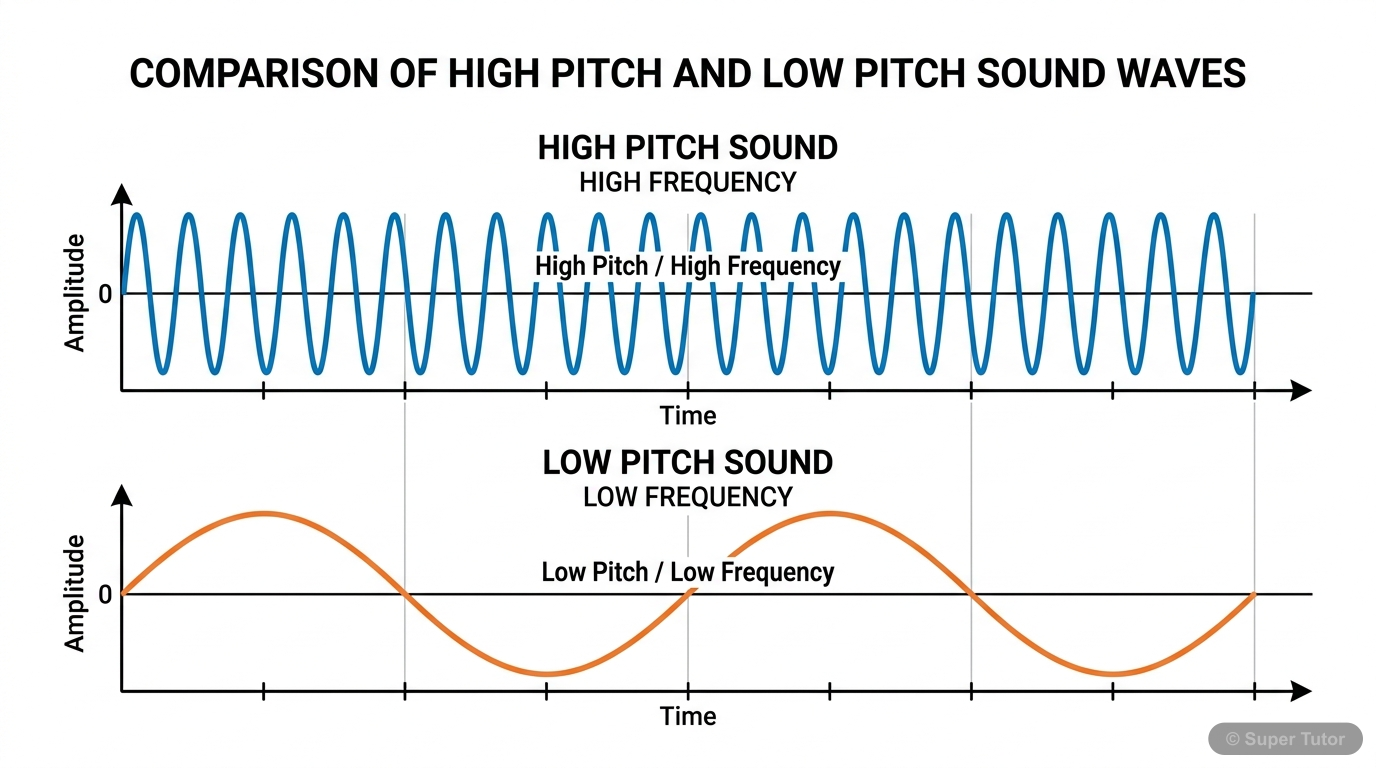
One of 3 illustrations for Sound in Super Tutor — alongside flashcards, concept maps and practice questions.
Key Topics to Revise
1
1. Production and Propagation of Sound
- Sound is produced by the vibration of objects (e.g., tuning fork, vocal cords, strings of musical instruments).
- Sound needs a material medium (solid, liquid, or gas) for propagation. It CANNOT travel through vacuum.
- Bell-Jar Experiment proves sound cannot travel through vacuum: as air is pumped out of the jar containing a ringing bell, the sound becomes fainter and finally disappears.
2
2. Characteristics of a Sound Wave
- A sound wave is completely described by five characteristics: Amplitude, Frequency, Time Period, Wavelength, and Velocity (Speed).
- Amplitude (A): Maximum displacement of medium particles from rest position. SI unit: metre (m). Larger amplitude → louder sound.
- Frequency (n): Number of complete vibrations (cycles) per second. SI unit: hertz (Hz) or s⁻¹.
3
3. Distinguishing Sounds – Loudness, Pitch, and Timbre
- Sounds can be distinguished by three qualities: Loudness, Pitch, and Timbre (Quality).
- LOUDNESS depends on the amplitude of the sound wave. Greater amplitude → louder sound. Loud sound has higher energy and travels farther.
- Intensity of sound is the amount of energy crossing per unit area per unit time, perpendicular to the direction of propagation. Unit: decibel (dB), named after Alexander Graham Bell.
4
4. Speed of Sound
- Speed of sound is the distance travelled by a sound wave per unit time in an elastic medium.
- Speed of sound varies with the medium: fastest in solids, slower in liquids, slowest in gases.
- Speed of sound in air at 0°C = 330 m/s; at 25°C = 340 m/s. Speed increases with increase in temperature.
Get complete notes with diagrams and examples
Full NotesKey Concepts
Sound is created when an objectSound cannot travel through a vacuumSound waves are longitudinal wavesAmplitude is the maximum displacementFrequency is the number of complete
Frequently Asked Questions
What are the important topics in Sound for Tamil Nadu Board Class 9 Science?
Key topics in Sound include Production and Propagation of Sound, Characteristics of a Sound Wave, Distinguishing Sounds – Loudness, Pitch, and Timbre, Speed of Sound. Study these first, then practise questions on each for Class 9 exams.
How should I revise Sound for Class 9 exams?
Learn the core ideas first, then work through the 43 practice questions on Sound. Revise definitions regularly and use flashcards for quick recall before the exam.
Sources & Official References
Content is aligned to the official syllabus. Refer to the board website for the latest curriculum.
More resources for Sound
For serious students
Get the full Sound chapter — start free.
Quizzes, flashcards, an AI doubt solver and a study plan for Tamil Nadu Board Class 9 Science. Free to start, no card needed.