Dissolution of Partnership Firm — NCERT Solutions
CBSE · Class 12 · Accountancy
NCERT question answers for Dissolution of Partnership Firm, CBSE Class 12 Accountancy: 26 textbook questions solved step by step.
Interactive on Super Tutor
Studying Dissolution of Partnership Firm? Get the full interactive chapter.
Quizzes, flashcards, AI doubt-solver and a step-by-step study plan — built for NCERT solutions and more.
Free trial, no card needed.
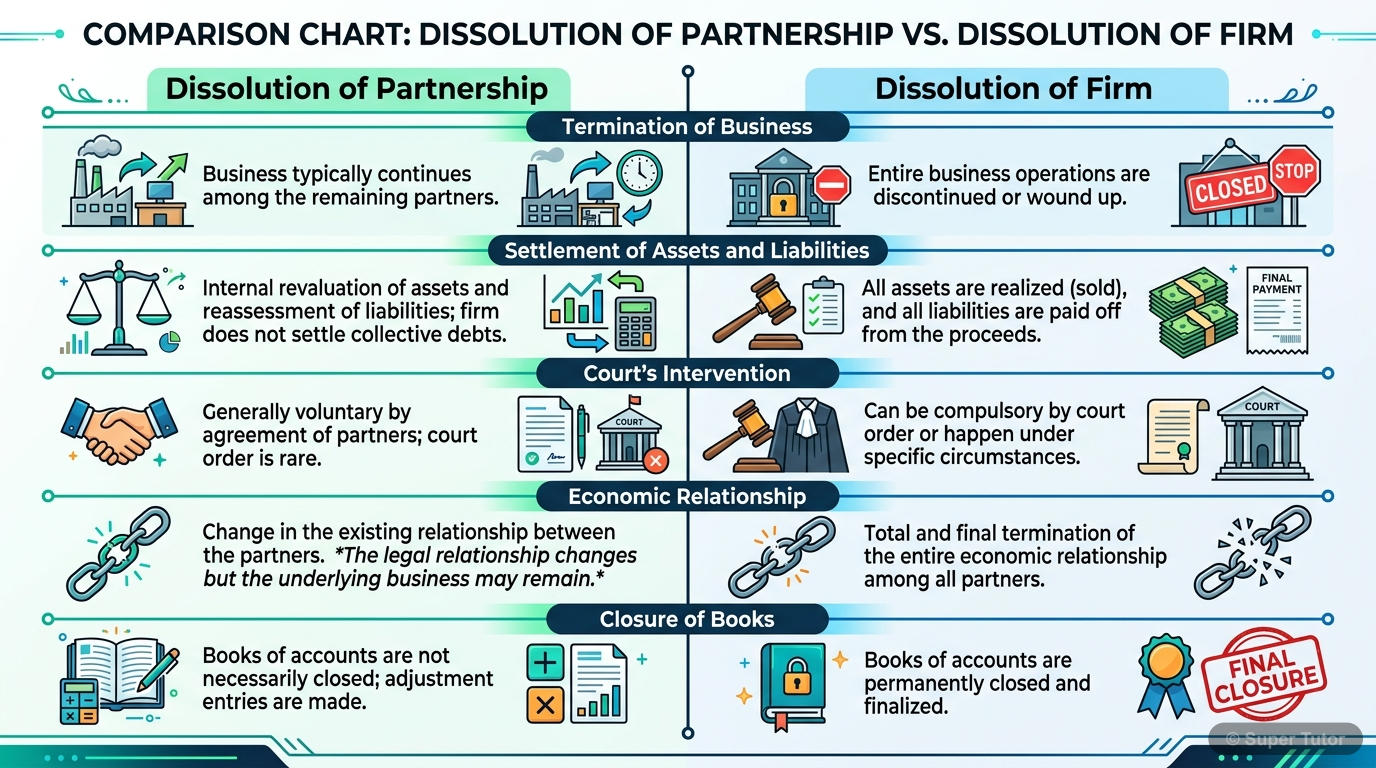
Learn better with visuals Super Tutor pairs illustrations like this with notes and quizzes for Dissolution of Partnership Firm.
Get startedThe first 13 solutions are open to read. The other 13 are free with a Super Tutor account. Unlock all 26 free in Super Tutor
Test your Understanding – I
1Dissolution of a partnership is different from dissolution of a firm.Show solution
The chapter states that dissolution of partnership only changes the relationship among partners, while dissolution of firm ends the business completely. So they are different.
Not sure why a step works? check your working in Super Tutor
2A partnership is dissolved when there is a death of a partner.Show solution
The chapter says that death of a partner causes dissolution of partnership, though the firm may continue if the partners decide so.
Not sure why a step works? check your working in Super Tutor
3A firm is dissolved when all partners give consent to it.Show solution
A firm is dissolved with the consent of all the partners. Therefore, this statement is true.
Not sure why a step works? check your working in Super Tutor
4A firm is compulsorily dissolved when a partner decide to retire.Show solution
A partner deciding to retire leads to dissolution of partnership, not compulsory dissolution of the firm. Compulsory dissolution happens in cases like insolvency of all partners or illegality of business.
Not sure why a step works? check your working in Super Tutor
5Dissolution of a firm necessarily involves dissolution of partnership.Show solution
The chapter says that dissolution of the firm necessarily brings dissolution of the partnership. So if the firm is dissolved, the partnership also ends.
Not sure why a step works? check your working in Super Tutor
6A firm is compulsorily dissolved when all partners or when all except one partner become insolvent.Show solution
The chapter states that a firm is compulsorily dissolved when all the partners or all but one partner become insolvent.
Not sure why a step works? check your working in Super Tutor
7Court can order a firm to be dissolved when a partner becomes insane.Show solution
Yes. Under dissolution by court, one ground is when a partner becomes insane.
Not sure why a step works? check your working in Super Tutor
8Dissolution of partnership can not take place without intervention of the court.Show solution
The chapter says dissolution of partnership may take place without intervention of court. So court intervention is not necessary.
Not sure why a step works? check your working in Super Tutor
Test your Understanding – II
1On dissolution of a firm, bank overdraft is transferred to :- (a) Cash Account
- (b) Bank Account
- (c) Realisation Account
- (d) Partner's capital Account.
Show solution
- (a) Cash Account
- (b) Bank Account
- (c) Realisation Account
- (d) Partner's capital Account.
On dissolution, bank overdraft is an external liability, so it is transferred to the Realisation Account.
Not sure why a step works? check your working in Super Tutor
2On dissolution of a firm, partner's loan account is transferred to:- (a) Realisation Account
- (b) Partner's Capital Account
- (c) Partner's Current Account
- (d) None of the above.
Show solution
- (a) Realisation Account
- (b) Partner's Capital Account
- (c) Partner's Current Account
- (d) None of the above.
The chapter states that partner's loan is paid through Bank Account and is not transferred to Realisation Account. So the correct option is None of the above.
Not sure why a step works? check your working in Super Tutor
3After transferring liabilities like creditors and bills payables in the Realisation Account, in the absence of any information regarding their payment, such liabilities are treated as:- (a) Never paid
- (b) Fully paid
- (c) Partly paid
- (d) None of the above.
Show solution
- (a) Never paid
- (b) Fully paid
- (c) Partly paid
- (d) None of the above.
In the absence of information, creditors and bills payable are treated as fully paid in Realisation Account.
Not sure why a step works? check your working in Super Tutor
4When realisation expenses are paid by the firm on behalf of a partner, such expenses are debited to:- (a) Realisation Account
- (b) Partner's Capital Account
- (c) Partner's Loan Account
- (d) None of the above.
Show solution
- (a) Realisation Account
- (b) Partner's Capital Account
- (c) Partner's Loan Account
- (d) None of the above.
When realisation expenses are paid by the firm on behalf of a partner, the chapter says the amount is debited to the partner's capital account.
Not sure why a step works? check your working in Super Tutor
5Unrecorded assets when taken over by a partner are shown in :- (a) Debit of Realisation Account
- (b) Debit of Bank Account
- (c) Credit of Realisation Account
- (d) Credit of Bank Account.
Show solution
- (a) Debit of Realisation Account
- (b) Debit of Bank Account
- (c) Credit of Realisation Account
- (d) Credit of Bank Account.
An unrecorded asset taken over by a partner is credited in the Realisation Account because the asset is being disposed of through realisation.
Not sure why a step works? check your working in Super Tutor
- (a) Debit of Realisation Account
- (b) Debit of Bank Account
- (c) Credit of Realisation Account
- (d) Credit of Bank Account.
Free with a Super Tutor account
- (a) Realisation Account
- (b) Partners' Capital Accounts
- (c) Bank Account
- (d) None of the above.
Free with a Super Tutor account
- (a) Realisation Account
- (b) Drawings Account
- (c) Bank Account
- (d) Loan Account.
Free with a Super Tutor account
Test your Understanding – III
Free with a Super Tutor account
Free with a Super Tutor account
Free with a Super Tutor account
Free with a Super Tutor account
Free with a Super Tutor account
Free with a Super Tutor account
Free with a Super Tutor account
Free with a Super Tutor account
Free with a Super Tutor account
Free with a Super Tutor account
13 more solved questions in Dissolution of Partnership Firm
They are free with a Super Tutor account, along with practice quizzes and flashcards for this chapter. Free to start, no card needed.
Frequently Asked Questions
What are the important topics in Dissolution of Partnership Firm for CBSE Class 12 Accountancy?
Are these NCERT Solutions for Dissolution of Partnership Firm free?
How should I revise Dissolution of Partnership Firm for the CBSE Class 12 board exam?
Sources & Official References
- NCERT Official — ncert.nic.in
- CBSE Academic — cbseacademic.nic.in
- CBSE Official — cbse.gov.in
- National Education Policy 2020 — education.gov.in
Content is aligned to the official syllabus. Refer to the board website for the latest curriculum.
More resources for Dissolution of Partnership Firm
Practice Quiz
Test yourself with a quick quiz
Important Questions
Exam-style questions with answers
Revision Notes
Key points for last-minute revision
Formula Sheet
The chapter's formulas in one place
Chapter Summary
Understand the chapter at a glance
Concept Maps
See how topics connect
Study Plan
Step-by-step plan for this chapter
Flashcards
Quick-fire cards for active recall
Syllabus
What topics to cover
For serious students
Get the full Dissolution of Partnership Firm chapter — start free.
Quizzes, flashcards, an AI doubt solver and a study plan for CBSE Class 12 Accountancy. Free to start, no card needed.