Issue and Redemption of Debentures
CBSE · Class 12 · Accountancy
NCERT Solutions for Issue and Redemption of Debentures — CBSE Class 12 Accountancy.
Interactive on Super Tutor
Studying Issue and Redemption of Debentures? Get the full interactive chapter.
Quizzes, flashcards, AI doubt-solver and a step-by-step study plan — built for ncert solutions and more.
1,000+ Class 12 students started this chapter today
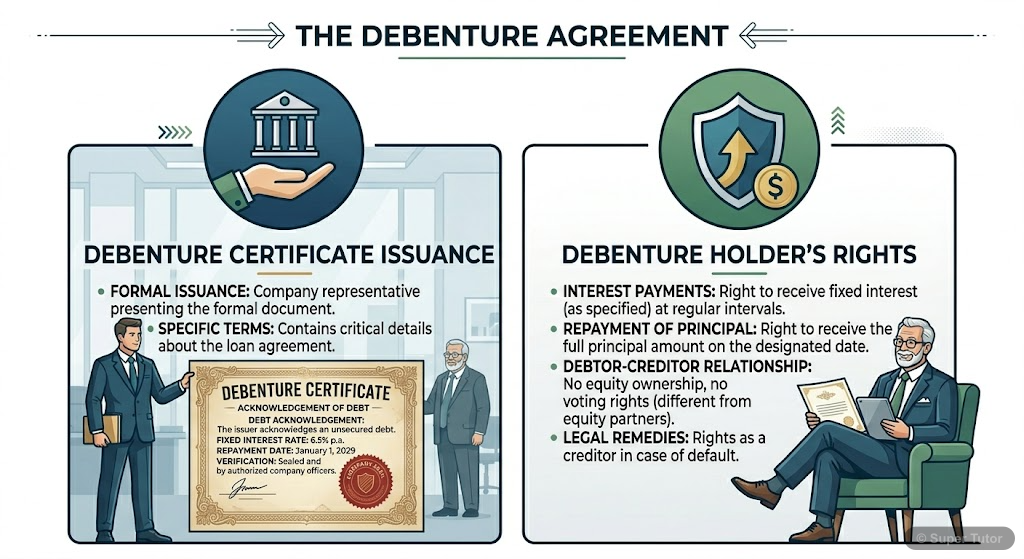
Super Tutor has 13+ illustrations like this for Issue and Redemption of Debentures alone — flashcards, concept maps, and step-by-step visuals.
See them all25 worked solutions below. Unlock all 49 free in Super Tutor
Questions for Practice
1What is meant by a Debenture?Show solution
Not sure why a step works? check your working in Super Tutor
2What does a Bearer Debenture mean?Show solution
Not sure why a step works? check your working in Super Tutor
3State the meaning of 'Debentures issued as a collateral security'.Show solution
Not sure why a step works? check your working in Super Tutor
4What is meant by 'Issue of debentures for consideration other than cash'?Show solution
Not sure why a step works? check your working in Super Tutor
5What is meant by Issue of debenture at discount and redeemable at premium?Show solution
Not sure why a step works? check your working in Super Tutor
6What is 'Capital Reserve'?Show solution
Not sure why a step works? check your working in Super Tutor
7What is meant by a 'Irredeemable Debenture'?Show solution
Not sure why a step works? check your working in Super Tutor
8What is a 'Convertible Debenture'?Show solution
Not sure why a step works? check your working in Super Tutor
9What is meant by 'Mortgaged Debentures'?Show solution
Not sure why a step works? check your working in Super Tutor
10What is discount on issue of debentures?Show solution
Not sure why a step works? check your working in Super Tutor
11What is meant by 'Premium on Redemption of Debentures'?Show solution
Not sure why a step works? check your working in Super Tutor
12How debentures are different from shares? Give two points.Show solution
1. Ownership: A share represents ownership of the company, while a debenture is only an acknowledgment of debt.
2. Return: Return on shares is called dividend, while return on debentures is called interest. Dividend depends on profits, but interest is fixed and must be paid whether or not there is profit.
Also, shares are part of owned capital, whereas debentures are part of borrowed capital.
Not sure why a step works? check your working in Super Tutor
13What is meant by redemption of debentures?Show solution
Not sure why a step works? check your working in Super Tutor
14Can the company purchase its own debentures?Show solution
Not sure why a step works? check your working in Super Tutor
15What is meant by redemption of debentures by conversion?Show solution
Not sure why a step works? check your working in Super Tutor
16How would you deal with 'Premium on Redemption of Debentures'?Show solution
Not sure why a step works? check your working in Super Tutor
17What is meant by redemption of debentures by "Purchase in Open Market"?Show solution
Not sure why a step works? check your working in Super Tutor
1Explain the different types of debentures?Show solution
1. From the point of view of security
- Secured debentures: charge created on assets; may be fixed or floating.
- Unsecured debentures: no specific charge on assets.
2. From the point of view of tenure
- Redeemable debentures: repayable after a fixed period or in instalments.
- Irredeemable/Perpetual debentures: no fixed repayment undertaking; repayable on winding up or after a long period.
3. From the point of view of convertibility
- Convertible debentures: can be converted into shares or other securities.
- Non-convertible debentures: cannot be converted.
4. From coupon rate point of view
- Specific coupon rate debentures: carry a specified rate of interest.
- Zero coupon rate debentures: no specific rate; issued at a substantial discount.
5. From the view point of registration
- Registered debentures: transferred by deed and recorded in company register.
- Bearer debentures: transferred by delivery.
Not sure why a step works? check your working in Super Tutor
2Distinguish between a debenture and a share. Why debenture is known as loan capital? Explain.Show solution
Two points of distinction:
- A share gives ownership; a debenture is only an acknowledgment of debt.
- Return on shares is dividend, but return on debentures is interest, which is payable even if there is no profit.
Not sure why a step works? check your working in Super Tutor
3Describe the meaning of 'Debenture Issued as Collateral Securities'. What accounting treatment is given to the issue of debentures in the books of accounts?Show solution
Accounting treatment:
- First method: No entry is made because no separate liability is created. In the balance sheet, a note is given below the loan showing that it is secured by issue of debentures as collateral security.
- Second method: A journal entry is passed:
- `Debenture Suspense A/c Dr. To Debentures A/c`
- In the balance sheet, Debenture Suspense is shown as a deduction from debentures under long-term borrowings.
- When the loan is repaid, the entry is reversed.
Not sure why a step works? check your working in Super Tutor
4Explain the different terms for the issue of debentures with reference to their redemption.Show solution
1. Issued at par and redeemable at par
2. Issued at discount and redeemable at par
3. Issued at premium and redeemable at par
4. Issued at par and redeemable at premium
5. Issued at discount and redeemable at premium
6. Issued at premium and redeemable at premium
Accordingly, the journal entry differs by whether discount, premium on issue, and premium on redemption are present.
Not sure why a step works? check your working in Super Tutor
5Differentiate between redemption of debentures out of capital and out of profits.Show solution
Redemption out of profits means the company uses its profits for redemption. For this, it may create a Debenture Redemption Reserve (DRR) out of profits and also make required investments in Debenture Redemption Investment (DRI) as per law.
So, the main difference is whether redemption is met from capital or from profits/accumulated surplus.
Not sure why a step works? check your working in Super Tutor
6Explain the guidelines of SEBI for creating Debenture Redemption Reserve.Show solution
If debentures are redeemed in instalments, the investment is carried forward and adjusted year by year. If the investment is more or less than required, it is respectively reduced or increased to maintain the minimum requirement.
Not sure why a step works? check your working in Super Tutor
7Describe the steps for creating Sinking Fund for redemption of debentures.Show solution
1. Estimate the amount needed for redemption at maturity.
2. Decide on annual contribution from profits.
3. Invest the annual amount in safe securities.
4. Record yearly interest earned on the investments.
5. Use the fund and investments at the time of redemption to pay debentureholders.
6. Transfer any balance left in the fund to General Reserve after redemption.
Thus, the fund is built up gradually out of profits and used specifically for repayment of debentures.
Not sure why a step works? check your working in Super Tutor
8Can a company purchase its own debentures in the open market? Explain.Show solution
Not sure why a step works? check your working in Super Tutor
Rs. 10 on Application;
Rs. 20 along with premium on allotment and balance on first and final call.
The debentures were fully subscribed and all money was duly received.
Record necessary Journal entries. Also show how the amount will appear in the balance sheet.
Rs. 20 on Application;
Rs. 20 on Allotment;
Rs. 30 on First call; and
Rs. 30 on Final call.
The public applied for 4,800 debentures. Applications for 3,600 debentures were accepted in full. Applications for 800 Debentures were allotted 400 debentures and applications for 400 Debentures were rejected. All money called and duly received. Record necessary journal entries.
What Journal entries will be made in the following three cases, if debentures are issued: (a) at par; (b) at 10% discount; (c) at premium of 10%? It was agreed that any fraction of debentures be paid in cash.
(Note: Goodwill Rs. 30,000)
Answer: No. of debentures issued: (a) 3,800 (b) 4,222 (c) 3,454
Answer: No. of debentures issued 4,000
- (i) The debentures are issued at a premium of 10%;
- (ii) The debentures are issued at a discount of 5%;
- (iii) The debentures are issued as a collateral security to bank against a loan of Rs. 12,00,000; and
- (iv) The debentures are issued to a supplier of machinery costing Rs. 13,50,000.
- (i) A debenture issued at Rs. 95, repayable at Rs. 100;
- (ii) A debenture issued at Rs. 95, repayable at Rs. 105; and
- (iii) A debenture issued at Rs. 100, repayable at Rs. 105;
The face value of debenture in each of the above cases is Rs. 100.
20,00,000 debentures on March, 2020
10,00,000 debentures on March, 2021
20,00,000 debentures on March, 2022
Record journal entries for issue of debentures. Prepare discount/loss on issue of debenture account.
- (i) 10,000, 12% debentures of Rs. 100 each at par but redeemable at premium of 5% after 5 years;
- (ii) 10,000, 12% debentures of Rs. 100 each at a discount of 10% but redeemable at par after 5 years;
- (iii) 5,000, 12% debentures of Rs. 1000 each at a premium of 5% but redeemable at par after 5 years;
- (iv) 1,000, 12% debentures of Rs. 100 each issued to a supplier of machinery costing Rs. 95,000. The debentures are repayable after 5 years; and
- (v) 300, 12% debentures of Rs. 100 each as a collateral security to a bank which has advanced a loan of Rs. 25,000 to the company for a period of 5 years
Pass the journal entries to record the: (a) issue of debentures; and (b) repayment of debentures after the given period.
Give journal entries for issue of debentures, writing-off discount and regarding redemption of debentures.
Give journal entries relating to the issue of debentures and debentures interest for the period ending March 31, 2015 assuming that interest is paid half-yearly on September 30 and March 31 and tax deducted at source is 10%.
(i) Issue of debentures
(ii) Writing off loss on issue of debentures.
(iii) Interest and debentures for 2015-16 assuring if is paid annually & tax deducted at service is 10%.
(iv) Regarding redemption of debentures.
March 31, 2018 - 10,000 debentures
March 31, 2019 - 12,000 debentures
March 31, 2020 - Remaining debentures
Pass necessary journal entries in the books of the company.
(i) Debentures are issued at par and redeemable at par.
(ii) Debentures are issued at a premium of 10% and redeemable at par.
(iii) Debentures are issued at a discount of 10% and redeemable at par.
(iv) Debenture are issued at par but redeemable at a premium of 10%.
(v) Debentures are issued at a premium of 10% and redeemable at premium of 10%.
(vi) Debenture are issued at a discount of 10% and redeemable at a premium of 10%.
24 more solved questions in Issue and Redemption of Debentures
Every remaining exercise is solved step by step in Super Tutor, plus practice quizzes and flashcards for this chapter. Free to start.
Stuck on a step?
Ask Super Tutor AI to explain any solution on this page in a simpler way — free, 24x7.
Ask a Doubt FreeFrequently Asked Questions
What are the important topics in Issue and Redemption of Debentures for CBSE Class 12 Accountancy?
How to score full marks in Issue and Redemption of Debentures — CBSE Class 12 Accountancy?
Where can I get free NCERT Solutions for Issue and Redemption of Debentures Class 12 Accountancy?
Sources & Official References
- NCERT Official — ncert.nic.in
- CBSE Academic — cbseacademic.nic.in
- CBSE Official — cbse.gov.in
- National Education Policy 2020 — education.gov.in
Content is aligned to the official syllabus. Refer to the board website for the latest curriculum.
More resources for Issue and Redemption of Debentures
Practice Quiz
Test yourself with a quick quiz
Important Questions
Practice with board exam-style questions
Revision Notes
Key points for last-minute revision
Formula Sheet
All formulas in one place
Chapter Summary
Understand the chapter at a glance
Concept Maps
See how topics connect visually
Study Plan
Step-by-step plan to ace this chapter
Flashcards
Quick-fire cards for active recall
Syllabus
What topics to cover
For serious students
Get the full Issue and Redemption of Debentures chapter — for free.
Quizzes, flashcards, AI doubt-solver and a step-by-step study plan for CBSE Class 12 Accountancy.