Financial Statements of a Company
CBSE · Class 12 · Accountancy
NCERT Solutions for Financial Statements of a Company — CBSE Class 12 Accountancy.
Interactive on Super Tutor
Studying Financial Statements of a Company? Get the full interactive chapter.
Quizzes, flashcards, AI doubt-solver and a step-by-step study plan — built for ncert solutions and more.
1,000+ Class 12 students started this chapter today
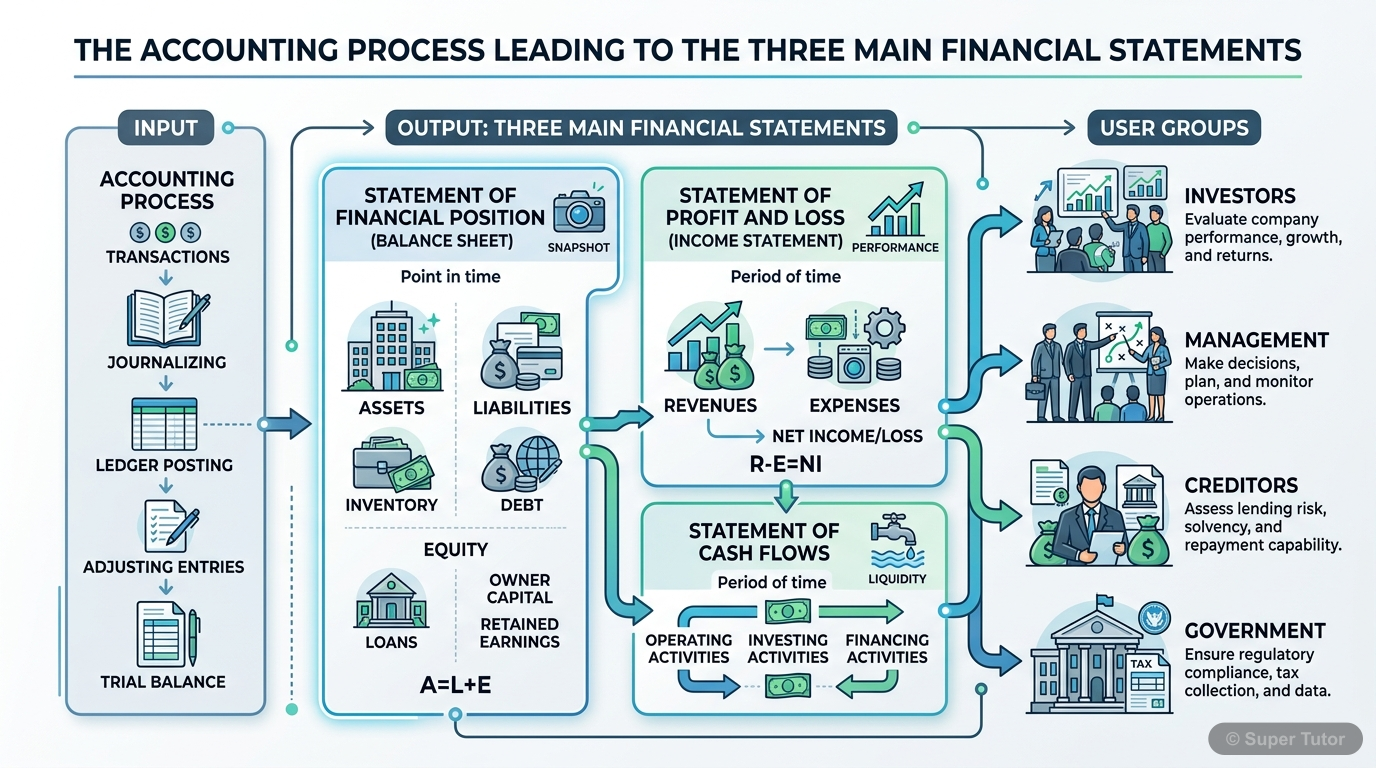
This is just one of 7+ visuals inside Super Tutor's Financial Statements of a Company chapter
Explore the full set12 worked solutions below. Unlock all 23 free in Super Tutor
Questions for Practice
1State the meaning of financial statements?Show solution
Not sure why a step works? check your working in Super Tutor
2What are limitations of financial statements?Show solution
1. Do not reflect current situation: They are prepared on the basis of historical cost, so they do not show current market values.
2. Assets may not realise: In case of liquidation, some assets may not realise their stated values.
3. Bias: Personal judgement, accounting concepts and conventions may affect the results.
4. Aggregate information: They show only summary information, not detailed information.
5. Vital information missing: Important facts like loss of markets or termination of agreements are not shown.
6. No qualitative information: They contain only monetary data, not qualitative factors like labour relations.
7. Only interim reports: They show results for a specific period and do not predict future performance exactly.
Not sure why a step works? check your working in Super Tutor
3List any three objectives of financial statements?Show solution
1. To provide information about economic resources and obligations of a business.
2. To provide information about the earning capacity of the business.
3. To provide information about cash flows.
Other objectives mentioned in the chapter include judging management effectiveness and disclosing accounting policies.
Not sure why a step works? check your working in Super Tutor
4State the importance of financial statements to :Show solution
- Shareholders: They help shareholders know the status, safety and return on their investment and decide whether to continue or discontinue it.
- Creditors: They help creditors judge the company’s ability to repay debts and decide whether to grant credit.
- Government: They provide basic input for fiscal, taxation and other economic policies.
- Investors: They help investors assess profitability, security, liquidity and solvency before investing.
Not sure why a step works? check your working in Super Tutor
5How will you disclose the following items in the Balance Sheet of a company;Show solution
(i) Current assets, inventory → shown under Current Assets as Inventories.
(ii) Contingent liabilities → disclosed in the Notes to Accounts, not on the face of the balance sheet.
(iii) Shareholders’ Funds, Reserve and Surplus → shown under Equity and Liabilities → Shareholders’ Funds → Reserve and Surplus.
(iv) Fixed Assets, Intangible Assets → shown under Non-current Assets → Fixed assets → Intangible assets.
(v) Proposed Dividend for the current year → shown in Notes to Accounts as it is contingent until approved.
(vi) Non-current Liabilities → shown under Equity and Liabilities as a separate major head.
(vii) Arrears of Dividend on Cumulative Preference Shares → shown under Notes to Accounts / as a liability-related disclosure, depending on the company’s presentation.
Not sure why a step works? check your working in Super Tutor
(v)Proposed Dividend for the current yearShow solution
Not sure why a step works? check your working in Super Tutor
(vi)Non Current LiabilitiesShow solution
Not sure why a step works? check your working in Super Tutor
(vii)Arrears of Dividend on Commulative Preference Shares.Show solution
Not sure why a step works? check your working in Super Tutor
Long Answer Questions
1Explain the nature of the financial statements.Show solution
Their nature is explained by the following points:
1. Recorded facts: They are prepared from figures recorded in accounting books at historical cost, not market value.
2. Accounting conventions: Conventions such as valuing inventory at cost or market price, whichever is lower, and valuing assets at cost less depreciation are followed.
3. Postulates: They are prepared on assumptions like going concern, money measurement and realisation.
4. Personal judgements: Items like depreciation, doubtful debts and inventory valuation involve estimates and judgement.
Thus, financial statements are summarised reports of recorded facts prepared according to accounting principles and legal requirements.
Not sure why a step works? check your working in Super Tutor
2Explain in detail about the significance of the financial statements.Show solution
1. Report on stewardship function: They show how effectively management has used the company’s resources.
2. Basis for fiscal policies: They help the government frame taxation and other economic policies.
3. Basis for granting credit: Banks and financial institutions use them to decide whether to lend.
4. Basis for prospective investors: They help investors judge profitability, liquidity and solvency.
5. Guide to value of investment already made: Shareholders use them to decide whether to continue their investment.
6. Aid trade associations: Associations may analyse them for standards and support to members.
7. Help stock exchanges: They help stock exchanges and brokers judge financial position and transparency.
So, financial statements are important because they provide the key information needed by management, investors, creditors, government and others.
Not sure why a step works? check your working in Super Tutor
3Explain the limitations of financial statements.Show solution
1. Do not reflect current situation because they are based on historical cost.
2. Assets may not realise their stated values if the company is liquidated.
3. Bias may arise because of accounting conventions and personal judgement.
4. They give only aggregate information, not detailed information.
5. Some vital information is missing, such as loss of markets or cessation of agreements.
6. They contain only quantitative/monetary information, not qualitative information.
7. They are only interim reports and do not show future changes.
Hence, financial statements should be analysed carefully before using them for decisions.
Not sure why a step works? check your working in Super Tutor
4Prepare the format of statement of profit and loss and explain its items upto the as certainment of profit before tax.Show solution
### Format
It contains the following major items:
- Revenue from operations
- Other income
- Total revenue
- Expenses:
- Cost of materials consumed
- Purchases of stock-in-trade
- Changes in inventories
- Employee benefits expense
- Finance costs
- Depreciation and amortisation expense
- Other expenses
- Profit before extraordinary items and tax
- Exceptional items
- Profit before extraordinary items and tax
- Extraordinary items
- Profit before tax
- Tax expense
- Profit/(Loss) for the period
- Earnings per share
### Explanation of items up to profit before tax
- Revenue from operations includes sale of products, sale of services and other operating revenues.
- Other income includes interest income, dividend income, gain/loss on sale of investments and other non-operating income.
- Expenses include the costs incurred to earn income, such as materials consumed, employee expenses, finance cost, depreciation and other expenses.
- Profit before tax is obtained by subtracting total expenses from total revenue, after considering exceptional and extraordinary items.
In formula form:
Profit before tax = Total Revenue − Total Expenses
where total revenue = revenue from operations + other income.
Not sure why a step works? check your working in Super Tutor
Numerical Questions
11 more solved questions in Financial Statements of a Company
Every remaining exercise is solved step by step in Super Tutor, plus practice quizzes and flashcards for this chapter. Free to start.
Stuck on a step?
Ask Super Tutor AI to explain any solution on this page in a simpler way — free, 24x7.
Ask a Doubt FreeFrequently Asked Questions
What are the important topics in Financial Statements of a Company for CBSE Class 12 Accountancy?
How to score full marks in Financial Statements of a Company — CBSE Class 12 Accountancy?
Where can I get free NCERT Solutions for Financial Statements of a Company Class 12 Accountancy?
Sources & Official References
- NCERT Official — ncert.nic.in
- CBSE Academic — cbseacademic.nic.in
- CBSE Official — cbse.gov.in
- National Education Policy 2020 — education.gov.in
Content is aligned to the official syllabus. Refer to the board website for the latest curriculum.
More resources for Financial Statements of a Company
Practice Quiz
Test yourself with a quick quiz
Important Questions
Practice with board exam-style questions
Revision Notes
Key points for last-minute revision
Formula Sheet
All formulas in one place
Chapter Summary
Understand the chapter at a glance
Concept Maps
See how topics connect visually
Study Plan
Step-by-step plan to ace this chapter
Flashcards
Quick-fire cards for active recall
Syllabus
What topics to cover
For serious students
Get the full Financial Statements of a Company chapter — for free.
Quizzes, flashcards, AI doubt-solver and a step-by-step study plan for CBSE Class 12 Accountancy.