Reconstitution of a Partnership Firm – Retirement/Death of a Partner
CBSE · Class 12 · Accountancy
NCERT Solutions for Reconstitution of a Partnership Firm – Retirement/Death of a Partner — CBSE Class 12 Accountancy.
Interactive on Super Tutor
Studying Reconstitution of a Partnership Firm – Retirement/Death of a Partner? Get the full interactive chapter.
Quizzes, flashcards, AI doubt-solver and a step-by-step study plan — built for ncert solutions and more.
1,000+ Class 12 students started this chapter today
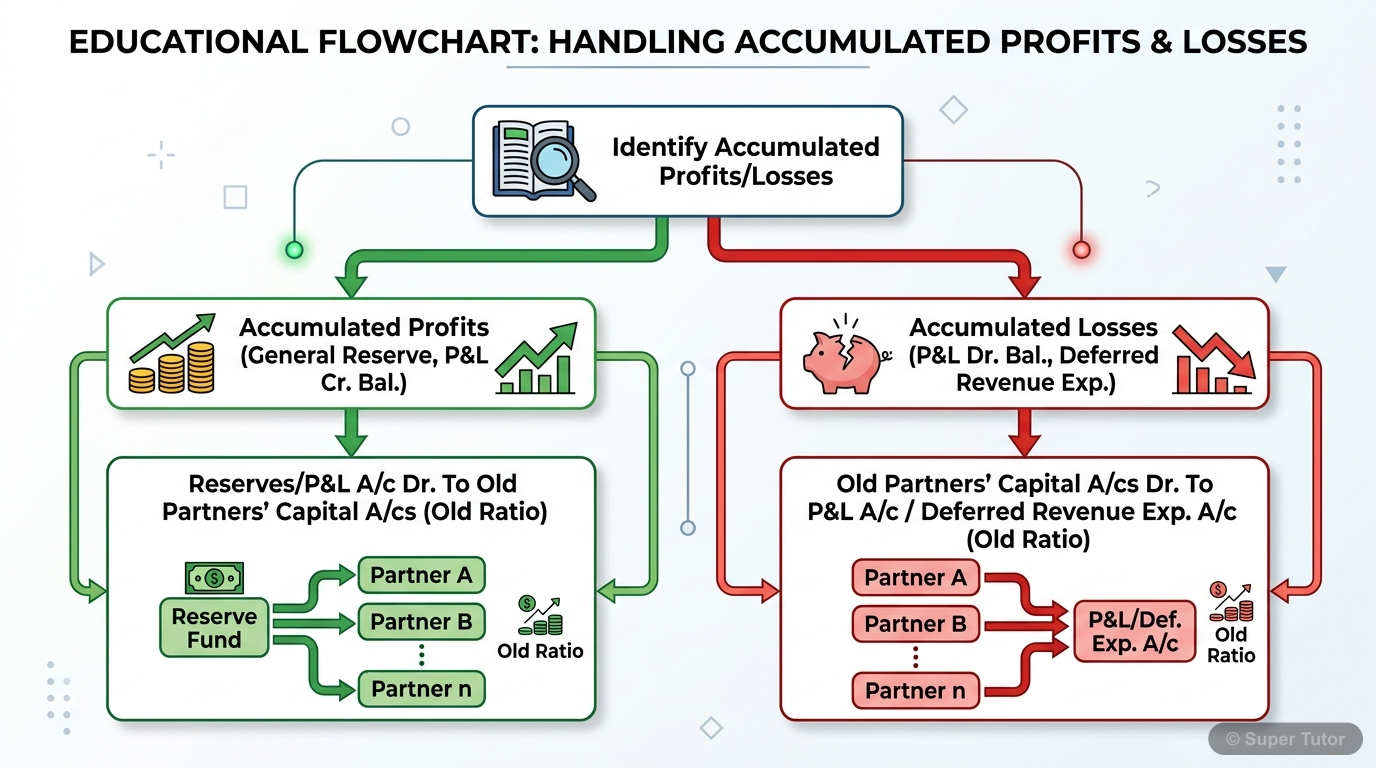
Super Tutor has 10+ illustrations like this for Reconstitution of a Partnership Firm – Retirement/Death of a Partner alone — flashcards, concept maps, and step-by-step visuals.
See them all12 worked solutions below. Unlock all 23 free in Super Tutor
Questions for Practice
1What are the different ways in which a partner can retire from the firm.Show solution
1. With the consent of all the other partners.
2. In accordance with an express agreement among the partners.
3. By giving notice in writing, if the partnership is at will.
Not sure why a step works? check your working in Super Tutor
2Write the various matters that need adjustments at the time of retirement of a partners.Show solution
1. Treatment of goodwill
2. Revaluation of assets and liabilities
3. Adjustment of unrecorded assets and liabilities
4. Distribution of accumulated profits or losses
5. Ascertainment of share of profit or loss up to the date of retirement
6. Adjustment of capital, if required
7. Settlement of the amount due to the retiring partner
Not sure why a step works? check your working in Super Tutor
3Distinguish between sacrificing ratio and gaining tab.Show solution
| Basis | Sacrificing Ratio | Gaining Ratio |
|---|---|---|
| Meaning | Ratio in which old partners give up their share | Ratio in which continuing partners acquire the share of the outgoing partner |
| Effect on share of profit | A partner’s share decreases | A partner’s share increases |
| Mode of calculation | Old share new share | New share old share |
| When calculated | At the time of admission of a partner | At the time of retirement/death of a partner |
Not sure why a step works? check your working in Super Tutor
4Why do firm reevaluate assets and reassess their liabilities on retirement or on the event of death of a partner.Show solution
Not sure why a step works? check your working in Super Tutor
5Why a retiring/deceased partner is entitled to a share of goodwill of the firm.Show solution
Not sure why a step works? check your working in Super Tutor
Long Answer Questions
1Explain the modes of payment to a retiring partner.Show solution
1. In full in cash immediately.
2. The whole amount may be treated as a loan to the firm.
3. Partly paid in cash and the remaining balance treated as loan.
4. In instalments, with or without interest, as agreed.
If the amount is paid in instalments, the loan account is reduced step by step along with interest, and the balance remains as a liability until fully paid.
Not sure why a step works? check your working in Super Tutor
2How will you compute the amount payable to a deceased partner?Show solution
- Balance in capital account
- Share of goodwill
- Share of accumulated profits
- Share of gain on revaluation of assets and liabilities
- Share of profit up to the date of death
- Interest on capital, if applicable
- Salary or commission, if any, due up to the date of death
and by deducting, if applicable:
- Debit balance of current account
- Share of goodwill to be written off
- Share of accumulated losses
- Share of loss on revaluation
- Share of loss up to the date of death
- Drawings up to the date of death
- Interest on drawings, if any
The final balance is transferred to the Executors’ Account.
Not sure why a step works? check your working in Super Tutor
3Explain the treatment of goodwill at the time of retirement or on the event of death of a partner?Show solution
1. If goodwill does not appear in the books:
- The retiring/deceased partner is credited for his share of goodwill.
- The continuing partners’ capital accounts are debited in their gaining ratio.
- Entry:
Gaining Partners’ Capital A/c Dr.
To Retiring/Deceased Partner’s Capital A/c
2. If goodwill already appears in the books:
- First, the existing goodwill is written off by debiting all partners’ capital accounts in their old profit sharing ratio.
- Then the retiring/deceased partner’s share of goodwill is adjusted by debiting the gaining partners’ capital accounts in their gaining ratio and crediting the outgoing partner’s capital account.
3. If a continuing partner also sacrifices in the new profit-sharing arrangement:
- That partner’s capital account is also credited to the extent of sacrifice, while the partner who gains bears the compensation.
Not sure why a step works? check your working in Super Tutor
4Discuss the various methods of computing the share in profits in the event of death of a partner.Show solution
1. On the basis of last year’s profit
- Profit for the year is taken.
- It is apportioned for the period from the last balance sheet date to the date of death.
2. On the basis of average profits of past years
- Average profit of the past few years is calculated.
- Then the deceased partner’s share is worked out for the relevant period.
3. On the basis of sales
- If the agreement provides, profit is estimated from sales.
- The profit for the period is calculated from the ratio of sales and then divided according to the deceased partner’s share.
In all cases, the deceased partner’s share is credited to his Capital Account, and later transferred to the Executors’ Account.
Not sure why a step works? check your working in Super Tutor
Numerical Questions
1Aparna, Manisha and Sonia are partners sharing profits in the ratio of 3 : 2 : 1. Manisha retires and goodwill of the firm is valued at Rs. 1,80,000. Aparna and Sonia decided to share future in the ratio of 3 : 2. Record necessary journal entries.Show solution
Manisha retires, so Aparna and Sonia will share the future profits in the ratio of their old shares, unless otherwise stated. The question says they decided to share future in the ratio 3:2, so the new profit sharing ratio is already given.
Goodwill of firm = Rs. 1,80,000
Manisha’s share of goodwill =
Since Aparna and Sonia share future profits in the ratio 3:2, Manisha’s goodwill is to be borne by them in that ratio.
Aparna’s share =
Sonia’s share =
Journal entry:
- Aparna’s Capital A/c Dr. 36,000
- Sonia’s Capital A/c Dr. 24,000
- To Manisha’s Capital A/c 60,000
Not sure why a step works? check your working in Super Tutor
2Sangeeta, Saroj and Shanti are partners sharing profits in the ratio of 2 : 3 : 5. Goodwill is appearing in the books at a value of Rs. 60,000. Sangeeta retires and goodwill is valued at Rs. 90,000. Saroj and Shanti decided to share future profits equally. Record necessary journal entries.Show solution
Goodwill already appears in the books at Rs. 60,000, so first it must be written off in the old ratio:
- Sangeeta =
- Saroj =
- Shanti =
Then Sangeeta’s share of current goodwill is:
Saroj and Shanti will share future profits equally, so new ratio = 1:1.
Their old shares were and , so their gaining ratio is:
- Saroj:
- Shanti:
So only Saroj gains in the new arrangement.
Since the goodwill in the books is written off and then the retiring partner is compensated, the journal entries are:
1. Goodwill written off
- Sangeeta’s Capital A/c Dr. 12,000
- Saroj’s Capital A/c Dr. 18,000
- Shanti’s Capital A/c Dr. 30,000
- To Goodwill A/c 60,000
2. Sangeeta’s share of goodwill adjusted
- Saroj’s Capital A/c Dr. 18,000
- To Sangeeta’s Capital A/c 18,000
Not sure why a step works? check your working in Super Tutor
3Himanshu, Gagan and Naman are partners sharing profits and losses in the ratio of 3 : 2 : 1. On March 31, 2019, Naman retires.Show solution
- New share = old share + acquired share
- Gaining ratio = new share – old share
The answer depends on the exact ratio in which Himanshu and Gagan acquire Naman’s share, but that information is not fully visible in the question statement here.
Not sure why a step works? check your working in Super Tutor
Record the necessary journal entries to the above effect.
11 more solved questions in Reconstitution of a Partnership Firm – Retirement/Death of a Partner
Every remaining exercise is solved step by step in Super Tutor, plus practice quizzes and flashcards for this chapter. Free to start.
Stuck on a step?
Ask Super Tutor AI to explain any solution on this page in a simpler way — free, 24x7.
Ask a Doubt FreeFrequently Asked Questions
What are the important topics in Reconstitution of a Partnership Firm – Retirement/Death of a Partner for CBSE Class 12 Accountancy?
How to score full marks in Reconstitution of a Partnership Firm – Retirement/Death of a Partner — CBSE Class 12 Accountancy?
Where can I get free NCERT Solutions for Reconstitution of a Partnership Firm – Retirement/Death of a Partner Class 12 Accountancy?
Sources & Official References
- NCERT Official — ncert.nic.in
- CBSE Academic — cbseacademic.nic.in
- CBSE Official — cbse.gov.in
- National Education Policy 2020 — education.gov.in
Content is aligned to the official syllabus. Refer to the board website for the latest curriculum.
More resources for Reconstitution of a Partnership Firm – Retirement/Death of a Partner
Practice Quiz
Test yourself with a quick quiz
Important Questions
Practice with board exam-style questions
Revision Notes
Key points for last-minute revision
Formula Sheet
All formulas in one place
Chapter Summary
Understand the chapter at a glance
Concept Maps
See how topics connect visually
Study Plan
Step-by-step plan to ace this chapter
Flashcards
Quick-fire cards for active recall
Syllabus
What topics to cover
For serious students
Get the full Reconstitution of a Partnership Firm – Retirement/Death of a Partner chapter — for free.
Quizzes, flashcards, AI doubt-solver and a step-by-step study plan for CBSE Class 12 Accountancy.