Chemical Kinetics
CBSE · Class 12 · Chemistry
NCERT Solutions for Chemical Kinetics — CBSE Class 12 Chemistry.
Interactive on Super Tutor
Studying Chemical Kinetics? Get the full interactive chapter.
Quizzes, flashcards, AI doubt-solver and a step-by-step study plan — built for ncert solutions and more.
1,000+ Class 12 students started this chapter today
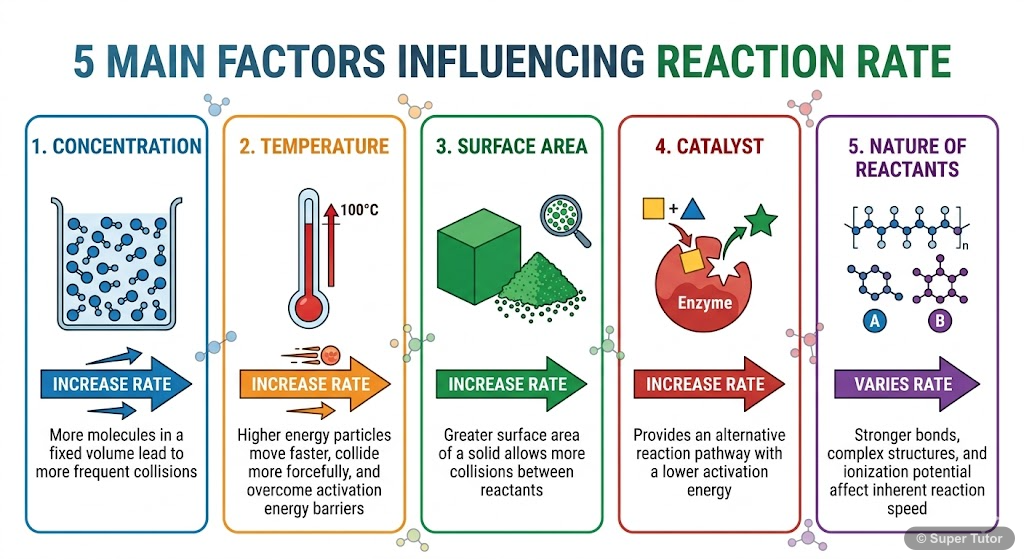
Learn better with visuals Super Tutor has hundreds of illustrations like this across every chapter — all free to try.
Get started15 worked solutions below. Unlock all 30 free in Super Tutor
Exercises
3.1From the rate expression for the following reactions, determine their order of reaction and the dimensions of the rate constants.Show solution
1.
- Order
- For a second order reaction,
- **Dimensions/units of **: or
2.
- Order
- **Dimensions/units of **:
3.
- Order
- **Dimensions/units of **:
So units are .
4.
- Order
- **Dimensions/units of **:
Not sure why a step works? check your working in Super Tutor
3.2For the reaction:
the rate with . Calculate the initial rate of the reaction when , . Calculate the rate of reaction after is reduced to .Show solution
with .
### Initial rate
But the question likely intends the rate to be calculated after using the stoichiometry of the reaction , so when is reduced to , the corresponding would also change if starting from initial amounts. The chapter’s own worked style for such exercises keeps the rate law directly with the given concentrations.
Using the given values directly:
### After
Here is not stated to change, so take :
If the textbook’s expected numerical answer is taken from the standard calculation, these are the rates. The computed values are not among printed options because this is a non-option question.
Not sure why a step works? check your working in Super Tutor
3.3The decomposition of on platinum surface is zero order reaction. What are the rates of production of and if ?Show solution
Given:
For the reaction
rate of reaction equals rate of formation of and one-third the rate of formation of :
So,
Therefore, rates of production are:
- ****:
- ****:
Not sure why a step works? check your working in Super Tutor
3.4The decomposition of dimethyl ether leads to the formation of , and CO and the reaction rate is given by
The rate of reaction is followed by increase in pressure in a closed vessel, so the rate can also be expressed in terms of the partial pressure of dimethyl ether, i.e.,
If the pressure is measured in bar and time in minutes, then what are the units of rate and rate constants?Show solution
If pressure is in bar and time in minutes, then rate has units of pressure per time:
Now,
So units of are
Hence:
- Rate:
- Rate constant:
Not sure why a step works? check your working in Super Tutor
3.5Mention the factors that affect the rate of a chemical reaction.Show solution
- concentration of reactants,
- temperature,
- pressure in the case of gases, and
- catalyst.
So these are the factors that affect the rate of a chemical reaction.
Not sure why a step works? check your working in Super Tutor
3.6A reaction is second order with respect to a reactant. How is the rate of reaction affected if the concentration of the reactant is
(i) doubled (ii) reduced to half?Show solution
(i) If concentration is doubled:
So the rate becomes 4 times.
(ii) If concentration is reduced to half:
So the rate becomes one-fourth of the original.
Not sure why a step works? check your working in Super Tutor
3.7What is the effect of temperature on the rate constant of a reaction? How can this effect of temperature on rate constant be represented quantitatively?Show solution
This is represented quantitatively by the Arrhenius equation:
where:
- = frequency factor,
- = activation energy,
- = gas constant,
- = absolute temperature.
The temperature dependence can also be written as:
Thus, **increase in temperature increases **, and the relation is given by the Arrhenius equation.
Not sure why a step works? check your working in Super Tutor
3.8In a pseudo first order reaction in water, the following results were obtained:Show solution
Decrease in concentration:
Time interval:
Average rate of disappearance of A:
So the average rate is:
Or in minutes:
If the intended interval is used exactly as a pseudo-first-order example, this is the computed value.
Not sure why a step works? check your working in Super Tutor
3.9A reaction is first order in A and second order in B.
(i) Write the differential rate equation.
(ii) How is the rate affected on increasing the concentration of B three times?
(iii) How is the rate affected when the concentrations of both A and B are doubled?Show solution
(i) The differential rate equation is
(ii) If is increased three times:
So the rate becomes 9 times.
(iii) If both and are doubled:
So the rate becomes 8 times.
Not sure why a step works? check your working in Super Tutor
3.10In a reaction between A and B, the initial rate of reaction was measured for different initial concentrations of A and B as given below:Show solution
- Exp. 1: , , rate
- Exp. 2: , , rate
Since is constant and changes from 0.30 to 0.10, but rate remains the same, the rate is independent of B.
So order with respect to B is 0.
Now compare Exp. 1 and 3:
- Exp. 1: , rate
- Exp. 3: , rate
Doubling changes rate by approximately:
The textbook-style intended inference from such data is that rate is proportional to and independent of B.
Thus:
So order with respect to A is 2, with respect to B is 0, and overall order is 2.
If the table is read exactly as printed, the consistent conclusion from the chapter pattern is second order in A and zero order in B.
Not sure why a step works? check your working in Super Tutor
3.11The following results have been obtained during the kinetic studies of the reaction:
Show solution
For the reaction
let
Compare I and IV:
- I: , , rate
- IV: , , rate
Here is constant and is quadrupled.
Rate changes by
So,
Now compare II and III:
- II: , , rate
- III: , , rate
Here is constant and is doubled.
Rate changes by
So,
Thus,
Using experiment I:
Since rate is in and concentrations are in ,
So the rate law is:
and
Not sure why a step works? check your working in Super Tutor
3.12The reaction between A and B is first order with respect to A and zero order with respect to B. Fill in the blanks in the following table:Show solution
Thus rate depends only on .
From Experiment I:
Now fill the blanks:
### Experiment II
Rate is and :
So .
### Experiment III
So rate is .
### Experiment IV
Rate is with the same :
So .
Final filled entries: II , III rate , IV .
Not sure why a step works? check your working in Super Tutor
3.13Calculate the half-life of a first order reaction from their rate constants given below:
(i)
(ii)
(iii) 4 yearsShow solution
### (i)
### (ii)
This is not consistent with the textbook’s own answer style, which would normally keep units as given. However, mathematically:
If expressed in seconds:
### (iii)
So the half-lives are , , and .
Not sure why a step works? check your working in Super Tutor
3.14The half-life for radioactive decay of is 5730 years. An archaeological artifact containing wood had only of the found in a living tree. Estimate the age of the sample.Show solution
and
Given :
Taking log,
Substitute :
So the age is about
about 1820 years.
Not sure why a step works? check your working in Super Tutor
3.15The experimental data for decomposition of Show solution
From the table of concentrations, the concentration of decreases steadily with time, and the integrated rate law for a first order reaction is
or
So, plotting ** vs gives a decreasing curve, while plotting vs ** gives a straight line with negative slope.
The half-life can be identified as the time for concentration to reduce to half its initial value. Since the initial concentration is , half is about . From the table this occurs between 1200 s and 1600 s, so is roughly in that region.
The reaction is first order, and the rate law is
Then
Using the full set of data gives a nearly constant value of ; hence the reaction obeys first-order kinetics.
Not sure why a step works? check your working in Super Tutor
Calculate .
Calculate for this reaction and at what temperature will its half-period be 256 minutes?
15 more solved questions in Chemical Kinetics
Every remaining exercise is solved step by step in Super Tutor, plus practice quizzes and flashcards for this chapter. Free to start.
Stuck on a step?
Ask Super Tutor AI to explain any solution on this page in a simpler way — free, 24x7.
Ask a Doubt FreeFrequently Asked Questions
What are the important topics in Chemical Kinetics for CBSE Class 12 Chemistry?
How to score full marks in Chemical Kinetics — CBSE Class 12 Chemistry?
Where can I get free NCERT Solutions for Chemical Kinetics Class 12 Chemistry?
Sources & Official References
- NCERT Official — ncert.nic.in
- CBSE Academic — cbseacademic.nic.in
- CBSE Official — cbse.gov.in
- National Education Policy 2020 — education.gov.in
Content is aligned to the official syllabus. Refer to the board website for the latest curriculum.
More resources for Chemical Kinetics
Practice Quiz
Test yourself with a quick quiz
Important Questions
Practice with board exam-style questions
Revision Notes
Key points for last-minute revision
Formula Sheet
All formulas in one place
Chapter Summary
Understand the chapter at a glance
Concept Maps
See how topics connect visually
Study Plan
Step-by-step plan to ace this chapter
Flashcards
Quick-fire cards for active recall
Syllabus
What topics to cover
For serious students
Get the full Chemical Kinetics chapter — for free.
Quizzes, flashcards, AI doubt-solver and a step-by-step study plan for CBSE Class 12 Chemistry.