Coordination Compounds
CBSE · Class 12 · Chemistry
NCERT Solutions for Coordination Compounds — CBSE Class 12 Chemistry.
Interactive on Super Tutor
Studying Coordination Compounds? Get the full interactive chapter.
Quizzes, flashcards, AI doubt-solver and a step-by-step study plan — built for ncert solutions and more.
1,000+ Class 12 students started this chapter today
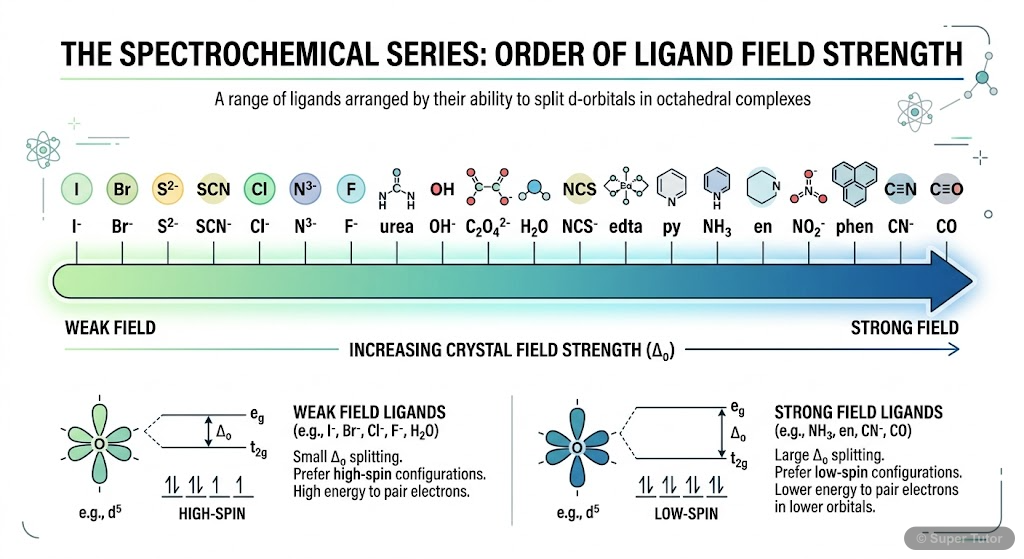
Super Tutor has 22+ illustrations like this for Coordination Compounds alone — flashcards, concept maps, and step-by-step visuals.
See them allIntext Questions
5.1Write the formulas for the following coordination compounds:
(i) tetraamminediaquacobalt(III) chloride
(ii) potassium tetracyanidonickelate(II)
(iii) tris(ethane-1,2-diamine) chromium(III) chloride
(iv) amminebromidochloridonitrito-N-platinate(II)
(v) dichloridobis(ethane-1,2-diamine)platinum(IV) nitrate
(vi) iron(III) hexacyanidoferrate(II)Show solution
(i) tetraamminediaquacobalt(III) chloride
- Central metal: Co(III), i.e., Co³⁺
- Ligands: 4 NH₃ (tetraammine) + 2 H₂O (diaqua)
- Charge on complex ion: +3, so 3 Cl⁻ outside
(ii) potassium tetracyanidonickelate(II)
- Central metal: Ni(II), i.e., Ni²⁺ (anionic complex → potassium outside)
- Ligands: 4 CN⁻ (tetracyanido)
- Charge on complex ion: 2−4 = −2, so K₂ outside
(iii) tris(ethane-1,2-diamine)chromium(III) chloride
- Central metal: Cr(III), i.e., Cr³⁺
- Ligands: 3 en (tris(ethane-1,2-diamine))
- Charge on complex ion: +3, so 3 Cl⁻ outside
(iv) amminebromidochloridonitrito-N-platinate(II)
- Central metal: Pt(II), anionic complex
- Ligands: NH₃ (ammine), Br⁻ (bromido), Cl⁻ (chlorido), NO₂⁻ bonded through N (nitrito-N)
- Charge: 2 − 1 − 1 − 1 = −1, so no outer cation shown (the name implies it is an anion; written as the anion)
(v) dichloridobis(ethane-1,2-diamine)platinum(IV) nitrate
- Central metal: Pt(IV), i.e., Pt⁴⁺
- Ligands: 2 Cl⁻ (dichloro) + 2 en (bis(ethane-1,2-diamine))
- Charge on complex ion: 4 − 2 = +2, so 2 NO₃⁻ outside
(vi) iron(III) hexacyanidoferrate(II)
- Two metal centres: Fe³⁺ (cation) and Fe²⁺ (in anionic complex)
- Complex anion: [Fe(CN)₆]⁴⁻
- Charge balance: 3 Fe³⁺ balanced by 4 [Fe(CN)₆]⁴⁻ → Fe₄[Fe(CN)₆]₃
5.2Write the IUPAC names of the following coordination compounds:
(i) [Co(NH₃)₆]Cl₃
(ii) [Co(NH₃)₅Cl]Cl₂
(iii) K₃[Fe(CN)₆]
(iv) K₃[Fe(C₂O₄)₃]
(v) K₂[PdCl₄]
(vi) [Pt(NH₃)₂Cl(NH₂CH₃)]ClShow solution
(i) [Co(NH₃)₆]Cl₃
- Ligands: 6 NH₃ → hexaammine
- Metal: Co; charge = +3 → cobalt(III)
- Anion: Cl⁻ → chloride
Name: Hexaamminecobalt(III) chloride
(ii) [Co(NH₃)₅Cl]Cl₂
- Ligands: 5 NH₃ (pentaammine) + 1 Cl⁻ (chlorido)
- Metal: Co; charge: let x + 0×5 − 1 = +2 (overall cation charge) → x = +3 → cobalt(III)
- Anion: 2 Cl⁻ → chloride
Name: Pentaamminechloridocobalt(III) chloride
(iii) K₃[Fe(CN)₆]
- Cation: K⁺ (potassium)
- Ligands: 6 CN⁻ → hexacyanido
- Metal: Fe; charge: 3K⁺ balances −3 on complex; x − 6 = −3 → x = +3 → ferrate(III) (anionic complex)
Name: Potassium hexacyanidoferrate(III)
(iv) K₃[Fe(C₂O₄)₃]
- Cation: K⁺ (potassium)
- Ligands: 3 C₂O₄²⁻ (oxalato) → trioxalato (or tris(oxalato))
- Metal: Fe; x − 6 = −3 → x = +3 → ferrate(III)
Name: Potassium trioxalatoferrate(III)
(v) K₂[PdCl₄]
- Cation: K⁺ (potassium)
- Ligands: 4 Cl⁻ → tetrachloro
- Metal: Pd; x − 4 = −2 → x = +2 → palladate(II)
Name: Potassium tetrachloridopalladate(II)
(vi) [Pt(NH₃)₂Cl(NH₂CH₃)]Cl
- Ligands (alphabetical): Cl⁻ (chlorido), NH₂CH₃ (methanamine), 2 NH₃ (diammine)
- Metal: Pt; charge: x − 1 = +1 → x = +2 → platinum(II)
- Anion: Cl⁻ → chloride
Name: Diamminechloridomethanamiineplatinum(II) chloride
*(More precisely: Diamminechlorido(methanamine)platinum(II) chloride)*
5.3Indicate the types of isomerism exhibited by the following complexes and draw the structures for these isomers:
(i) K[Cr(H₂O)₂(C₂O₄)₂]
(ii) [Co(en)₃]Cl₃
(iii) [Co(NH₃)₅(NO₂)](NO₃)₂
(iv) [Pt(NH₃)(H₂O)Cl₂]Show solution
Types of isomerism: Geometrical isomerism (cis and trans) and Optical isomerism (for the cis form).
- The complex ion [Cr(H₂O)₂(C₂O₄)₂]⁻ is octahedral with two water molecules and two bidentate oxalate ligands.
- Cis isomer: The two H₂O ligands are adjacent (90° apart). This cis form is non-superimposable on its mirror image → optical isomers (Δ and Λ).
- Trans isomer: The two H₂O ligands are opposite (180° apart). This form has a plane of symmetry → optically inactive.
Structures (described):
- *trans*: H₂O–Cr–OH₂ along one axis; two oxalates in the equatorial plane.
- *cis*: H₂O and H₂O adjacent; two oxalates spanning adjacent positions → gives d and l (Δ and Λ) optical isomers.
Summary: Geometrical isomers (cis and trans) + optical isomers of the cis form.
---
(ii) [Co(en)₃]Cl₃
Type of isomerism: Optical isomerism only.
- The complex [Co(en)₃]³⁺ is octahedral with three bidentate en ligands. It has no plane of symmetry.
- Two non-superimposable mirror images exist: Δ (d) and Λ (l) forms.
- No geometrical isomerism is possible since all three ligands are identical bidentate ligands.
Summary: Two optical isomers (enantiomers).
---
(iii) [Co(NH₃)₅(NO₂)](NO₃)₂
Types of isomerism:
1. Linkage isomerism: NO₂⁻ can coordinate through N (nitrito-N, –NO₂) or through O (nitrito-O, –ONO).
- Isomer 1: [Co(NH₃)₅(NO₂)]²⁺ — N-bonded (nitro)
- Isomer 2: [Co(NH₃)₅(ONO)]²⁺ — O-bonded (nitrito)
2. Ionisation isomerism: The NO₃⁻ outside can exchange with NO₂⁻ inside:
- [Co(NH₃)₅(NO₂)](NO₃)₂ ↔ [Co(NH₃)₅(NO₃)](NO₃)(NO₂) ↔ [Co(NH₃)₅(NO₃)₂]NO₂
3. Geometrical isomerism: Not applicable here (all NH₃ are equivalent in a MA₅B type complex — only one geometric form possible).
Summary: Linkage isomerism and ionisation isomerism (total ~10 possible isomers when all types are considered).
---
(iv) [Pt(NH₃)(H₂O)Cl₂]
Type of isomerism: Geometrical isomerism (cis and trans).
- Square planar complex of type MA₂BC (two different unidentate ligands Cl₂, plus NH₃ and H₂O).
- Cis isomer: Two Cl ligands are adjacent to each other.
- Trans isomer: Two Cl ligands are opposite to each other.
Structures:
- *cis*-[Pt(NH₃)(H₂O)Cl₂]: Cl–Pt–Cl at 90°; NH₃ and H₂O adjacent.
- *trans*-[Pt(NH₃)(H₂O)Cl₂]: Cl–Pt–Cl at 180°; NH₃ and H₂O opposite each other.
Summary: Two geometrical isomers (cis and trans).
5.4Give evidence that [Co(NH₃)₅Cl]SO₄ and [Co(NH₃)₅(SO₄)]Cl are ionisation isomers.Show solution
Evidence from chemical reactions:
Test with BaCl₂/Ba²⁺ solution (test for SO₄²⁻):
Adding Ba²⁺: (white precipitate formed ✓)
Adding Ba²⁺: No free SO₄²⁻ in solution → No precipitate ✗
Test with AgNO₃/Ag⁺ solution (test for Cl⁻):
(Cl⁻ is inside the coordination sphere, not free)
(white precipitate formed ✓)
Conclusion: The two compounds produce different ions in solution and respond differently to the same reagents, confirming they are ionisation isomers.
5.5Explain on the basis of valence bond theory that [Ni(CN)₄]²⁻ ion with square planar structure is diamagnetic and the [NiCl₄]²⁻ ion with tetrahedral geometry is paramagnetic.Show solution
Electronic configuration of Ni²⁺:
Ni: [Ar] 3d⁸ 4s²; Ni²⁺: [Ar] 3d⁸ (8 electrons in 3d)
---
[Ni(CN)₄]²⁻ — Square Planar, Diamagnetic:
CN⁻ is a strong field ligand. It forces the two unpaired 3d electrons to pair up:
One 3d orbital becomes empty. Hybridisation: dsp² (one 3d + one 4s + two 4p orbitals).
All electrons are paired → Diamagnetic ✓
---
[NiCl₄]²⁻ — Tetrahedral, Paramagnetic:
Cl⁻ is a weak field ligand. It does not cause pairing of 3d electrons.
Hybridisation uses 4s and three 4p orbitals: sp³ (tetrahedral).
Two unpaired electrons remain in 3d orbitals → Paramagnetic ✓
Magnetic moment: BM
5.6[NiCl₄]²⁻ is paramagnetic while [Ni(CO)₄] is diamagnetic though both are tetrahedral. Why?Show solution
Key difference: Oxidation state of Ni and nature of ligand.
In [NiCl₄]²⁻:
- Ni is in +2 oxidation state → Ni²⁺: [Ar] 3d⁸
- Cl⁻ is a weak field ligand → does not cause pairing of electrons
- 3d⁸ configuration retains 2 unpaired electrons
- Hybridisation: sp³ (tetrahedral)
- Result: Paramagnetic ( BM)
In [Ni(CO)₄]:
- Ni is in zero oxidation state → Ni⁰: [Ar] 3d¹⁰ 4s⁰ (in the complex, 4s electrons shift to 3d)
- Actually Ni⁰: [Ar] 3d¹⁰ — all 3d orbitals are completely filled
- CO is a strong field ligand and also causes back-bonding; in Ni(0), the configuration is 3d¹⁰
- Hybridisation: sp³ (tetrahedral)
- All electrons are paired → Diamagnetic
Conclusion: The difference arises because in [NiCl₄]²⁻, Ni is Ni²⁺ (3d⁸, 2 unpaired electrons) with weak-field Cl⁻, while in [Ni(CO)₄], Ni is Ni⁰ (3d¹⁰, no unpaired electrons) with strong-field CO.
5.7[Fe(H₂O)₆]³⁺ is strongly paramagnetic whereas [Fe(CN)₆]³⁻ is weakly paramagnetic. Explain.Show solution
[Fe(H₂O)₆]³⁺ — Strongly Paramagnetic:
- H₂O is a weak field ligand → small crystal field splitting (Δ₀ < P, pairing energy)
- 3d electrons do not pair up → high spin complex
- Electronic configuration: → 5 unpaired electrons
- Hybridisation: sp³d² (outer orbital complex)
- Magnetic moment: BM → strongly paramagnetic
[Fe(CN)₆]³⁻ — Weakly Paramagnetic:
- CN⁻ is a strong field ligand → large crystal field splitting (Δ₀ > P)
- 3d electrons pair up as much as possible → low spin complex
- Electronic configuration: → 1 unpaired electron
- Hybridisation: d²sp³ (inner orbital complex)
- Magnetic moment: BM → weakly paramagnetic
Conclusion: The difference is due to the field strength of the ligands. H₂O (weak field) gives high-spin Fe³⁺ with 5 unpaired electrons; CN⁻ (strong field) gives low-spin Fe³⁺ with only 1 unpaired electron.
5.8Explain [Co(NH₃)₆]³⁺ is an inner orbital complex whereas [Ni(NH₃)₆]²⁺ is an outer orbital complex.Show solution
- Co³⁺: [Ar] 3d⁶ → 6 electrons in 3d
- Free Co³⁺: (4 unpaired)
- NH₃ is a strong field ligand → forces pairing of 3d electrons:
- Two empty 3d orbitals + one 4s + two 4p → d²sp³ hybridisation
- Uses inner (n−1)d = 3d orbitals → inner orbital complex
- All electrons paired → diamagnetic
[Ni(NH₃)₆]²⁺ — Outer Orbital Complex:
- Ni²⁺: [Ar] 3d⁸ → 8 electrons in 3d
- NH₃, though a moderately strong ligand, cannot pair up the 3d electrons in Ni²⁺ (3d⁸ — no room to pair further without using 4d)
- Hybridisation uses 4s, three 4p, and two 4d orbitals → sp³d² hybridisation
- Uses outer nd = 4d orbitals → outer orbital complex
- 2 unpaired electrons → paramagnetic
Conclusion: Co³⁺ (3d⁶) with strong-field NH₃ undergoes d²sp³ hybridisation (inner orbital), while Ni²⁺ (3d⁸) cannot free inner 3d orbitals, so sp³d² hybridisation (outer orbital) occurs.
5.9Predict the number of unpaired electrons in the square planar [Pt(CN)₄]²⁻ ion.Show solution
Step 1: Find oxidation state of Pt.
Let oxidation state of Pt = x.
So Pt is in +2 oxidation state.
Step 2: Electronic configuration of Pt²⁺.
Pt: [Xe] 4f¹⁴ 5d⁹ 6s¹; Pt²⁺: [Xe] 4f¹⁴ 5d⁸
Step 3: Effect of CN⁻ (strong field ligand).
For square planar geometry, hybridisation is dsp². One 5d orbital must be emptied.
CN⁻ forces pairing:
Step 4: Hybridisation.
One empty 5d + 6s + two 6p → dsp² (square planar)
Result: All electrons are paired.
The complex is diamagnetic.
5.10The hexaquo manganese(II) ion contains five unpaired electrons, while the hexacyano ion contains only one unpaired electron. Explain using Crystal Field Theory.Show solution
Electronic configuration of Mn²⁺: [Ar] 3d⁵ (5 electrons)
---
[Mn(H₂O)₆]²⁺ — 5 unpaired electrons (High Spin):
- H₂O is a weak field ligand → small crystal field splitting energy
- Since \Delta_o < P (pairing energy), electrons occupy all five 3d orbitals singly before pairing
- Crystal field configuration:
- 5 unpaired electrons → strongly paramagnetic
- BM
---
[Mn(CN)₆]⁴⁻ — 1 unpaired electron (Low Spin):
- CN⁻ is a strong field ligand → large crystal field splitting energy
- Since \Delta_o > P, electrons pair up in the lower energy orbitals
- Crystal field configuration:
Actually for 3d⁵ in strong field:
- 1 unpaired electron → weakly paramagnetic
- BM
---
Conclusion: The difference is due to the magnitude of . Weak-field H₂O gives high-spin (5 unpaired e⁻); strong-field CN⁻ gives low-spin (1 unpaired e⁻) for Mn²⁺ (3d⁵).
Exercises
5.1Explain the bonding in coordination compounds in terms of Werner's postulates.Show solution
Alfred Werner (1893) proposed the following postulates to explain bonding in coordination compounds:
Postulate 1 — Primary (Ionisable) Valence:
- Every metal exhibits a primary valence (Hauptvalenz), which is its normal oxidation state (electrovalence).
- Primary valences are satisfied by negative ions and are ionisable.
- Example: In [Co(NH₃)₆]Cl₃, the primary valence of Co is 3, satisfied by 3 Cl⁻ ions.
Postulate 2 — Secondary (Non-ionisable) Valence:
- Every metal also has a secondary valence (Nebenvalenz), which is the coordination number.
- Secondary valences are satisfied by neutral molecules or negative ions (ligands) and are non-ionisable.
- Secondary valences are directed in space, giving the complex a definite geometry.
- Example: In [Co(NH₃)₆]Cl₃, the secondary valence (coordination number) of Co is 6, satisfied by 6 NH₃ molecules.
Postulate 3 — Geometry:
- The secondary valences are directed towards fixed positions in space around the central metal, giving rise to definite geometrical shapes (octahedral, tetrahedral, square planar, etc.).
Illustration:
- Co has primary valence = 3 (satisfied by 3 Cl⁻ outside the bracket)
- Co has secondary valence = 6 (satisfied by 6 NH₃ inside the bracket)
- Geometry: Octahedral
Werner's theory successfully explained the existence of isomers and the number of ions produced in solution by coordination compounds.
5.2FeSO₄ solution mixed with (NH₄)₂SO₄ solution in 1:1 molar ratio gives the test of Fe²⁺ ion but CuSO₄ solution mixed with aqueous ammonia in 1:4 molar ratio does not give the test of Cu²⁺ ion. Explain why?Show solution
- FeSO₄ + (NH₄)₂SO₄ (1:1) → gives Fe²⁺ test
- CuSO₄ + NH₃(aq) (1:4) → does not give Cu²⁺ test
Explanation:
Case 1: FeSO₄ + (NH₄)₂SO₄
When FeSO₄ and (NH₄)₂SO₄ are mixed in 1:1 ratio, they form a double salt:
Double salts completely dissociate in aqueous solution to give all their constituent ions:
Free Fe²⁺ ions are present in solution → Fe²⁺ test is positive.
Case 2: CuSO₄ + NH₃(aq) (1:4)
When CuSO₄ reacts with excess aqueous ammonia, it forms a complex compound (coordination compound):
This is tetraamminecopper(II) sulphate, a coordination compound. In solution, it ionises as:
The Cu²⁺ ions are not free — they are firmly held within the coordination sphere as [Cu(NH₃)₄]²⁺. The complex ion does not dissociate appreciably to give free Cu²⁺ ions → Cu²⁺ test is negative.
Conclusion: Double salts dissociate completely in solution releasing all ions, while coordination compounds retain the metal ion within the complex entity, so the metal ion test fails.
5.3Explain with two examples each of the following: coordination entity, ligand, coordination number, coordination polyhedron, homoleptic and heteroleptic.Show solution
A coordination entity is the central metal atom/ion bonded to a fixed number of ions or molecules (ligands). It is enclosed in square brackets.
*Examples:*
1. — hexacyanidoferrate(II) ion
2. — hexaamminecobalt(III) ion
---
(ii) Ligand:
Ligands are ions or molecules that donate electron pairs to the central metal atom/ion to form coordinate bonds. They must have at least one lone pair of electrons.
*Examples:*
1. (ammonia) — neutral unidentate ligand
2. (oxalate ion) — anionic bidentate ligand
---
(iii) Coordination Number:
The coordination number of a metal in a complex is the total number of ligand donor atoms directly bonded to the central metal atom/ion.
*Examples:*
1. In : Co is bonded to 6 N atoms → coordination number = 6
2. In : Pt is bonded to 4 Cl atoms → coordination number = 4
---
(iv) Coordination Polyhedron:
The spatial arrangement of the ligand atoms directly attached to the central metal defines the coordination polyhedron.
*Examples:*
1. : 6 ligands arranged at corners of an octahedron
2. : 4 ligands arranged at corners of a tetrahedron
---
(v) Homoleptic Complexes:
Complexes in which the metal is bonded to only one type of donor groups/ligands.
*Examples:*
1. — only NH₃ ligands
2. — only CN⁻ ligands
---
(vi) Heteroleptic Complexes:
Complexes in which the metal is bonded to more than one type of donor groups/ligands.
*Examples:*
1. — NH₃ and Cl⁻ ligands
2. — NH₃ and Cl⁻ ligands
5.4What is meant by unidentate, didentate and ambidentate ligands? Give two examples for each.Show solution
Ligands that coordinate to the central metal through only one donor atom (one lone pair donated).
*Examples:*
1. (chlorido) — donates through Cl
2. (ammine) — donates through N
---
(ii) Didentate (Bidentate) Ligands:
Ligands that coordinate to the central metal through two donor atoms simultaneously, forming a ring (chelate).
*Examples:*
1. Ethane-1,2-diamine (en), ––– — donates through two N atoms
2. Oxalate ion () — donates through two O atoms
---
(iii) Ambidentate Ligands:
Ligands that can coordinate to the central metal through two different donor atoms (but only one at a time), giving rise to linkage isomerism.
*Examples:*
1. (nitrite ion) — can bond through N (nitro, –NO₂) or through O (nitrito, –ONO)
2. (thiocyanate ion) — can bond through S (thiocyanato-S) or through N (thiocyanato-N)
5.5Specify the oxidation numbers of the metals in the following coordination entities:
(i) [Co(H₂O)(CN)(en)₂]²⁺
(ii) [CoBr₂(en)₂]⁺
(iii) [PtCl₄]³⁻ (Note: likely [PtCl₆]³⁻ or as written)
(iv) K₃[Fe(CN)₆]
(v) [Cr(NH₃)₃Cl₃]Show solution
(i) [Co(H₂O)(CN)(en)₂]²⁺
- H₂O: neutral (0); CN⁻: −1; en: neutral (0); overall charge: +2
Oxidation state of Co = +3
---
(ii) [CoBr₂(en)₂]⁺
- Br⁻: −1 each (×2 = −2); en: neutral (0); overall charge: +1
Oxidation state of Co = +3
---
(iii) [PtCl₄]³⁻ (as written; note: unusual, but solving as given)
- Cl⁻: −1 each (×4 = −4); overall charge: −3
Oxidation state of Pt = +1
*(Note: If the formula is [PtCl₆]³⁻, then x − 6 = −3, giving Pt = +3)*
---
(iv) K₃[Fe(CN)₆]
- 3 K⁺ outside; complex ion [Fe(CN)₆]³⁻
- CN⁻: −1 each (×6 = −6); overall charge on complex: −3
Oxidation state of Fe = +3
---
(v) [Cr(NH₃)₃Cl₃]
- NH₃: neutral (0); Cl⁻: −1 each (×3 = −3); overall charge: 0
Oxidation state of Cr = +3
5.6Using IUPAC norms write the formulas for the following:
(i) Tetrahydroxidozincate(II)
(ii) Potassium tetrachloridopalladate(II)
(iii) Diamminedichloridoplatinum(II)
(iv) Potassium tetracyanidonickelate(II)
(v) Pentaamminenitrito-O-cobalt(III)
(vi) Hexaamminecobalt(III) sulphate
(vii) Potassium tri(oxalato)chromate(III)
(viii) Hexaammineplatinum(IV)
(ix) Tetrabromidocuprate(II)
(x) Pentaamminenitrito-N-cobalt(III)Show solution
- Zn²⁺, 4 OH⁻ ligands, anionic complex
- Charge: 2 − 4 = −2
(ii) Potassium tetrachloridopalladate(II)
- K⁺ outside; Pd²⁺, 4 Cl⁻ ligands
- Charge on complex: 2 − 4 = −2 → K₂ outside
(iii) Diamminedichloridoplatinum(II)
- Pt²⁺, 2 NH₃ + 2 Cl⁻; neutral complex
(iv) Potassium tetracyanidonickelate(II)
- K⁺ outside; Ni²⁺, 4 CN⁻
- Charge: 2 − 4 = −2 → K₂ outside
(v) Pentaamminenitrito-O-cobalt(III)
- Co³⁺, 5 NH₃ + NO₂⁻ bonded through O (–ONO)
- Charge: 3 − 1 = +2 → no counter ion specified (cation)
(vi) Hexaamminecobalt(III) sulphate
- Co³⁺, 6 NH₃; charge = +3; SO₄²⁻ outside
- 2 formula units of complex needed for 3 SO₄²⁻:
(vii) Potassium tri(oxalato)chromate(III)
- K⁺ outside; Cr³⁺, 3 C₂O₄²⁻
- Charge: 3 − 6 = −3 → K₃ outside
(viii) Hexaammineplatinum(IV)
- Pt⁴⁺, 6 NH₃; charge = +4 (cation only, no anion specified)
(ix) Tetrabromidocuprate(II)
- Cu²⁺, 4 Br⁻; anionic complex
- Charge: 2 − 4 = −2
(x) Pentaamminenitrito-N-cobalt(III)
- Co³⁺, 5 NH₃ + NO₂⁻ bonded through N (–NO₂)
- Charge: 3 − 1 = +2
5.7Using IUPAC norms write the systematic names of the following:
(i) [Co(NH₃)₆]Cl₃
(ii) [Pt(NH₃)₂Cl(NH₂CH₃)]Cl
(iii) [Ti(H₂O)₆]³⁺
(iv) [Co(NH₃)₄Cl(NO₂)]Cl
(v) [Mn(H₂O)₆]²⁺
(vi) [NiCl₄]²⁻
(vii) [Ni(NH₃)₆]Cl₂
(viii) [Co(en)₃]³⁺
(ix) [Ni(CO)₄]Show solution
(i) [Co(NH₃)₆]Cl₃
- 6 NH₃ (hexaammine); Co: x = +3; Cl⁻ outside
Hexaamminecobalt(III) chloride
(ii) [Pt(NH₃)₂Cl(NH₂CH₃)]Cl
- Ligands: 2 NH₃ (diammine), Cl⁻ (chlorido), NH₂CH₃ (methanamine) — alphabetical: chlorido, diammine, methanamine
- Pt: x − 1 = +1 → x = +2; Cl⁻ outside
Diamminechloridomethanamiineplatinum(II) chloride
*(Diamminechlorido(methanamine)platinum(II) chloride)*
(iii) [Ti(H₂O)₆]³⁺
- 6 H₂O (hexaaqua); Ti: x = +3
Hexaaquatitanium(III) ion
(iv) [Co(NH₃)₄Cl(NO₂)]Cl
- Ligands: 4 NH₃ (tetraammine), Cl⁻ (chlorido), NO₂⁻ (nitrito-N or nitro)
- Co: x − 1 − 1 = +1 → x = +3; Cl⁻ outside
Tetraamminechloridonitrito-N-cobalt(III) chloride
*(or Tetraamminechloridonitrocobalt(III) chloride)*
(v) [Mn(H₂O)₆]²⁺
- 6 H₂O (hexaaqua); Mn: x = +2
Hexaaquamanganese(II) ion
(vi) [NiCl₄]²⁻
- 4 Cl⁻ (tetrachloro); Ni: x − 4 = −2 → x = +2; anionic → nickelate
Tetrachloronickelate(II) ion
*(Tetrachloridodickelate(II) ion)*
(vii) [Ni(NH₃)₆]Cl₂
- 6 NH₃ (hexaammine); Ni: x = +2; Cl⁻ outside
Hexaamminenickel(II) chloride
(viii) [Co(en)₃]³⁺
- 3 en (tris(ethane-1,2-diamine)); Co: x = +3
Tris(ethane-1,2-diamine)cobalt(III) ion
(ix) [Ni(CO)₄]
- 4 CO (tetracarbonyl); Ni: x = 0 (neutral complex, CO is neutral)
Tetracarbonylnickel(0)
5.8List various types of isomerism possible for coordination compounds, giving an example of each.Show solution
## A. Stereoisomerism
(i) Geometrical Isomerism:
Arises due to different spatial arrangements of ligands around the central metal. Common in square planar and octahedral complexes.
*Example:* cis- and trans-
- *cis*: two Cl adjacent (90°)
- *trans*: two Cl opposite (180°)
---
(ii) Optical Isomerism:
Arises when a complex and its mirror image are non-superimposable (chiral). The two forms are called enantiomers (d and l, or Δ and Λ).
*Example:* — exists as Δ (right-handed) and Λ (left-handed) forms.
---
## B. Structural Isomerism
(iii) Linkage Isomerism:
Arises when an ambidentate ligand coordinates through different donor atoms.
*Example:* (nitro, N-bonded) and (nitrito, O-bonded)
---
(iv) Coordination Isomerism:
Arises in compounds containing both cationic and anionic complex ions, where the distribution of ligands between the two metal centres differs.
*Example:* and
---
(v) Ionisation Isomerism:
Arises when the counter ion and a ligand exchange positions (inside and outside the coordination sphere), giving different ions in solution.
*Example:* and
---
(vi) Solvate (Hydrate) Isomerism:
Arises when solvent molecules (e.g., water) are either inside the coordination sphere as ligands or outside as free solvent molecules.
*Example:* (violet) and (grey-green)
5.9How many geometrical isomers are possible in the following coordination entities?
(i) [Cr(C₂O₄)₃]³⁻
(ii) [Co(NH₃)₃Cl₃]Show solution
- This is an octahedral complex with three identical bidentate ligands (oxalate, C₂O₄²⁻).
- For a complex of type [M(AA)₃] where AA is a symmetric bidentate ligand, all three ligands are equivalent.
- There is only one geometric arrangement possible — no geometric isomers.
*(However, it does show optical isomerism — Δ and Λ forms)*
---
(ii) [Co(NH₃)₃Cl₃]
- This is an octahedral complex of type [MA₃B₃].
- Two geometric isomers are possible:
1. fac (facial) isomer: Three NH₃ (and three Cl) occupy the three positions of one triangular face of the octahedron. Each NH₃ is adjacent to two other NH₃ molecules.
2. mer (meridional) isomer: Three NH₃ (and three Cl) occupy positions along a meridian (one axis and two equatorial positions). The three NH₃ are not all equivalent.
5.10Draw the structures of optical isomers of:
(i) [Cr(C₂O₄)₃]³⁻
(ii) [PtCl₂(en)₂]²⁺
(iii) [Cr(NH₃)₂Cl₂(en)]⁺Show solution
(i) [Cr(C₂O₄)₃]³⁻
- Octahedral complex with three bidentate oxalate ligands: [M(AA)₃] type.
- This complex is chiral — it has no plane of symmetry.
- Two optical isomers exist:
- Δ (delta) form: Right-handed propeller arrangement of the three oxalate ligands around Cr.
- Λ (lambda) form: Left-handed propeller arrangement (mirror image of Δ).
- The two forms are non-superimposable mirror images (enantiomers).
*Description of structure:* In the Δ isomer, looking down the C₃ axis, the three oxalate ligands spiral clockwise. In the Λ isomer, they spiral anticlockwise.
---
(ii) [PtCl₂(en)₂]²⁺
- Octahedral complex with two bidentate en ligands and two Cl⁻.
- First, geometric isomers exist:
- *cis* isomer: two Cl adjacent → chiral → shows optical isomers (Δ and Λ)
- *trans* isomer: two Cl opposite → has a plane of symmetry → optically inactive
- So optical isomers exist only for the cis form:
- Δ-cis-[PtCl₂(en)₂]²⁺
- Λ-cis-[PtCl₂(en)₂]²⁺
---
(iii) [Cr(NH₃)₂Cl₂(en)]⁺
- Octahedral complex with one bidentate en, two NH₃, and two Cl⁻.
- The en ligand occupies two cis positions.
- Geometric isomers are possible depending on the relative positions of NH₃ and Cl.
- For the isomer where the two Cl are cis to each other and the en spans two adjacent positions, the complex is chiral → optical isomers (Δ and Λ) exist.
- Δ form and Λ form are non-superimposable mirror images.
*In all cases, the optical isomers rotate plane-polarised light in opposite directions (+/−) and are called dextrorotatory (d) and laevorotatory (l) forms.*
5.11Draw all the isomers (geometrical and optical) of:
(i) [CoCl₂(en)₂]⁺
(ii) [Co(NH₃)Cl(en)₂]²⁺
(iii) [Co(NH₃)₂Cl₂(en)]⁺Show solution
Octahedral complex with two bidentate en ligands and two Cl⁻ (type [MA₂B₂] with bidentate A).
Geometric Isomers:
1. trans isomer: Two Cl⁻ are trans (opposite) to each other. The two en ligands are in the equatorial plane. This isomer has a plane of symmetry → optically inactive.
2. cis isomer: Two Cl⁻ are cis (adjacent) to each other. This isomer is chiral (no plane of symmetry) → shows optical isomers:
- Δ-cis isomer (d-form)
- Λ-cis isomer (l-form)
Total isomers: 3 (1 trans + 2 optical isomers of cis)
---
(ii) [Co(NH₃)Cl(en)₂]²⁺
Octahedral complex with two bidentate en, one NH₃, and one Cl⁻.
- The two en ligands can be arranged so that NH₃ and Cl are either *trans* or *cis* to each other.
Geometric Isomers:
1. trans isomer: NH₃ and Cl are trans to each other. This has a plane of symmetry → optically inactive.
2. cis isomer: NH₃ and Cl are cis to each other. This is chiral → shows optical isomers:
- Δ-cis isomer
- Λ-cis isomer
Total isomers: 3 (1 trans + 2 optical isomers of cis)
---
(iii) [Co(NH₃)₂Cl₂(en)]⁺
Octahedral complex with one bidentate en, two NH₃, and two Cl⁻. The en occupies two cis positions.
Geometric Isomers (based on positions of NH₃ and Cl relative to en):
1. Isomer A: Both Cl trans to each other (trans-Cl,Cl); en and two NH₃ in remaining positions.
- Has a plane of symmetry → optically inactive.
2. Isomer B: Both NH₃ trans to each other; en and two Cl in remaining positions.
- Has a plane of symmetry → optically inactive.
3. Isomer C: One Cl trans to NH₃, one Cl trans to en nitrogen.
- Chiral → shows optical isomers (Δ and Λ).
Total isomers: 4 (2 optically inactive geometric isomers + 2 optical isomers of the chiral form)
5.12Write all the geometrical isomers of [Pt(NH₃)(Br)(Cl)(py)] and how many of these will exhibit optical isomers?Show solution
Number of Geometrical Isomers:
For a square planar complex [MABCD], the number of geometrical isomers = 3.
The three isomers arise from the three different ways to place the four different ligands:
Isomer 1:
(NH₃ trans to py; Cl trans to Br)
Isomer 2:
(NH₃ trans to Cl; py trans to Br)
Isomer 3:
(NH₃ trans to Br; py trans to Cl)
Total geometrical isomers = 3
Optical Isomers:
Square planar complexes generally have a plane of symmetry (the plane of the molecule) and are therefore optically inactive.
All three geometrical isomers of [Pt(NH₃)(Br)(Cl)(py)] lie in a plane → each has a plane of symmetry → none of them exhibit optical isomerism.
5.13Aqueous copper sulphate solution (blue in colour) gives:
(i) a green precipitate with aqueous potassium fluoride and
(ii) a bright green solution with aqueous potassium chloride. Explain these experimental results.Show solution
---
(i) Green precipitate with aqueous KF:
When KF is added to CuSO₄ solution, F⁻ ions (being a hard base and small ion) displace water ligands and form copper(II) fluoride:
Copper(II) fluoride is insoluble in water and precipitates as a green precipitate. F⁻ is not a good ligand for forming stable soluble complexes with Cu²⁺ under these conditions, so a precipitate forms rather than a soluble complex.
---
(ii) Bright green solution with aqueous KCl:
When excess KCl is added to CuSO₄ solution, Cl⁻ ions displace water ligands and form a stable soluble complex:
The tetrachloridocuprate(II) ion is bright green in colour and remains in solution.
Conclusion: The difference in behaviour is due to the different abilities of F⁻ and Cl⁻ to form stable soluble complexes with Cu²⁺. F⁻ forms an insoluble precipitate (CuF₂), while Cl⁻ forms a soluble green complex [CuCl₄]²⁻.
5.14What is the coordination entity formed when excess of aqueous KCN is added to an aqueous solution of copper sulphate? Why is it that no precipitate of copper sulphide is obtained when H₂S(g) is passed through this solution?Show solution
When excess KCN is added to CuSO₄ solution, CN⁻ ions first reduce Cu²⁺ to Cu⁺ and then form a stable complex:
With excess KCN:
The coordination entity formed is tetracyanidocuprate(I):
---
Step 2: Why no CuS precipitate with H₂S?
In the complex , CN⁻ is a very strong field ligand and forms an extremely stable complex with Cu⁺. The complex has a very low dissociation constant (very high stability constant).
As a result, the concentration of free Cu²⁺ (or Cu⁺) ions in solution is negligibly small — far below the concentration required to exceed the solubility product () of CuS.
Since is extremely low, the ionic product [\text{Cu}^{2+}][\text{S}^{2-}] < K_{sp}, and therefore no precipitate of CuS is formed when H₂S is passed through the solution.
5.15Discuss the nature of bonding in the following coordination entities on the basis of valence bond theory:
(i) [Fe(CN)₆]⁴⁻
(ii) [FeF₆]³⁻
(iii) [Co(C₂O₄)₃]³⁻
(iv) [CoF₆]³⁻Show solution
- Fe in [Fe(CN)₆]⁴⁻: oxidation state = +2; Fe²⁺: [Ar] 3d⁶
- Free Fe²⁺: (4 unpaired)
- CN⁻ is a strong field ligand → forces pairing of 3d electrons:
- Two empty 3d orbitals available; hybridisation: d²sp³ (inner orbital)
- 6 CN⁻ donate electron pairs into these 6 hybrid orbitals
- Geometry: Octahedral; Diamagnetic (no unpaired electrons)
---
(ii) [FeF₆]³⁻
- Fe in [FeF₆]³⁻: oxidation state = +3; Fe³⁺: [Ar] 3d⁵
- Free Fe³⁺: (5 unpaired)
- F⁻ is a weak field ligand → no pairing of 3d electrons
- 3d orbitals remain half-filled; hybridisation uses outer orbitals: sp³d² (outer orbital)
- 6 F⁻ donate electron pairs into 6 sp³d² hybrid orbitals
- Geometry: Octahedral; Paramagnetic (5 unpaired electrons)
- BM
---
(iii) [Co(C₂O₄)₃]³⁻
- Co in [Co(C₂O₄)₃]³⁻: oxidation state = +3; Co³⁺: [Ar] 3d⁶
- Free Co³⁺: (4 unpaired)
- Oxalate (C₂O₄²⁻) is a moderate to strong field ligand → causes pairing:
- Hybridisation: d²sp³ (inner orbital, octahedral)
- 3 bidentate oxalate ligands donate 6 electron pairs
- Geometry: Octahedral; Diamagnetic (no unpaired electrons)
---
(iv) [CoF₆]³⁻
- Co in [CoF₆]³⁻: oxidation state = +3; Co³⁺: [Ar] 3d⁶
- Free Co³⁺: (4 unpaired)
- F⁻ is a weak field ligand → no pairing of 3d electrons
- Hybridisation uses outer orbitals: sp³d² (outer orbital)
- 6 F⁻ donate electron pairs into 6 sp³d² hybrid orbitals
- Geometry: Octahedral; Paramagnetic (4 unpaired electrons)
- BM
5.16Draw figure to show the splitting of d orbitals in an octahedral crystal field.Show solution
In a free metal ion, all five d orbitals are degenerate (equal energy).
When six ligands approach along the ±x, ±y, ±z axes (octahedral field), the d orbitals split into two sets:
Higher energy set — (2 orbitals):
- and
- These orbitals point directly towards the ligands → greater repulsion → higher energy
- Energy raised by (or ) above the barycentre
Lower energy set — (3 orbitals):
- , ,
- These orbitals point between the ligands → less repulsion → lower energy
- Energy lowered by (or ) below the barycentre
Energy diagram:
The energy gap between and is called the crystal field splitting energy (or ).
The barycentre (weighted average energy) remains unchanged:
5.17What is spectrochemical series? Explain the difference between a weak field ligand and a strong field ligand.Show solution
The spectrochemical series is an empirical series that arranges ligands in order of their increasing ability to cause crystal field splitting () of the d orbitals of the central metal ion.
\text{I}^- < \text{Br}^- < \text{SCN}^- < \text{Cl}^- < \text{S}^{2-} < \text{F}^- < \text{OH}^- < \text{C}_2\text{O}_4^{2-} < \text{H}_2\text{O} < \text{NCS}^- < \text{edta}^{4-} < \text{NH}_3 < \text{en} < \text{CN}^- < \text{CO}
(Increasing →)
---
Weak Field Ligands:
- Ligands at the lower end of the spectrochemical series.
- Cause small crystal field splitting (\Delta_o < P, where P = pairing energy).
- Electrons prefer to occupy all d orbitals singly before pairing → high spin complexes.
- Examples: I⁻, Br⁻, Cl⁻, F⁻, OH⁻, H₂O
- Result in outer orbital complexes (sp³d² hybridisation in VBT)
Strong Field Ligands:
- Ligands at the higher end of the spectrochemical series.
- Cause large crystal field splitting (\Delta_o > P).
- Electrons pair up in lower energy orbitals before occupying → low spin complexes.
- Examples: CN⁻, CO, en, NH₃
- Result in inner orbital complexes (d²sp³ hybridisation in VBT)
5.18What is crystal field splitting energy? How does the magnitude of Δₒ decide the actual configuration of d orbitals in a coordination entity?Show solution
When a metal ion is placed in an octahedral crystal field (created by six ligands), the five degenerate d orbitals split into two sets:
- Lower energy set (3 orbitals): stabilised by each
- Higher energy set (2 orbitals): destabilised by each
The energy difference between the and sets is called the crystal field splitting energy, denoted (or ).
---
How decides d orbital configuration:
The actual filling of electrons depends on the competition between and the pairing energy (P):
Case 1: Weak field ligands (\Delta_o < P)
- It costs less energy to place an electron in the higher orbital than to pair it in .
- Electrons spread over all five d orbitals (Hund's rule applies).
- Result: High spin configuration (maximum unpaired electrons)
- Example: : (5 unpaired)
Case 2: Strong field ligands (\Delta_o > P)
- It costs less energy to pair electrons in than to promote them to .
- Electrons fill completely before entering .
- Result: Low spin configuration (minimum unpaired electrons)
- Example: : (1 unpaired)
Summary:
\Delta_o < P \Rightarrow \text{High spin (weak field)}
\Delta_o > P \Rightarrow \text{Low spin (strong field)}
5.19[Cr(NH₃)₆]³⁺ is paramagnetic while [Ni(CN)₄]²⁻ is diamagnetic. Explain why?Show solution
- Cr³⁺: [Ar] 3d³ (3 electrons in d orbitals)
- NH₃ is a strong field ligand, but with only 3 d electrons, they occupy the three orbitals singly (no pairing needed regardless of field strength):
- 3 unpaired electrons → Paramagnetic
- BM
- Hybridisation: d²sp³ (inner orbital, octahedral)
---
[Ni(CN)₄]²⁻ — Diamagnetic:
- Ni²⁺: [Ar] 3d⁸ (8 electrons in d orbitals)
- CN⁻ is a strong field ligand → forces pairing of 3d electrons
- One 3d orbital is emptied by pairing:
- Hybridisation: dsp² (square planar)
- 0 unpaired electrons → Diamagnetic
Conclusion: Cr³⁺ (3d³) has 3 unpaired electrons even with strong-field NH₃ (no pairing needed for 3 electrons in 3 orbitals), making [Cr(NH₃)₆]³⁺ paramagnetic. Ni²⁺ (3d⁸) with strong-field CN⁻ undergoes forced pairing, making [Ni(CN)₄]²⁻ diamagnetic.
5.20A solution of [Ni(H₂O)₆]²⁺ is green but a solution of [Ni(CN)₄]²⁻ is colourless. Explain.Show solution
---
[Ni(H₂O)₆]²⁺ — Green:
- Ni²⁺: 3d⁸ configuration
- H₂O is a weak field ligand → small
- The energy gap corresponds to a photon in the red/orange region of visible light
- Red light is absorbed → complementary colour green is transmitted/observed
- d-d transition is possible because the and levels are partially filled
- Solution appears green ✓
---
[Ni(CN)₄]²⁻ — Colourless:
- Ni²⁺: 3d⁸; CN⁻ is a strong field ligand → large
- In the square planar [Ni(CN)₄]²⁻, the dsp² hybridisation results in all electrons being paired (no unpaired electrons)
- The energy gap between filled and empty d orbitals is very large (in the UV region)
- No d-d transition occurs in the visible region
- No visible light is absorbed → solution appears colourless ✓
Conclusion: [Ni(H₂O)₆]²⁺ absorbs visible light (d-d transition possible with small Δ), while [Ni(CN)₄]²⁻ has all electrons paired and the energy gap falls outside the visible range, so no colour is observed.
5.21[Fe(CN)₆]⁴⁻ and [Fe(H₂O)₆]²⁺ are of different colours in dilute solutions. Why?Show solution
---
[Fe(H₂O)₆]²⁺:
- H₂O is a weak field ligand → small
- The energy gap corresponds to absorption in the red region of visible spectrum
- Complementary colour (green-blue) is transmitted
- Appears pale green in solution
- High spin:
---
[Fe(CN)₆]⁴⁻:
- CN⁻ is a strong field ligand → large
- The energy gap corresponds to absorption in a different region of visible spectrum (higher energy, towards blue/violet)
- A different complementary colour is transmitted
- Appears yellow in solution
- Low spin:
---
Conclusion: The two complexes absorb different wavelengths of visible light because is different (H₂O gives small , CN⁻ gives large ). Since different wavelengths are absorbed, different complementary colours are observed, resulting in different colours for the two complexes.
5.22Discuss the nature of bonding in metal carbonyls.Show solution
Metal carbonyls are compounds in which CO (carbonyl) ligands are bonded to transition metals. The bonding involves a unique synergic (synergistic) mechanism with two components:
---
1. σ-Bond (Ligand → Metal donation):
- The carbon atom of CO has a lone pair in a σ-type orbital.
- This lone pair is donated to an empty d orbital (or hybrid orbital) of the metal.
- This forms a σ-bond: CO → Metal (ligand to metal donation)
- This increases electron density on the metal.
---
2. π-Bond (Metal → Ligand back-donation):
- The metal has filled d orbitals with electron density.
- These electrons are donated back into the **empty π* (antibonding) orbital of CO.
- This forms a π-bond: Metal → CO (metal to ligand back-donation)
- This is called back-bonding or π-back donation.
- It reduces the electron density on the metal (relieving the excess from σ-donation).
---
Synergic Effect:
The σ-donation and π-back donation reinforce each other:
- σ-donation increases electron density on metal → metal donates back via π
- π-back donation strengthens the M–C bond and weakens the C≡O bond
- This mutual reinforcement is called the synergic effect
Consequence:
- The M–C bond is strengthened (has both σ and π character)
- The C–O bond is weakened compared to free CO (C≡O bond order decreases)
- This is evidenced by the lower C–O stretching frequency in metal carbonyls compared to free CO
Examples:**
- : tetrahedral, Ni(0),
- : trigonal bipyramidal, Fe(0),
- : octahedral, Cr(0),
5.23Give the oxidation state, d orbital occupation and coordination number of the central metal ion in the following complexes:
(i) K₃[Co(C₂O₄)₃]
(ii) cis-[CrCl₂(en)₂]Cl
(iii) (NH₄)₂[CoF₄]
(iv) [Mn(H₂O)₆]SO₄Show solution
- 3 K⁺ outside → complex ion has charge −3
- C₂O₄²⁻: −2 each; 3 oxalates = −6
- Let oxidation state of Co = x:
- Oxidation state: +3
- Co³⁺: [Ar] 3d⁶ → d orbital occupation: d⁶
- 3 bidentate oxalate ligands → 6 donor atoms → Coordination number: 6
---
(ii) cis-[CrCl₂(en)₂]Cl
- Cl⁻ outside → complex ion has charge +1
- 2 Cl⁻ inside (−2) + 2 en (0)
- Let oxidation state of Cr = x:
- Oxidation state: +3
- Cr³⁺: [Ar] 3d³ → d orbital occupation: d³
- 2 Cl⁻ (2 donor atoms) + 2 en (4 donor atoms) = 6 donor atoms → Coordination number: 6
---
(iii) (NH₄)₂[CoF₄]
- 2 NH₄⁺ outside → complex ion has charge −2
- 4 F⁻ inside (−4)
- Let oxidation state of Co = x:
- Oxidation state: +2
- Co²⁺: [Ar] 3d⁷ → d orbital occupation: d⁷
- 4 F⁻ ligands → Coordination number: 4
---
(iv) [Mn(H₂O)₆]SO₄
- SO₄²⁻ outside → complex ion has charge +2
- 6 H₂O (neutral)
- Let oxidation state of Mn = x:
- Oxidation state: +2
- Mn²⁺: [Ar] 3d⁵ → d orbital occupation: d⁵
- 6 H₂O ligands → Coordination number: 6
5.24Write down the IUPAC name for each of the following complexes and indicate the oxidation state, electronic configuration and coordination number. Also give stereochemistry and magnetic moment of the complex:
(i) K[Cr(H₂O)₂(C₂O₄)₂]·3H₂O
(ii) [Co(NH₃)₅Cl]Cl₂
(iii) [CrCl₃(py)₃]
(iv) Cs[FeCl₄]
(v) K₄[Mn(CN)₆]Show solution
- IUPAC Name: Potassium diaquadioxalatochromate(III) trihydrate
- Oxidation state: K⁺ outside; complex charge = −1; 2 H₂O (0) + 2 C₂O₄²⁻ (−4); x − 4 = −1 → Cr = +3
- Electronic configuration: Cr³⁺: [Ar] 3d³
- Coordination number: 2 (H₂O) + 4 (from 2 oxalates) = 6
- Stereochemistry: Octahedral; cis and trans geometric isomers possible; cis form shows optical isomers
- Magnetic moment: 3d³, 3 unpaired electrons; BM
---
(ii) [Co(NH₃)₅Cl]Cl₂
- IUPAC Name: Pentaamminechloridocobalt(III) chloride
- Oxidation state: 2 Cl⁻ outside; complex charge = +2; 5 NH₃ (0) + Cl⁻ (−1); x − 1 = +2 → Co = +3
- Electronic configuration: Co³⁺: [Ar] 3d⁶; with NH₃ (strong field) → low spin:
- Coordination number: 5 + 1 = 6
- Stereochemistry: Octahedral; no geometric isomerism (MA₅B type)
- Magnetic moment: 0 unpaired electrons; BM → Diamagnetic
---
(iii) [CrCl₃(py)₃]
- IUPAC Name: Trichloridotripyridinechromium(III)
- Oxidation state: Neutral complex; 3 Cl⁻ (−3) + 3 py (0); x − 3 = 0 → Cr = +3
- Electronic configuration: Cr³⁺: [Ar] 3d³
- Coordination number: 3 + 3 = 6
- Stereochemistry: Octahedral; two geometric isomers: fac and mer
- Magnetic moment: 3 unpaired electrons; BM → Paramagnetic
---
(iv) Cs[FeCl₄]
- IUPAC Name: Caesium tetrachloridoferrate(III)
- Oxidation state: Cs⁺ outside; complex charge = −1; 4 Cl⁻ (−4); x − 4 = −1 → Fe = +3
- Electronic configuration: Fe³⁺: [Ar] 3d⁵; Cl⁻ weak field → high spin: all 5 d electrons unpaired
- Coordination number: 4
- Stereochemistry: Tetrahedral
- Magnetic moment: 5 unpaired electrons; BM → Strongly paramagnetic
---
(v) K₄[Mn(CN)₆]
- IUPAC Name: Potassium hexacyanidomanganate(II)
- Oxidation state: 4 K⁺ outside; complex charge = −4; 6 CN⁻ (−6); x − 6 = −4 → Mn = +2
- Electronic configuration: Mn²⁺: [Ar] 3d⁵; CN⁻ strong field → low spin: → 1 unpaired electron
- Coordination number: 6
- Stereochemistry: Octahedral
- Magnetic moment: 1 unpaired electron; BM → Weakly paramagnetic
5.25Explain the violet colour of the complex [Ti(H₂O)₆]³⁺ on the basis of crystal field theory.Show solution
Step 1: Electronic configuration of Ti³⁺
Ti: [Ar] 3d² 4s²; Ti³⁺: [Ar] 3d¹ (one electron in d orbitals)
Step 2: Crystal field splitting
In the octahedral field of 6 H₂O ligands, the d orbitals split:
- Lower energy: (3 orbitals)
- Higher energy: (2 orbitals)
- Energy gap:
The single d electron occupies the lower level in the ground state:
Step 3: d-d Transition
When visible light of appropriate energy falls on the complex, the electron absorbs a photon and is excited from to :
The energy absorbed corresponds to:
Step 4: Colour observed
For [Ti(H₂O)₆]³⁺, the absorbed wavelength corresponds to the yellow-green region (~500 nm) of visible light.
The complementary colour of yellow-green is violet/purple.
Therefore, the complex appears violet in solution.
Conclusion: The violet colour of [Ti(H₂O)₆]³⁺ is due to the absorption of yellow-green light during the d-d transition of the single 3d electron from the to the level in the octahedral crystal field.
5.26What is meant by the chelate effect? Give an example.Show solution
The chelate effect refers to the enhanced stability of a complex containing chelate rings (formed by polydentate ligands) compared to a similar complex containing unidentate ligands.
When a polydentate (chelating) ligand replaces several unidentate ligands, the resulting chelate complex is thermodynamically more stable (higher stability constant) than the corresponding complex with unidentate ligands.
Reason:
1. Entropy factor: When a chelating ligand replaces unidentate ligands, the number of free particles in solution increases (positive ), making the process thermodynamically favourable.
2. Enthalpy factor: The ring formation also contributes to stability.
Example:
Compare the stability of:
The reaction:
This reaction proceeds spontaneously to the right because:
- Reactants: 1 complex + 3 en = 4 species
- Products: 1 complex + 6 NH₃ = 7 species
- Increase in number of molecules → increase in entropy (\Delta S > 0)
- \Delta G = \Delta H - T\Delta S < 0 → reaction is spontaneous
(log K ≈ 18.3) is far more stable than (log K ≈ 8.6).
5.27Discuss briefly giving an example in each case the role of coordination compounds in:
(i) biological systems
(ii) medicinal chemistry
(iii) analytical chemistry
(iv) extraction/metallurgy of metalsShow solution
Coordination compounds play vital roles in biological processes:
1. Haemoglobin: A coordination compound of iron (Fe²⁺) with a porphyrin ring (haem) and a protein (globin). It acts as an oxygen carrier in blood. The Fe²⁺ centre coordinates with O₂ reversibly.
2. Chlorophyll: A coordination compound of magnesium (Mg²⁺) with a porphyrin ring. It is the green pigment responsible for photosynthesis in plants.
3. Vitamin B₁₂ (Cyanocobalamin): A coordination compound of cobalt — used in treatment of pernicious anaemia.
4. Carbonic anhydrase: An enzyme containing zinc as a coordination centre — catalyses CO₂ hydration in biological systems.
---
(ii) Medicinal Chemistry:
1. Cisplatin [-[PtCl₂(NH₃)₂]]: Used as an anticancer drug — inhibits the growth of tumours by binding to DNA.
2. EDTA complexes: EDTA (ethylenediaminetetraacetic acid) forms stable complexes with Pb²⁺ and is used in the treatment of lead poisoning (chelation therapy).
3. D-penicillamine and desferrioxime B: Chelating agents used to remove excess copper and iron from the body in cases of metal toxicity.
---
(iii) Analytical Chemistry:
1. Detection of metal ions: Many metal ions are detected using specific ligands that form coloured complexes. For example, is detected using SCN⁻ (forms blood-red ).
2. EDTA titrations: EDTA forms stable 1:1 complexes with most metal ions and is used in complexometric titrations to determine the hardness of water (Ca²⁺, Mg²⁺ estimation).
3. Gravimetric analysis: Ni²⁺ is precipitated as (nickel dimethylglyoximate) for gravimetric determination.
---
(iv) Extraction/Metallurgy of Metals:
1. Extraction of silver and gold (hydrometallurgy): Ag and Au are extracted using NaCN solution, forming soluble complex ions:
Gold is then recovered by displacement with zinc.
2. Purification of nickel (Mond process): Impure nickel reacts with CO to form volatile (tetracarbonylnickel), which is then decomposed at higher temperature to give pure nickel:
5.28How many ions are produced from the complex Co(NH₃)₆Cl₂ in solution?
(i) 6
(ii) 4
(iii) 3
(iv) 2Show solution
Justification:
The complex is .
In solution, it ionises as:
This produces 3 ions: one cation and two Cl⁻ anions.
The NH₃ ligands are inside the coordination sphere and do not dissociate.
5.29Amongst the following ions which one has the highest magnetic moment value?
(i) [Cr(H₂O)₆]³⁺
(ii) [Fe(H₂O)₆]²⁺
(iii) [Zn(H₂O)₆]²⁺Show solution
Justification:
Magnetic moment BM, where n = number of unpaired electrons.
- [Cr(H₂O)₆]³⁺: Cr³⁺ = 3d³ → 3 unpaired electrons; BM
- [Fe(H₂O)₆]²⁺: Fe²⁺ = 3d⁶; H₂O is weak field → high spin: → 4 unpaired electrons; BM
- [Zn(H₂O)₆]²⁺: Zn²⁺ = 3d¹⁰ → 0 unpaired electrons; BM
Highest magnetic moment = [Fe(H₂O)₆]²⁺ ≈ 4.90 BM
5.30Amongst the following, the most stable complex is:
(i) [Fe(H₂O)₆]³⁺
(ii) [Fe(NH₃)₆]³⁺
(iii) [Fe(C₂O₄)₃]³⁻
(iv) [FeCl₆]³⁻Show solution
Justification:
contains oxalate (), which is a bidentate chelating ligand.
Chelate complexes are significantly more stable than complexes with unidentate ligands due to the chelate effect:
- Formation of 5-membered chelate rings with oxalate
- Large positive entropy change upon chelation
- High stability constant (log K is very large)
The other complexes contain unidentate ligands (H₂O, NH₃, Cl⁻) which do not benefit from the chelate effect and are therefore less stable.
[Fe(C₂O₄)₃]³⁻ is the most stable due to the chelate effect of three bidentate oxalate ligands.
5.31What will be the correct order for the wavelengths of absorption in the visible region for the following:
[Ni(NO₂)₆]⁴⁻, [Ni(NH₃)₆]²⁺, [Ni(H₂O)₆]²⁺?Show solution
Stronger field ligands → larger → shorter wavelength absorbed.
Spectrochemical series order of ligands:
\text{H}_2\text{O} < \text{NH}_3 < \text{NO}_2^-
Wait — from the spectrochemical series:
\text{H}_2\text{O} < \text{NH}_3 < \text{NO}_2^-
So: \Delta_o(\text{NO}_2^-) > \Delta_o(\text{NH}_3) > \Delta_o(\text{H}_2\text{O})
Therefore:
\lambda(\text{NO}_2^-) < \lambda(\text{NH}_3) < \lambda(\text{H}_2\text{O})
Correct order of wavelengths of absorption:
\boxed{[\text{Ni}(\text{NO}_2)_6]^{4-} < [\text{Ni}(\text{NH}_3)_6]^{2+} < [\text{Ni}(\text{H}_2\text{O})_6]^{2+}}
That is, absorbs at the longest wavelength (lowest energy), and absorbs at the shortest wavelength (highest energy) in the visible region.
Stuck on a step?
Ask Super Tutor AI to explain any solution on this page in a simpler way — free, 24x7.
Ask a Doubt FreeFrequently Asked Questions
What are the important topics in Coordination Compounds for CBSE Class 12 Chemistry?
How to score full marks in Coordination Compounds — CBSE Class 12 Chemistry?
Where can I get free NCERT Solutions for Coordination Compounds Class 12 Chemistry?
Sources & Official References
- NCERT Official — ncert.nic.in
- CBSE Academic — cbseacademic.nic.in
- CBSE Official — cbse.gov.in
- National Education Policy 2020 — education.gov.in
Content is aligned to the official syllabus. Refer to the board website for the latest curriculum.
More resources for Coordination Compounds
Important Questions
Practice with board exam-style questions
Syllabus
What topics to cover
Revision Notes
Key points for last-minute revision
Study Plan
Step-by-step plan to ace this chapter
Flashcards
Quick-fire cards for active recall
Formula Sheet
All formulas in one place
Chapter Summary
Understand the chapter at a glance
Practice Quiz
Test yourself with a quick quiz
Concept Maps
See how topics connect visually
For serious students
Get the full Coordination Compounds chapter — for free.
Quizzes, flashcards, AI doubt-solver and a step-by-step study plan for CBSE Class 12 Chemistry.