Chapter 4 of 10
NCERT Solutions

Alcohols, Phenols and Ethers

CBSE · Class 12 · Chemistry

NCERT Solutions for Alcohols, Phenols and Ethers — CBSE Class 12 Chemistry.

88 questions80 flashcards5 concepts

Interactive on Super Tutor

Studying Alcohols, Phenols and Ethers? Get the full interactive chapter.

Quizzes, flashcards, AI doubt-solver and a step-by-step study plan — built for ncert solutions and more.

1,000+ Class 12 students started this chapter today
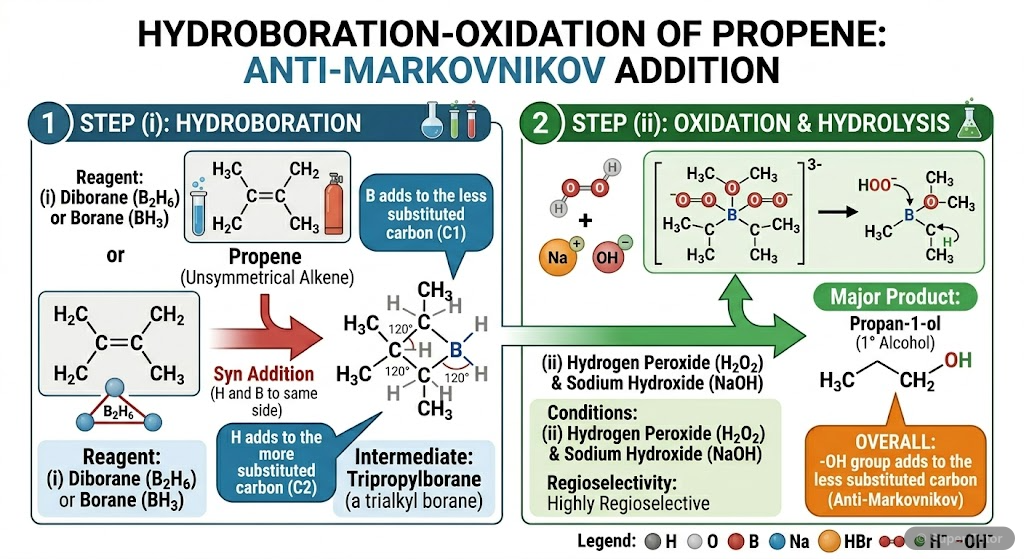
A reaction scheme showing the hydroboration-oxidation of an alkene (e.g., propene) to form an alcohol, highlighting the anti-Markownikov addition.
Super Tutor

Super Tutor has 32+ illustrations like this for Alcohols, Phenols and Ethers alone — flashcards, concept maps, and step-by-step visuals.

See them all
39 Questions Solved · 1 Section

20 worked solutions below. Unlock all 39 free in Super Tutor

Exercises

7.1Write IUPAC names of the following compounds:Show solution
The chapter’s method is to name each compound by choosing the longest parent chain/ring, numbering it to give the –OH group the lowest locant, and then naming substituents in alphabetical order. If you share the individual structures, I can give the exact IUPAC names.

Not sure why a step works? check your working in Super Tutor

7.2Write structures of the compounds whose IUPAC names are as follows:Show solution
The chapter’s rule is:
- for alcohols, write the carbon chain with –OH and place it at the stated position;
- for phenols, put –OH on the benzene ring and add substituents at the given locants;
- for ethers, write the alkoxy group and parent hydrocarbon. If you provide the specific names clearly, I can write each structure exactly.

Not sure why a step works? check your working in Super Tutor

7.3(i)Draw the structures of all isomeric alcohols of molecular formula C5H12O\mathrm{C_5H_{12}O} and give their IUPAC names.Show solution
For molecular formula **C5H12O\mathrm{C_5H_{12}O}, the monohydric alcohol isomers are:

1.
Pentan-1-ol**: CH3CH2CH2CH2CH2OH\mathrm{CH_3CH_2CH_2CH_2CH_2OH}
2. Pentan-2-ol: CH3CH(OH)CH2CH2CH3\mathrm{CH_3CH(OH)CH_2CH_2CH_3}
3. Pentan-3-ol: CH3CH2CH(OH)CH2CH3\mathrm{CH_3CH_2CH(OH)CH_2CH_3}
4. 2-Methylbutan-1-ol: CH3CH2CH(CH3)CH2OH\mathrm{CH_3CH_2CH(CH_3)CH_2OH}
5. 3-Methylbutan-1-ol: (CH3)2CHCH2CH2OH\mathrm{(CH_3)_2CHCH_2CH_2OH}
6. 3-Methylbutan-2-ol: CH3CH(OH)CH(CH3)CH3\mathrm{CH_3CH(OH)CH(CH_3)CH_3}
7. 2-Methylbutan-2-ol: (CH3)2C(OH)CH2CH3\mathrm{(CH_3)_2C(OH)CH_2CH_3}

These are all the isomeric alcohols of formula C5H12O\mathrm{C_5H_{12}O}.

Not sure why a step works? check your working in Super Tutor

7.3(ii)Classify the isomers of alcohols in question 11.3 (i) as primary, secondary and tertiary alcohols.Show solution
Classifying the alcohol isomers of C5H12O\mathrm{C_5H_{12}O} by the carbon bearing the –OH group:

- Primary alcohols:
- Pentan-1-ol
- 2-Methylbutan-1-ol
- 3-Methylbutan-1-ol

- Secondary alcohols:
- Pentan-2-ol
- Pentan-3-ol
- 3-Methylbutan-2-ol

- Tertiary alcohols:
- 2-Methylbutan-2-ol

So, there are 3 primary, 3 secondary and 1 tertiary alcohols.

Not sure why a step works? check your working in Super Tutor

7.4Explain why propanol has higher boiling point than that of the hydrocarbon, butane?Show solution
Propanol has a higher boiling point than butane because propanol molecules form intermolecular hydrogen bonding through the –OH group. Butane molecules do not have hydrogen bonding; they are held together only by weak van der Waals forces. Therefore, more heat is needed to separate propanol molecules, so its boiling point is higher.

Not sure why a step works? check your working in Super Tutor

7.5Alcohols are comparatively more soluble in water than hydrocarbons of comparable molecular masses. Explain this fact.Show solution
Alcohols are more soluble in water because their –OH group can form hydrogen bonds with water molecules. The lower alcohols are especially soluble. In hydrocarbons, there is no polar –OH group, so they cannot form hydrogen bonds with water; hence they are much less soluble. As the alkyl part becomes larger, solubility decreases because the hydrophobic part increases.

Not sure why a step works? check your working in Super Tutor

7.6What is meant by hydroboration-oxidation reaction? Illustrate it with an example.Show solution
Hydroboration-oxidation is a method of preparing alcohols from alkenes. First, an alkene reacts with diborane/borane to form an organoborane; then oxidation with hydrogen peroxide in alkaline medium gives the alcohol.

It gives the alcohol in a way opposite to Markovnikov’s rule.

Example:
CH3CH=CH2(2) H2O2/NaOH(1) BH3CH3CH2CH2OH \mathrm{CH_3CH=CH_2 \xrightarrow[(2)\ H_2O_2/NaOH]{(1)\ BH_3} CH_3CH_2CH_2OH}
So propene gives propan-1-ol.

Not sure why a step works? check your working in Super Tutor

7.7Give the structures and IUPAC names of monohydric phenols of molecular formula, C7H8O\mathrm{C_7H_8O}.Show solution
Monohydric phenols of molecular formula **C7H8O\mathrm{C_7H_8O} are the three cresols:

-
2-Methylphenol = o-cresol
-
3-Methylphenol = m-cresol
-
4-Methylphenol = p-cresol

Their structures are benzene rings with
–OH and one –CH3** group at positions 2, 3, and 4 relative to the hydroxyl group.

Not sure why a step works? check your working in Super Tutor

7.8While separating a mixture of *ortho* and *para* nitrophenols by steam distillation, name the isomer which will be steam volatile. Give reason.Show solution
o-Nitrophenol is steam volatile. It has intramolecular hydrogen bonding, so its molecules are less associated and can distil with steam more easily. p-Nitrophenol has intermolecular hydrogen bonding, so its molecules are more associated and less volatile.

Not sure why a step works? check your working in Super Tutor

7.9Give the equations of reactions for the preparation of phenol from cumene.Show solution
Phenol is prepared from cumene in two steps:

1. Oxidation of cumene to cumene hydroperoxide:
C6H5CH(CH3)2+O2C6H5C(CH3)2OOH \mathrm{C_6H_5CH(CH_3)_2 + O_2 \rightarrow C_6H_5C(CH_3)_2OOH}

2. Acidic cleavage of cumene hydroperoxide to phenol and acetone:
C6H5C(CH3)2OOHdil. H+C6H5OH+(CH3)2CO \mathrm{C_6H_5C(CH_3)_2OOH \xrightarrow{dil.\ H^+} C_6H_5OH + (CH_3)_2CO}

Thus, phenol and acetone are formed.

Not sure why a step works? check your working in Super Tutor

7.10Write chemical reaction for the preparation of phenol from chlorobenzene.Show solution
Phenol is prepared from chlorobenzene by fusing it with NaOH at 623 K and 320 atm to form sodium phenoxide, followed by acidification:

C6H5Cl+NaOH320 atm623 KC6H5ONa+NaCl \mathrm{C_6H_5Cl + NaOH \xrightarrow[320\ atm]{623\ K} C_6H_5ONa + NaCl}
C6H5ONa+HClC6H5OH+NaCl \mathrm{C_6H_5ONa + HCl \rightarrow C_6H_5OH + NaCl}

Not sure why a step works? check your working in Super Tutor

7.11Write the mechanism of hydration of ethene to yield ethanol.Show solution
Hydration of ethene to ethanol occurs by acid-catalysed addition of water.

Mechanism:

1. Protonation of ethene to form carbocation:
CH2=CH2+H3O+CH3CH2++H2O \mathrm{CH_2=CH_2 + H_3O^+ \rightarrow CH_3CH_2^+ + H_2O}

2. Nucleophilic attack by water:
CH3CH2++H2OCH3CH2OH2+ \mathrm{CH_3CH_2^+ + H_2O \rightarrow CH_3CH_2OH_2^+}

3. Deprotonation to give ethanol and regenerate acid:
CH3CH2OH2++H2OCH3CH2OH+H3O+ \mathrm{CH_3CH_2OH_2^+ + H_2O \rightarrow CH_3CH_2OH + H_3O^+}

So the product is ethanol.

Not sure why a step works? check your working in Super Tutor

7.12You are given benzene, conc. H2SO4\mathrm{H_2SO_4} and NaOH\mathrm{NaOH}. Write the equations for the preparation of phenol using these reagents.Show solution
From benzene, conc. H2SO4, and NaOH, phenol is prepared by first sulphonating benzene and then replacing the sulphonic group by –OH:

1. Sulphonation of benzene:
C6H6+H2SO4C6H5SO3H+H2O \mathrm{C_6H_6 + H_2SO_4 \rightarrow C_6H_5SO_3H + H_2O}

2. Fusion with NaOH:
C6H5SO3H+2NaOHC6H5ONa+Na2SO3+H2O \mathrm{C_6H_5SO_3H + 2NaOH \rightarrow C_6H_5ONa + Na_2SO_3 + H_2O}

3. Acidification:
C6H5ONa+HClC6H5OH+NaCl \mathrm{C_6H_5ONa + HCl \rightarrow C_6H_5OH + NaCl}

Thus phenol is obtained.

Not sure why a step works? check your working in Super Tutor

7.13(i)Show how will you synthesise:Show solution
If this is from the intext exercise on preparing alcohols from a suitable Grignard reagent on methanal, the method is:

HCHO+RMgXRCH2OMgXH2ORCH2OH \mathrm{HCHO + RMgX \rightarrow RCH_2OMgX \xrightarrow{H_2O} RCH_2OH}

For the specific alcohol shown in the chapter’s answer key, the product is prepared by reacting the appropriate alkyl magnesium bromide with methanal, followed by hydrolysis.

Not sure why a step works? check your working in Super Tutor

7.13(ii)Show how will you synthesise:Show solution
This item is also an incomplete pointer to a textbook synthesis question. From the chapter, a suitable synthesis of an alcohol from an alkene uses acid-catalysed hydration or hydroboration-oxidation, depending on the target product.

If you provide the exact structure after the colon, I can write the precise synthesis.

Not sure why a step works? check your working in Super Tutor

7.13(iii)Show how will you synthesise:Show solution
This appears to be a truncated synthesis prompt from the exercise section. The chapter contains several standard methods: preparation from alkenes, carbonyl compounds, and Grignard reagents.

Not sure why a step works? check your working in Super Tutor

7.14Give two reactions that show the acidic nature of phenol. Compare acidity of phenol with that of ethanol.Show solution
Two reactions showing the acidic nature of phenol are:

1. With sodium metal:
2C6H5OH+2Na2C6H5ONa+H2 \mathrm{2C_6H_5OH + 2Na \rightarrow 2C_6H_5ONa + H_2}

2. With sodium hydroxide:
C6H5OH+NaOHC6H5ONa+H2O \mathrm{C_6H_5OH + NaOH \rightarrow C_6H_5ONa + H_2O}

Comparison with ethanol: Phenol is much more acidic than ethanol. The chapter states that phenol is about a million times more acidic than ethanol, because the phenoxide ion is resonance-stabilised whereas the ethoxide ion is not.

Not sure why a step works? check your working in Super Tutor

7.15Explain why is ortho nitrophenol more acidic than ortho methoxyphenol?Show solution
o-Nitrophenol is more acidic than o-methoxyphenol because the nitro group is electron withdrawing and stabilises the phenoxide ion by delocalising the negative charge. The methoxy group is electron releasing by resonance, which decreases acidity by making the phenoxide ion less stable. Therefore, o-nitrophenol loses proton more easily than o-methoxyphenol.

Not sure why a step works? check your working in Super Tutor

7.16Explain how does the -OH group attached to a carbon of benzene ring activate it towards electrophilic substitution?Show solution
The –OH group on benzene ring activates it towards electrophilic substitution because its oxygen atom donates an unshared electron pair into the ring by resonance. This increases electron density, especially at the ortho and para positions, so the incoming electrophile attacks these positions more easily. The +R effect of –OH thus makes phenol much more reactive than benzene.

Not sure why a step works? check your working in Super Tutor

7.17Give equations of the following reactions:Show solution
The reactions are:

1. Oxidation of propan-1-ol with alkaline KMnO4:
CH3CH2CH2OHalk.KMnO4CH3CH2COOH \mathrm{CH_3CH_2CH_2OH \xrightarrow[alk.]{KMnO_4} CH_3CH_2COOH}

2. Bromine in CS2 with phenol gives mainly o-bromophenol and p-bromophenol:
C6H5OH+Br2CS2o-BrC6H4OH+p-BrC6H4OH+HBr \mathrm{C_6H_5OH + Br_2 \xrightarrow{CS_2} o\text{-}BrC_6H_4OH + p\text{-}BrC_6H_4OH + HBr}

3. Dilute HNO3 with phenol gives o-nitrophenol and p-nitrophenol:
C6H5OH+HNO3o-NO2C6H4OH+p-NO2C6H4OH+H2O \mathrm{C_6H_5OH + HNO_3 \rightarrow o\text{-}NO_2C_6H_4OH + p\text{-}NO_2C_6H_4OH + H_2O}

4. Phenol with chloroform and aqueous NaOH gives salicylaldehyde:
C6H5OH+CHCl3+3NaOHo-HOC6H4CHO+3NaCl+2H2O \mathrm{C_6H_5OH + CHCl_3 + 3NaOH \rightarrow o\text{-}HOC_6H_4CHO + 3NaCl + 2H_2O}

Not sure why a step works? check your working in Super Tutor

7.18Explain the following with an example.
7.19Write the mechanism of acid dehydration of ethanol to yield ethene.
7.20How are the following conversions carried out?
7.21Name the reagents used in the following reactions:
7.22Give reason for the higher boiling point of ethanol in comparison to methoxymethane.
7.23(i)Give IUPAC names of the following ethers:
7.23(ii)Give IUPAC names of the following ethers:
7.23(iii)Give IUPAC names of the following ethers:
7.23(iv)Give IUPAC names of the following ethers:
7.24Write the names of reagents and equations for the preparation of the following ethers by Williamson's synthesis:
7.25Illustrate with examples the limitations of Williamson synthesis for the preparation of certain types of ethers.
7.26How is 1-propoxypropane synthesised from propan-1-ol? Write mechanism of this reaction.
7.27Preparation of ethers by acid dehydration of secondary or tertiary alcohols is not a suitable method. Give reason.
7.28Write the equation of the reaction of hydrogen iodide with:
7.29Explain the fact that in aryl alkyl ethers (i) the alkoxy group activates the benzene ring towards electrophilic substitution and (ii) it directs the incoming substituents to ortho and para positions in benzene ring.
7.30Write the mechanism of the reaction of HI with methoxymethane.
7.31Write equations of the following reactions:
7.32Show how would you synthesise the following alcohols from appropriate alkenes?
7.33When 3-methylbutan-2-ol is treated with HBr, the following reaction takes place:

19 more solved questions in Alcohols, Phenols and Ethers

Every remaining exercise is solved step by step in Super Tutor, plus practice quizzes and flashcards for this chapter. Free to start.

Stuck on a step?

Ask Super Tutor AI to explain any solution on this page in a simpler way — free, 24x7.

Ask a Doubt Free

Frequently Asked Questions

What are the important topics in Alcohols, Phenols and Ethers for CBSE Class 12 Chemistry?
Key topics in Alcohols, Phenols and Ethers include Classification of Alcohols, Phenols and Ethers, Alcohols, Phenols and Ethers — Complete Chapter Overview, Correct vs Wrong: Predicting Products of Alcohol Reactions. These are the concepts CBSE Class 12 examiners draw on most — study them first, then practise related questions.
How to score full marks in Alcohols, Phenols and Ethers — CBSE Class 12 Chemistry?
Understand the core concepts first, then work through the 88 practice questions available for this chapter. Revise formulas and definitions regularly, and use flashcards for quick recall before the exam.
Where can I get free NCERT Solutions for Alcohols, Phenols and Ethers Class 12 Chemistry?
This page has free step-by-step NCERT Solutions for every exercise question in Alcohols, Phenols and Ethers (CBSE Class 12 Chemistry) — written the way examiners award marks: given, formula, working, answer.

Sources & Official References

Content is aligned to the official syllabus. Refer to the board website for the latest curriculum.

For serious students

Get the full Alcohols, Phenols and Ethers chapter — for free.

Quizzes, flashcards, AI doubt-solver and a step-by-step study plan for CBSE Class 12 Chemistry.