Amines
CBSE · Class 12 · Chemistry
NCERT Solutions for Amines — CBSE Class 12 Chemistry.
Interactive on Super Tutor
Studying Amines? Get the full interactive chapter.
Quizzes, flashcards, AI doubt-solver and a step-by-step study plan — built for ncert solutions and more.
1,000+ Class 12 students started this chapter today
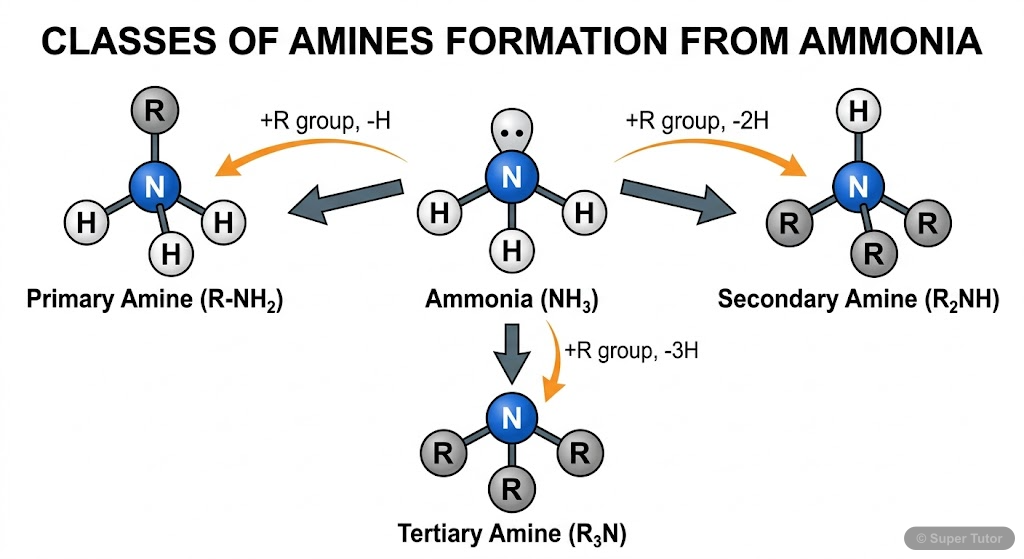
Learn better with visuals Super Tutor has hundreds of illustrations like this across every chapter — all free to try.
Get started8 worked solutions below. Unlock all 16 free in Super Tutor
Intext Questions
9.1Classify the following amines as primary, secondary or tertiary:Show solution
- Primary amine: one alkyl/aryl group attached to nitrogen, e.g. **
- Secondary amine: two alkyl/aryl groups attached to nitrogen, e.g. or
- Tertiary amine: three alkyl/aryl groups attached to nitrogen, e.g. **
So the given amines are classified accordingly as primary, secondary, or tertiary based on how many hydrogens of ammonia are replaced.
Not sure why a step works? check your working in Super Tutor
9.2(i)Write structures of different isomeric amines corresponding to the molecular formula, .Show solution
1.
2.
3.
4.
5.
6.
7.
8. **
These include primary, secondary and tertiary amines.
Not sure why a step works? check your working in Super Tutor
9.2(ii)Write IUPAC names of all the isomers.Show solution
- butan-1-amine
- butan-2-amine
- 2-methylpropan-1-amine
- 2-methylpropan-2-amine
- N-ethylethanamine
- N-methylpropan-1-amine
- N-methylpropan-2-amine
- N,N-dimethylethanamine**
Not sure why a step works? check your working in Super Tutor
9.2(iii)What type of isomerism is exhibited by different pairs of amines?Show solution
- Chain isomerism: due to different carbon skeletons, e.g. butan-1-amine and 2-methylpropan-1-amine.
- Position isomerism: due to different position of the amino group, e.g. butan-1-amine and butan-2-amine.
- Metamerism: in secondary and tertiary amines because alkyl groups on either side of nitrogen may differ.
So the main types are chain isomerism and position isomerism; metamerism** is also present in some pairs.
Not sure why a step works? check your working in Super Tutor
9.3How will you convertShow solution
### (i) Benzene into aniline
1. First nitrate benzene to nitrobenzene:
2. Reduce nitrobenzene to aniline:
### (ii) Benzene into N,N-dimethylaniline
1. Convert benzene to aniline as above.
2. Methylate aniline with excess methyl iodide:
So the required product is N,N-dimethylaniline.
Not sure why a step works? check your working in Super Tutor
9.4Arrange the following in increasing order of their basic strength:Show solution
This matches the chapter’s answer for the corresponding intext question.
Not sure why a step works? check your working in Super Tutor
9.5Complete the following acid-base reactions and name the products:Show solution
### (i)
Product: propylammonium chloride or propan-1-aminium chloride.
### (ii)
Product: triethylammonium chloride.
Amines act as bases and form ammonium salts with acids.
Not sure why a step works? check your working in Super Tutor
9.6Write reactions of the final alkylation product of aniline with excess of methyl iodide in the presence of sodium carbonate solution.Show solution
The sequence is:
With sodium carbonate solution, the free base is regenerated/maintained during methylation. The final product is the quaternary ammonium salt [N,N,N-trimethylanilinium iodide].
Not sure why a step works? check your working in Super Tutor
8 more solved questions in Amines
Every remaining exercise is solved step by step in Super Tutor, plus practice quizzes and flashcards for this chapter. Free to start.
Stuck on a step?
Ask Super Tutor AI to explain any solution on this page in a simpler way — free, 24x7.
Ask a Doubt FreeFrequently Asked Questions
What are the important topics in Amines for CBSE Class 12 Chemistry?
How to score full marks in Amines — CBSE Class 12 Chemistry?
Where can I get free NCERT Solutions for Amines Class 12 Chemistry?
Sources & Official References
- NCERT Official — ncert.nic.in
- CBSE Academic — cbseacademic.nic.in
- CBSE Official — cbse.gov.in
- National Education Policy 2020 — education.gov.in
Content is aligned to the official syllabus. Refer to the board website for the latest curriculum.
More resources for Amines
Practice Quiz
Test yourself with a quick quiz
Important Questions
Practice with board exam-style questions
Revision Notes
Key points for last-minute revision
Formula Sheet
All formulas in one place
Chapter Summary
Understand the chapter at a glance
Concept Maps
See how topics connect visually
Study Plan
Step-by-step plan to ace this chapter
Flashcards
Quick-fire cards for active recall
Syllabus
What topics to cover
For serious students
Get the full Amines chapter — for free.
Quizzes, flashcards, AI doubt-solver and a step-by-step study plan for CBSE Class 12 Chemistry.