Determination of Income and Employment — NCERT Solutions
CBSE · Class 12 · Economics
NCERT Solutions for Determination of Income and Employment, CBSE Class 12 Economics: 6 textbook questions solved step by step. Covers Exercises.
Interactive on Super Tutor
Studying Determination of Income and Employment? Get the full interactive chapter.
Quizzes, flashcards, AI doubt-solver and a step-by-step study plan — built for NCERT solutions and more.
Free trial, no card needed.
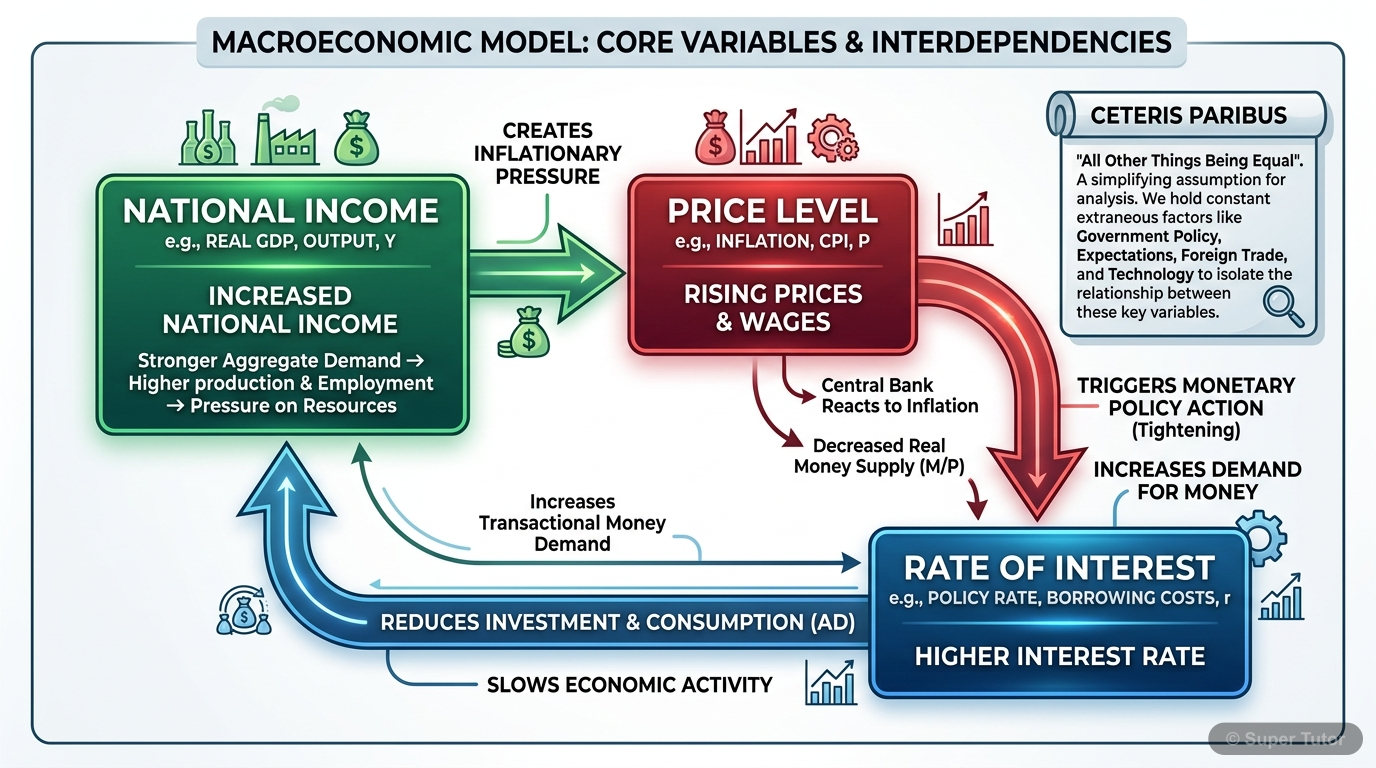
One of 12 illustrations for Determination of Income and Employment in Super Tutor — alongside flashcards, concept maps and practice questions.
See them allThe first 3 solutions are open to read. The other 3 are free with a Super Tutor account. Unlock all 6 free in Super Tutor
Exercises
1What is marginal propensity to consume? How is it related to marginal propensity to save?Show solution
Marginal propensity to consume (MPC) is the change in consumption per unit change in income. It is denoted by and given by
It is related to marginal propensity to save (MPS) as follows:
Since ,
So,
and therefore
Not sure why a step works? check your working in Super Tutor
2What is the difference between ex ante investment and ex post investment?Show solution
Ex ante investment means the amount of investment a producer plans to make during a year. It is the planned addition to stock or capital.
Ex post investment means the investment that actually takes place by the end of the year.
They can be different because actual sales may differ from planned sales. For example, if a producer plans to add goods worth Rs 100 to inventory but unexpected demand forces her to sell goods worth Rs 30 from stock, then actual inventory rises only by Rs 70. So planned investment is Rs 100, but ex post investment is Rs 70.
Thus, ex ante = planned, while ex post = actual.
Not sure why a step works? check your working in Super Tutor
3What do you understand by 'parametric shift of a line'? How does a line shift when its (i) slope decreases, and (ii) its intercept increases?Show solution
A parametric shift of a line means a shift in the position of the line caused by a change in one of its parameters, such as the intercept or the slope.
- If the slope decreases, the line swings downward and becomes flatter.
- If the intercept increases, the line shifts upward in parallel.
So, a decrease in slope changes the tilt of the line, while an increase in intercept moves the whole line up without changing its slope.
Not sure why a step works? check your working in Super Tutor
Free with a Super Tutor account
Free with a Super Tutor account
Free with a Super Tutor account
3 more solved questions in Determination of Income and Employment
They are free with a Super Tutor account, along with practice quizzes and flashcards for this chapter. Free to start, no card needed.
Frequently Asked Questions
What are the important topics in Determination of Income and Employment for CBSE Class 12 Economics?
Are these NCERT Solutions for Determination of Income and Employment free?
How should I revise Determination of Income and Employment for the CBSE Class 12 board exam?
Sources & Official References
- NCERT Official — ncert.nic.in
- CBSE Academic — cbseacademic.nic.in
- CBSE Official — cbse.gov.in
- National Education Policy 2020 — education.gov.in
Content is aligned to the official syllabus. Refer to the board website for the latest curriculum.
More resources for Determination of Income and Employment
Practice Quiz
Test yourself with a quick quiz
Important Questions
Exam-style questions with answers
Revision Notes
Key points for last-minute revision
Formula Sheet
The chapter's formulas in one place
Chapter Summary
Understand the chapter at a glance
Concept Maps
See how topics connect
Study Plan
Step-by-step plan for this chapter
Flashcards
Quick-fire cards for active recall
Syllabus
What topics to cover
For serious students
Get the full Determination of Income and Employment chapter — start free.
Quizzes, flashcards, an AI doubt solver and a study plan for CBSE Class 12 Economics. Free to start, no card needed.