Money and Banking
CBSE · Class 12 · Economics
NCERT Solutions for Money and Banking — CBSE Class 12 Economics.
Interactive on Super Tutor
Studying Money and Banking? Get the full interactive chapter.
Quizzes, flashcards, AI doubt-solver and a step-by-step study plan — built for ncert solutions and more.
1,000+ Class 12 students started this chapter today
This is just one of 17+ visuals inside Super Tutor's Money and Banking chapter
Explore the full set6 worked solutions below. Unlock all 11 free in Super Tutor
Exercises
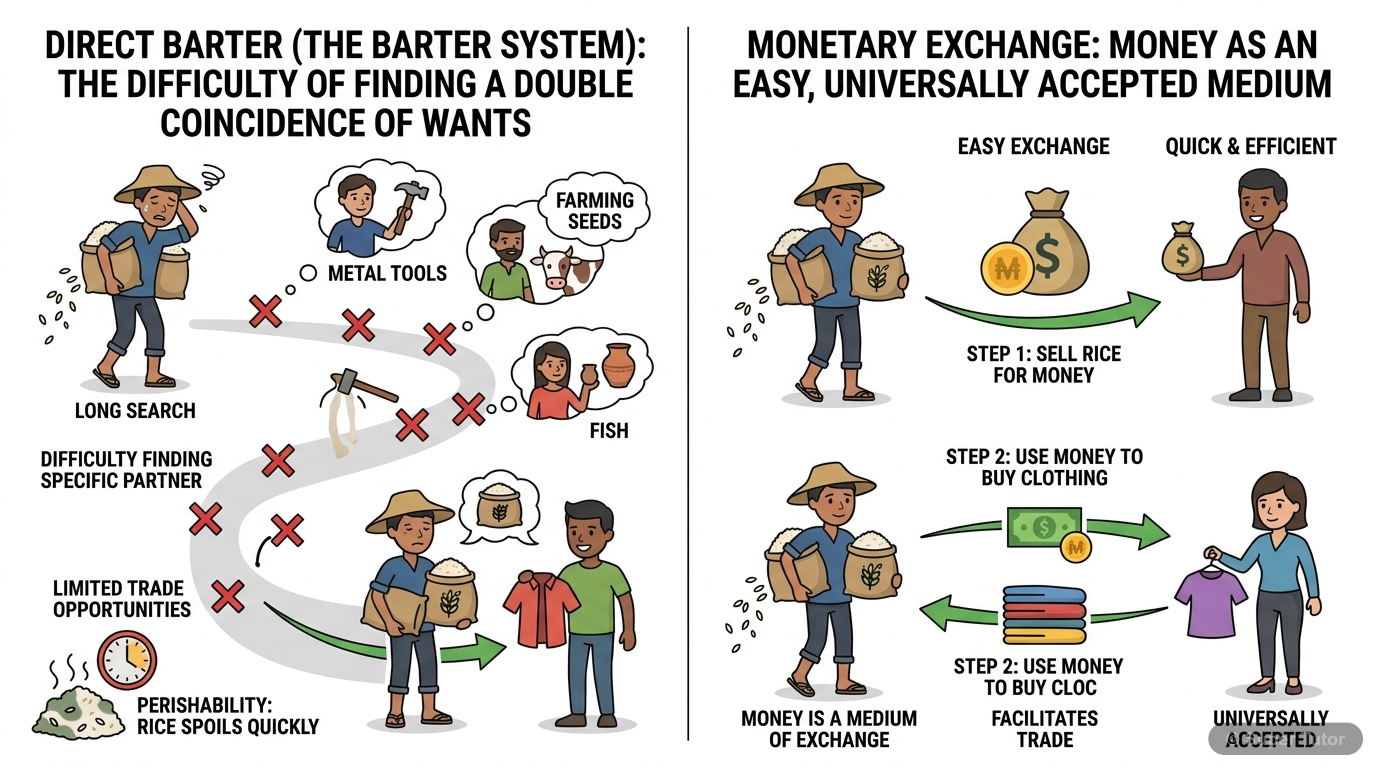
1What is a barter system? What are its drawbacks?Show solution
Its drawbacks are:
- It requires double coincidence of wants: each person must want exactly what the other offers.
- It is difficult to find suitable exchange partners, so search costs are high.
- It is hard to store wealth in perishable goods like rice.
- Many goods are difficult to divide, transport, or keep safely.
- It becomes inconvenient as the number of people and transactions increases.
So, barter is inefficient in a large economy and money is needed to make exchanges easier.
Not sure why a step works? check your working in Super Tutor
2What are the main functions of money? How does money overcome the shortcomings of a barter system?Show solution
1. Medium of exchange
2. Unit of account
3. Store of value
Money overcomes the shortcomings of barter in these ways:
- As a medium of exchange, it removes the need for double coincidence of wants. People can sell goods for money and then buy what they need.
- As a unit of account, it allows the value of all goods and services to be expressed in one common measure, making comparison and calculation easy.
- As a store of value, it helps people carry wealth forward to the future because money is not perishable and has low storage cost, unlike many barter goods.
Thus, money makes exchange easier, wealth easier to store, and economic transactions simpler.
Not sure why a step works? check your working in Super Tutor
3What is transaction demand for money? How is it related to the value of transactions over a specified period of time?Show solution
It is related to the value of transactions over a period of time because the larger the value of transactions, the more money people need to keep for spending. In the chapter, it is shown that transaction demand is positively related to the value of nominal transactions:
where is the total value of transactions over a unit period and is a positive fraction.
Since the value of transactions is generally related to income and price level, transaction demand for money rises when income or price level rises.
Not sure why a step works? check your working in Super Tutor
4What are the alternative definitions of money supply in India?Show solution
- M1 = CU + DD
- M2 = M1 + savings deposits with Post Office savings banks
- M3 = M1 + net time deposits of commercial banks
- M4 = M3 + total deposits with Post Office savings organisations (excluding National Savings Certificates)
Here, CU means currency held by the public and DD means net demand deposits held by commercial banks.
So the four measures are M1, M2, M3 and M4.
Not sure why a step works? check your working in Super Tutor
5What is a 'legal tender'? What is 'fiat money'?Show solution
Fiat money is money whose value comes from the guarantee of the issuing authority, not from the intrinsic value of the material it is made of. Currency notes and coins are fiat money because their paper or metal value is much less than their face value, but they are accepted because the government and RBI guarantee them.
So, legal tender refers to money that must be accepted, and fiat money refers to money that has value because of official backing, not intrinsic worth.
Not sure why a step works? check your working in Super Tutor
6What is High Powered Money?Show solution
Not sure why a step works? check your working in Super Tutor
5 more solved questions in Money and Banking
Every remaining exercise is solved step by step in Super Tutor, plus practice quizzes and flashcards for this chapter. Free to start.
Stuck on a step?
Ask Super Tutor AI to explain any solution on this page in a simpler way — free, 24x7.
Ask a Doubt FreeFrequently Asked Questions
What are the important topics in Money and Banking for CBSE Class 12 Economics?
How to score full marks in Money and Banking — CBSE Class 12 Economics?
Where can I get free NCERT Solutions for Money and Banking Class 12 Economics?
Sources & Official References
- NCERT Official — ncert.nic.in
- CBSE Academic — cbseacademic.nic.in
- CBSE Official — cbse.gov.in
- National Education Policy 2020 — education.gov.in
Content is aligned to the official syllabus. Refer to the board website for the latest curriculum.
More resources for Money and Banking
Practice Quiz
Test yourself with a quick quiz
Important Questions
Practice with board exam-style questions
Revision Notes
Key points for last-minute revision
Formula Sheet
All formulas in one place
Chapter Summary
Understand the chapter at a glance
Concept Maps
See how topics connect visually
Study Plan
Step-by-step plan to ace this chapter
Flashcards
Quick-fire cards for active recall
Syllabus
What topics to cover
For serious students
Get the full Money and Banking chapter — for free.
Quizzes, flashcards, AI doubt-solver and a step-by-step study plan for CBSE Class 12 Economics.