Market Equilibrium
CBSE · Class 12 · Economics
NCERT Solutions for Market Equilibrium — CBSE Class 12 Economics.
Interactive on Super Tutor
Studying Market Equilibrium? Get the full interactive chapter.
Quizzes, flashcards, AI doubt-solver and a step-by-step study plan — built for ncert solutions and more.
1,000+ Class 12 students started this chapter today
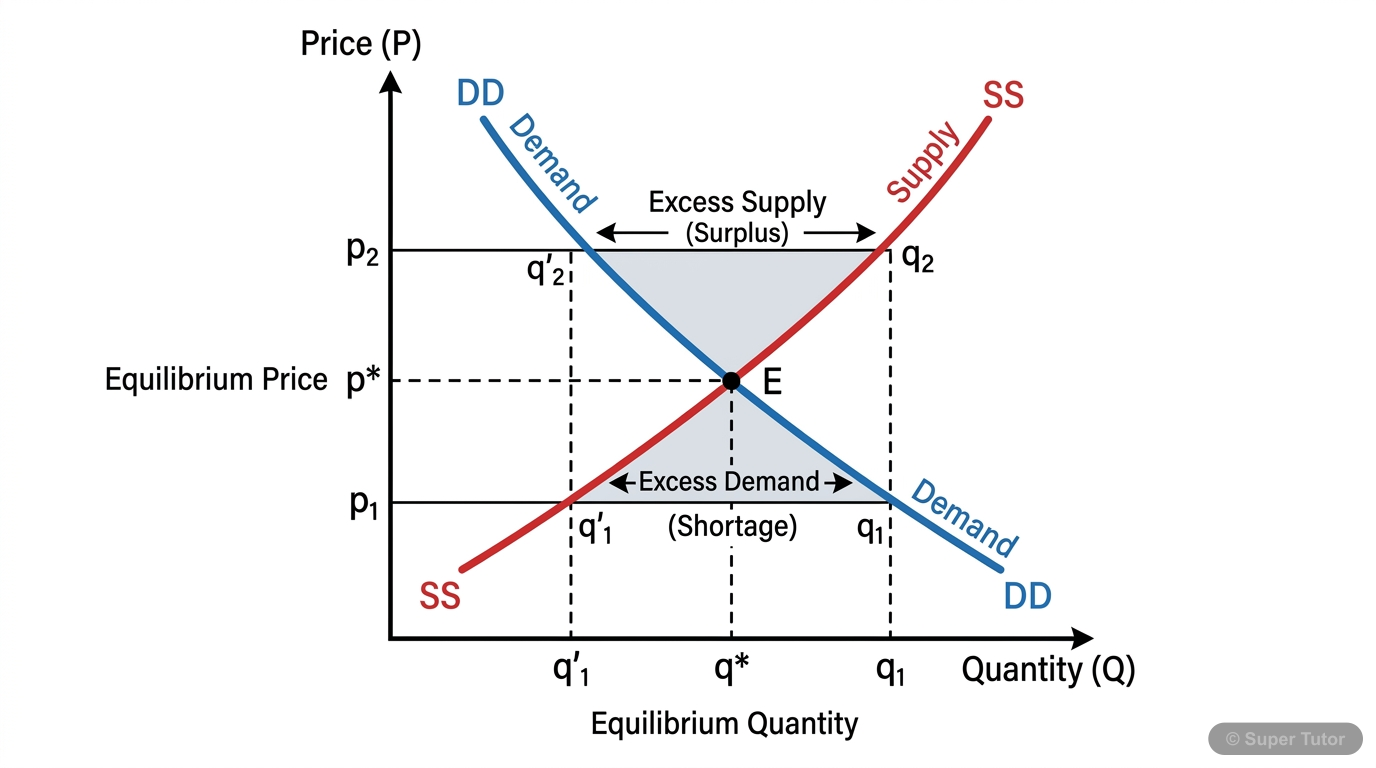
Super Tutor has 11+ illustrations like this for Market Equilibrium alone — flashcards, concept maps, and step-by-step visuals.
See them all13 worked solutions below. Unlock all 25 free in Super Tutor
Exercises
1Explain market equilibrium.Show solution
Not sure why a step works? check your working in Super Tutor
2When do we say there is excess demand for a commodity in the market?Show solution
Not sure why a step works? check your working in Super Tutor
3When do we say there is excess supply for a commodity in the market?Show solution
Not sure why a step works? check your working in Super Tutor
4What will happen if the price prevailing in the market isShow solution
(i) above the equilibrium price, there will be excess supply. Firms will not be able to sell all they want to sell, so they will tend to lower the price.
(ii) below the equilibrium price, there will be excess demand. Consumers will not be able to get all they want to buy, so the price will tend to rise.
Not sure why a step works? check your working in Super Tutor
5Explain how price is determined in a perfectly competitive market with fixed number of firms.Show solution
- If price is above equilibrium, there is excess supply, so price falls.
- If price is below equilibrium, there is excess demand, so price rises.
Thus, the market moves toward the price at which quantity demanded = quantity supplied. That intersection gives the equilibrium price and equilibrium quantity.
Not sure why a step works? check your working in Super Tutor
6Suppose the price at which equilibrium is attained in exercise 5 is above the minimum average cost of the firms constituting the market. Now if we allow for free entry and exit of firms, how will the market price adjust to it?Show solution
This process continues until supernormal profit is wiped out. Therefore, the market price adjusts to the minimum average cost of the firms, i.e. ****.
Not sure why a step works? check your working in Super Tutor
7At what level of price do the firms in a perfectly competitive market supply when free entry and exit is allowed in the market? How is equilibrium quantity determined in such a market?Show solution
The equilibrium quantity** is determined by the market demand at that price. In other words, at the equilibrium price, the quantity consumers want to buy equals the quantity firms collectively supply.
Not sure why a step works? check your working in Super Tutor
8How is the equilibrium number of firms determined in a market where entry and exit is permitted?Show solution
If total equilibrium quantity is and each firm supplies , then
So the number of firms is just the number needed to produce the total market quantity at the equilibrium price.
Not sure why a step works? check your working in Super Tutor
9How are equilibrium price and quantity affected when income of the consumersShow solution
- For a normal good, demand increases, so the demand curve shifts rightward. With supply unchanged, both equilibrium price and equilibrium quantity increase.
- For a decrease in income, the reverse happens for a normal good: demand falls, so the demand curve shifts leftward, and both equilibrium price and equilibrium quantity decrease.
For an inferior good, the effect on demand would be opposite, but the chapter’s general discussion here is for a normal good.
Not sure why a step works? check your working in Super Tutor
10Using supply and demand curves, show how an increase in the price of shoes affects the price of a pair of socks and the number of pairs of socks bought and sold.Show solution
Thus:
- the demand curve for socks shifts leftward,
- the equilibrium price of socks falls,
- the equilibrium quantity of socks decreases.
So fewer pairs of socks are bought and sold at a lower price.
Not sure why a step works? check your working in Super Tutor
11How will a change in price of coffee affect the equilibrium price of tea? Explain the effect on equilibrium quantity also through a diagram.Show solution
Therefore:
- the demand curve for tea shifts rightward,
- the equilibrium price of tea increases,
- the equilibrium quantity of tea increases.
Diagrammatically, with the supply curve unchanged, a rightward shift of demand moves the equilibrium to a point with both higher price and higher quantity.
Not sure why a step works? check your working in Super Tutor
12How do the equilibrium price and quantity of a commodity change when price of input used in its production changes?Show solution
As a result:
- equilibrium price rises,
- equilibrium quantity falls.
If the input price falls, the supply curve shifts rightward, so price falls and quantity rises.
Not sure why a step works? check your working in Super Tutor
13If the price of a substitute(Y) of good X increases, what impact does it have on the equilibrium price and quantity of good X?Show solution
Therefore, the equilibrium price of X rises and the equilibrium quantity of X increases.
Not sure why a step works? check your working in Super Tutor
12 more solved questions in Market Equilibrium
Every remaining exercise is solved step by step in Super Tutor, plus practice quizzes and flashcards for this chapter. Free to start.
Stuck on a step?
Ask Super Tutor AI to explain any solution on this page in a simpler way — free, 24x7.
Ask a Doubt FreeFrequently Asked Questions
What are the important topics in Market Equilibrium for CBSE Class 12 Economics?
How to score full marks in Market Equilibrium — CBSE Class 12 Economics?
Where can I get free NCERT Solutions for Market Equilibrium Class 12 Economics?
Sources & Official References
- NCERT Official — ncert.nic.in
- CBSE Academic — cbseacademic.nic.in
- CBSE Official — cbse.gov.in
- National Education Policy 2020 — education.gov.in
Content is aligned to the official syllabus. Refer to the board website for the latest curriculum.
More resources for Market Equilibrium
Practice Quiz
Test yourself with a quick quiz
Important Questions
Practice with board exam-style questions
Revision Notes
Key points for last-minute revision
Formula Sheet
All formulas in one place
Chapter Summary
Understand the chapter at a glance
Concept Maps
See how topics connect visually
Study Plan
Step-by-step plan to ace this chapter
Flashcards
Quick-fire cards for active recall
Syllabus
What topics to cover
For serious students
Get the full Market Equilibrium chapter — for free.
Quizzes, flashcards, AI doubt-solver and a step-by-step study plan for CBSE Class 12 Economics.