Chapter 3 of 12
NCERT Solutions

Theory of Consumer Behavior

CBSE · Class 12 · Economics

NCERT Solutions for Theory of Consumer Behavior — CBSE Class 12 Economics.

46 questions80 flashcards5 concepts

Interactive on Super Tutor

Studying Theory of Consumer Behavior? Get the full interactive chapter.

Quizzes, flashcards, AI doubt-solver and a step-by-step study plan — built for ncert solutions and more.

1,000+ Class 12 students started this chapter today
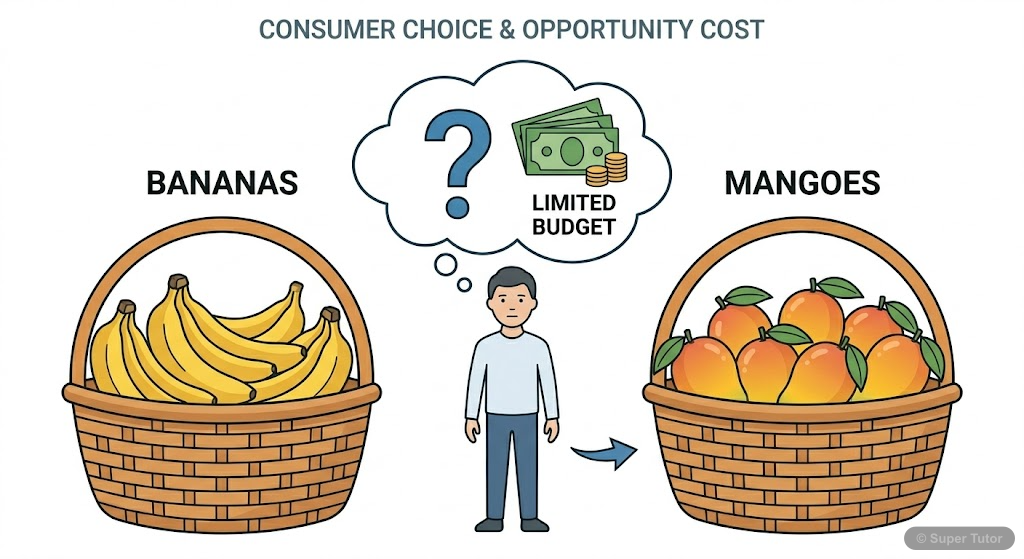
An illustration showing a consumer facing a choice between two goods (e.g., bananas and mangoes) with a limited income, representing the fundamental problem of choice in consumer behavior.
Super Tutor

This is just one of 24+ visuals inside Super Tutor's Theory of Consumer Behavior chapter

Explore the full set
30 Questions Solved · 1 Section

15 worked solutions below. Unlock all 30 free in Super Tutor

Exercises

1What do you mean by the budget set of a consumer?Show solution
The budget set is the collection of all consumption bundles that a consumer can buy with her given income at the prevailing market prices.

Not sure why a step works? check your working in Super Tutor

2What is budget line?Show solution
The budget line is the line showing all bundles that cost exactly equal to the consumer's income.

Not sure why a step works? check your working in Super Tutor

3Explain why the budget line is downward sloping.Show solution
The budget line is downward sloping because income is fixed. If the consumer wants to buy more of one good, she must give up some of the other good to keep total spending equal to her income. In symbols, the budget line is p1x1+p2x2=Mp_1x_1+p_2x_2=M, so if x1x_1 increases, x2x_2 must fall. Its slope is p1p2-\frac{p_1}{p_2}, which is negative.

Not sure why a step works? check your working in Super Tutor

4(i)Write down the equation of the budget line.Show solution
Given income MM and prices p1p_1 and p2p_2, the budget line is the set of bundles that cost exactly the income. So the equation is p1x1+p2x2=Mp_1x_1+p_2x_2=M.

Not sure why a step works? check your working in Super Tutor

4(ii)How much of good 1 can the consumer consume if she spends her entire income on that good?Show solution
If she spends her entire income on good 1, then

x1=Mp1=204=5.x_1=\frac{M}{p_1}=\frac{20}{4}=5.

So she can buy 5 units of good 1.

Not sure why a step works? check your working in Super Tutor

4(iii)How much of good 2 can she consume if she spends her entire income on that good?Show solution
If she spends her entire income on good 2, then

x2=Mp2=205=4.x_2=\frac{M}{p_2}=\frac{20}{5}=4.

So she can buy 4 units of good 2.

Not sure why a step works? check your working in Super Tutor

4(iv)What is the slope of the budget line?Show solution
The slope of the budget line is

p1p2=45.-\frac{p_1}{p_2}=-\frac{4}{5}.

So the slope is **4/5-4/5**.

Not sure why a step works? check your working in Super Tutor

5How does the budget line change if the consumer's income increases to Rs 40 but the prices remain unchanged?Show solution
If income rises from Rs 20 to Rs 40 while prices remain unchanged, the budget line shifts parallel outward. Its slope remains the same because prices do not change, but both intercepts increase. So the consumer can now afford more of both goods.

Not sure why a step works? check your working in Super Tutor

6How does the budget line change if the price of good 2 decreases by a rupee but the price of good 1 and the consumer's income remain unchanged?Show solution
If the price of good 2 decreases by Re 1 while the price of good 1 and income remain unchanged, the budget line becomes flatter because the slope p1p2-\frac{p_1}{p_2} changes in absolute value. The vertical intercept stays the same, while the horizontal intercept increases. So the budget line pivots outward around the vertical intercept.

Not sure why a step works? check your working in Super Tutor

7What happens to the budget set if both the prices as well as the income double?Show solution
If both prices and income double, the budget constraint becomes

2p1x1+2p2x22M.2p_1x_1+2p_2x_2\le 2M.

Dividing by 2 gives

p1x1+p2x2M.p_1x_1+p_2x_2\le M.

So the budget set does not change at all. The budget line is exactly the same.

Not sure why a step works? check your working in Super Tutor

8Suppose a consumer can afford to buy 6 units of good 1 and 8 units of good 2 if she spends her entire income. The prices of the two goods are Rs 6 and Rs 8 respectively. How much is the consumer's income?Show solution
Since she spends her entire income on the bundle (6,8)(6,8),

M=p1x1+p2x2.M=p_1x_1+p_2x_2.

Here p1=6p_1=6, x1=6x_1=6, p2=8p_2=8, and x2=8x_2=8.

So,

M=6×6+8×8=36+64=100.M=6\times 6+8\times 8=36+64=100.

Thus the consumer's income is Rs 100.

Not sure why a step works? check your working in Super Tutor

9(i)Write down all the bundles that are available to the consumer.Show solution
Each good costs Rs 10 and income is Rs 40. Since the goods are available only in integer units, the consumer can buy any bundle (x1,x2)(x_1,x_2) satisfying

10x1+10x240,10x_1+10x_2\le 40,

or

x1+x24.x_1+x_2\le 4.

So the available bundles are:

(0,0),(0,1),(0,2),(0,3),(0,4),(1,0),(1,1),(1,2),(1,3),(2,0),(2,1),(2,2),(3,0),(3,1),(4,0).(0,0), (0,1), (0,2), (0,3), (0,4), (1,0), (1,1), (1,2), (1,3), (2,0), (2,1), (2,2), (3,0), (3,1), (4,0).

Not sure why a step works? check your working in Super Tutor

9(ii)Among the bundles that are available to the consumer, identify those which cost her exactly Rs 40.Show solution
A bundle costs exactly Rs 40 when

10x1+10x2=40,10x_1+10x_2=40,

so

x1+x2=4.x_1+x_2=4.

Hence the bundles costing exactly Rs 40 are:

(0,4),(1,3),(2,2),(3,1),(4,0).(0,4), (1,3), (2,2), (3,1), (4,0).

Not sure why a step works? check your working in Super Tutor

10What do you mean by 'monotonic preferences'?Show solution
Monotonic preferences mean that if one bundle has more of at least one good and no less of the other good compared to another bundle, then the consumer prefers the bundle with more. In short, more of a good, without less of the other, is preferred.

Not sure why a step works? check your working in Super Tutor

11If a consumer has monotonic preferences, can she be indifferent between the bundles (10, 8) and (8, 6)?Show solution
No. With monotonic preferences, if one bundle has more of at least one good and no less of the other, it is preferred. The bundle (10,8)(10,8) has more of both goods than (8,6)(8,6). So the consumer must prefer (10,8)(10,8) to (8,6)(8,6), and cannot be indifferent between them.

Not sure why a step works? check your working in Super Tutor

12Suppose a consumer's preferences are monotonic. What can you say about her preference ranking over the bundles (10, 10), (10, 9) and (9, 9)?
13Suppose your friend is indifferent to the bundles (5, 6) and (6, 6). Are the preferences of your friend monotonic?
14Suppose there are two consumers in the market for a good and their demand functions are as follows:
15Suppose there are 20 consumers for a good and they have identical demand functions:
16Consider a market where there are just two consumers and suppose their demands for the good are given as follows:
17What do you mean by a normal good?
18What do you mean by an 'inferior good'? Give some examples.
19What do you mean by substitutes? Give examples of two goods which are substitutes of each other.
20What do you mean by complements? Give examples of two goods which are complements of each other.
21Explain price elasticity of demand.
22Consider the demand for a good. At price Rs 4, the demand for the good is 25 units. Suppose price of the good increases to Rs 5, and as a result, the demand for the good falls to 20 units. Calculate the price elasticity.
23Consider the demand curve D(p)=103pD(p) = 10 - 3p. What is the elasticity at price 53\frac{5}{3}?
24Suppose the price elasticity of demand for a good is 0.2-0.2. If there is a 5 % increase in the price of the good, by what percentage will the demand for the good go down?
25Suppose the price elasticity of demand for a good is 0.2-0.2. How will the expenditure on the good be affected if there is a 10 % increase in the price of the good?
26Suppose there was a 4 % decrease in the price of a good, and as a result, the expenditure on the good increased by 2 %. What can you say about the elasticity of demand?

15 more solved questions in Theory of Consumer Behavior

Every remaining exercise is solved step by step in Super Tutor, plus practice quizzes and flashcards for this chapter. Free to start.

Stuck on a step?

Ask Super Tutor AI to explain any solution on this page in a simpler way — free, 24x7.

Ask a Doubt Free

Frequently Asked Questions

What are the important topics in Theory of Consumer Behavior for CBSE Class 12 Economics?
Key topics in Theory of Consumer Behavior include Theory of Consumer Behaviour — Complete Concept Map, Correct vs Incorrect: What Causes Movement vs Shift in Demand Curve, Overview of Theory of Consumer Behaviour. These are the concepts CBSE Class 12 examiners draw on most — study them first, then practise related questions.
How to score full marks in Theory of Consumer Behavior — CBSE Class 12 Economics?
Understand the core concepts first, then work through the 46 practice questions available for this chapter. Revise formulas and definitions regularly, and use flashcards for quick recall before the exam.
Where can I get free NCERT Solutions for Theory of Consumer Behavior Class 12 Economics?
This page has free step-by-step NCERT Solutions for every exercise question in Theory of Consumer Behavior (CBSE Class 12 Economics) — written the way examiners award marks: given, formula, working, answer.

Sources & Official References

Content is aligned to the official syllabus. Refer to the board website for the latest curriculum.

For serious students

Get the full Theory of Consumer Behavior chapter — for free.

Quizzes, flashcards, AI doubt-solver and a step-by-step study plan for CBSE Class 12 Economics.