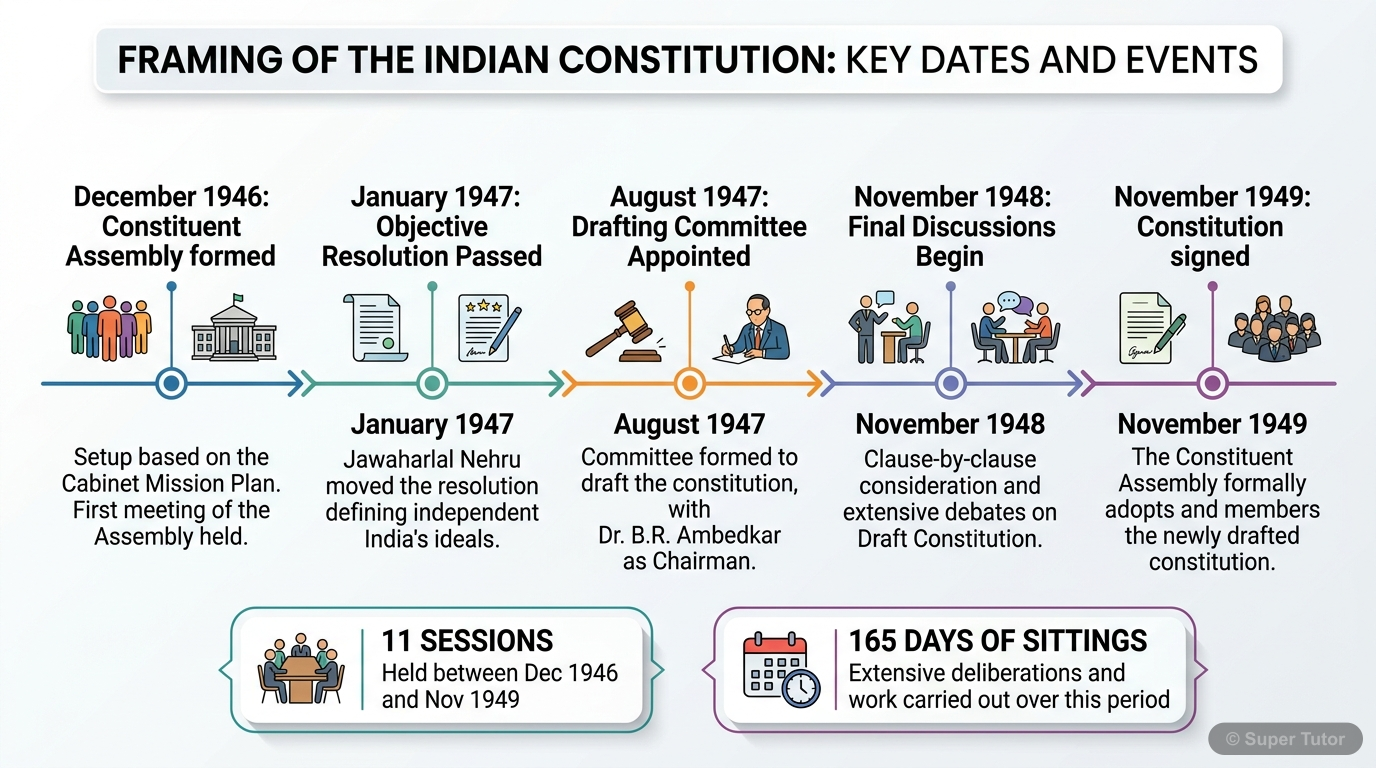
Framing the Constitution: The Beginning of a New Era
CBSE · Class 12 · History
NCERT Solutions for Framing the Constitution: The Beginning of a New Era — CBSE Class 12 History.
Interactive on Super Tutor
Studying Framing the Constitution: The Beginning of a New Era? Get the full interactive chapter.
Quizzes, flashcards, AI doubt-solver and a step-by-step study plan — built for ncert solutions and more.
1,000+ Class 12 students started this chapter today

Learn better with visuals Super Tutor has hundreds of illustrations like this across every chapter — all free to try.
Get startedDiscuss Questions (In-text)
D1Look again at Chapter 11. Discuss how the political situation of the time may have shaped the nature of the debates within the Constituent Assembly.Show solution
How the political situation shaped the debates:
1. Partition and communal violence: The violence accompanying Partition made members acutely conscious of the need to protect minorities while simultaneously building a unified nation. This shaped debates on separate electorates, minority rights, and the abolition of untouchability.
2. Presence of the British: Somnath Lahiri argued that the Assembly was working under British influence. This pushed members like Nehru to emphasise that the Assembly derived its strength from the will of the people, not from British sanction.
3. Demand for a strong Centre: The chaos of Partition and the fear of fragmentation led most nationalists to favour a strong central government, reversing earlier Congress positions that had favoured provincial autonomy.
4. Urgency of nation-building: The need to integrate a diverse country — with different languages, religions, castes, and regions — made the debates on language, rights, and federalism particularly intense.
5. Legacy of colonial constitutional experiments: The Acts of 1909, 1919, and 1935 had given Indians limited experience of representative government, which informed debates about the scope of adult franchise and responsible government.
Conclusion: The political situation of 1946–49 — marked by Partition, communal tension, and the transition from colonial to independent rule — gave the debates their urgency, their caution, and their emphasis on unity, justice, and democratic rights.
D2What explanation does Jawaharlal Nehru give for not using the term 'democratic' in the Objectives Resolution (Source 1)?Show solution
Nehru's explanation: Nehru deliberately avoided defining the specific form of democracy in the Objectives Resolution because he did not want to restrict or pre-determine the nature of the democratic system India would adopt. He felt that the exact form of democracy had to be decided through deliberation and debate within the Assembly, and that it should 'fit in with the temper of our people and be acceptable to them.'
He was not suggesting that India should mechanically copy the democratic models of America or France. Instead, he wanted India to learn from the achievements and failures of Western democracies, adapt those ideas creatively, and fuse liberal democratic ideals with socialist ideas of economic justice — all within the Indian context.
In short: By not using the term 'democratic' in a fixed sense, Nehru left open the possibility of creative and contextual thinking about what democracy should mean for India, rather than importing a ready-made Western blueprint.
D3Why does the speaker in Source 2 think that the Constituent Assembly was under the shadow of British guns?Show solution
Lahiri's argument: Lahiri believed the Constituent Assembly was under the shadow of British guns for the following reasons:
1. British were still in India: In the winter of 1946–47, when the Assembly was deliberating, India had not yet achieved independence. The British were still the ruling power.
2. Interim Government operated under the Viceroy: Although an interim administration headed by Nehru was in place, it could only function under the directions of the Viceroy and the British Government in London. Real power still rested with the British.
3. Assembly was British-made: Lahiri argued that the Constituent Assembly had been created according to a British plan (the Cabinet Mission Plan of 1946) and was therefore working within a framework designed by the British to serve British interests.
4. Conditions attached: The British Government had attached certain conditions within which the Assembly had to function, limiting its freedom.
Conclusion: For Lahiri, as long as the British retained political and military power in India, the Assembly could not be truly free or sovereign — it was, in his view, operating under imperial supervision.
D4What were the ideas outlined by Jawaharlal Nehru in his speech on the Objectives Resolution?Show solution
Key ideas outlined by Nehru:
1. Sovereign Independent Republic: India was to be an independent, sovereign republic, free from all external control.
2. Democratic governance: The government would be based on the will of the people. Nehru stressed that governments are expressions of the will of the people, not mere state papers.
3. Justice — social, economic, and political: The Constitution aimed to secure justice for all citizens, combining liberal democratic ideals with socialist ideas of economic justice.
4. Equality and fundamental rights: Every citizen was to be guaranteed equality of status and opportunity, and fundamental rights.
5. Protection of minorities and depressed groups: Adequate safeguards were to be provided for minorities, backward and tribal areas, and depressed and other backward classes.
6. Learning from history without copying: Nehru referred to the American and French Revolutions to locate India's constitution-making within a longer history of struggle for liberty, but stressed that India should not mechanically copy Western models. The system had to 'fit in with the temper of our people.'
7. Creative adaptation: The objective was to fuse liberal democracy with economic justice and re-work these ideas within the Indian context.
Conclusion: The Objectives Resolution was a visionary document that laid down the philosophical foundations of the Indian Constitution — sovereignty, democracy, justice, equality, and the protection of vulnerable groups.
D5Read Sources 3 and 4. What are the different arguments being put forward against separate electorates?Show solution
Arguments against separate electorates (from Source 4 and the surrounding text):
1. Suicidal for minorities: Pant argued that separate electorates would be 'suicidal to the minorities.' By permanently isolating minorities, they would never be able to convert themselves into a majority or play a decisive role in governance.
2. Permanent isolation and frustration: If minorities were segregated into air-tight compartments, they would feel permanently excluded from the mainstream, leading to frustration and a sense of helplessness.
3. No effective voice: Minorities returned through separate electorates could never have any effective voice in the government because they would always remain a small, isolated group.
4. Obstacle to national integration: Separate electorates would create divided loyalties and make it impossible to forge a unified nation. Citizens had to act as equal members of one State, not as members of separate communities.
5. Begum Aizaas Rasul's view: She felt separate electorates were self-destructive since they isolated minorities from the majority, making it harder for them to participate effectively in democracy.
6. By 1949, Muslim members agreed: Most Muslim members of the Constituent Assembly came to agree that separate electorates were against the interests of minorities, and that active participation in the democratic process was a better way to ensure their voice.
Conclusion: The core argument was that separate electorates would permanently marginalise minorities rather than protect them, and would undermine national unity.
D6How does G.B. Pant define the attributes of a loyal citizen? (Source 5)Show solution
Pant's definition of a loyal citizen:
According to Pant, a loyal citizen in a democracy must have the following attributes:
1. Self-discipline: A citizen must train himself in the art of self-discipline. Democracy cannot function if individuals only pursue their own interests.
2. Concern for others over self: In a democracy, one should 'care less for himself and more for others.' Personal interests must be subordinated to the common good.
3. Undivided loyalty to the State: There cannot be any divided loyalty. All loyalties must be exclusively centred around the State. A citizen cannot simultaneously owe loyalty to a community or religious group and to the State — the State must come first.
4. Suppression of narrow interests: A citizen must suppress his own 'extravagance' (narrow, selfish, or communal interests) and care for larger interests — the interests of the nation as a whole.
5. Avoidance of rival loyalties: Creating rival loyalties — for example, loyalty to one's community over the nation — would doom democracy.
Conclusion: For Pant, a loyal citizen is one who places the nation and the State above community, religion, or self, and participates in democracy with discipline and a sense of collective responsibility.
D7How is the notion of minority defined by Ranga? (Source 6)Show solution
Ranga's definition of minority:
N.G. Ranga challenged the conventional understanding of minorities as religious or ethnic groups (such as Muslims, Sikhs, or Hindus in Pakistan provinces). Instead, he defined minorities in economic and social terms.
For Ranga, the real minorities were:
- The masses of India — the poor, the depressed, and the oppressed.
- The tribal people whose lands were being snatched away by merchants despite legal protections.
- The ordinary villagers who were exploited by moneylenders, landlords, zamindars, and malguzars.
- Those who had no access to elementary education and could not take advantage of ordinary civil rights.
Key argument: These groups were minorities not because of their numbers (in fact, they formed the majority of India's population) but because they were systematically marginalised, exploited, and denied the ability to exercise their rights. They were 'so depressed and oppressed and suppressed' that formal constitutional rights meant little to them without concrete economic and social protection.
Conclusion: Ranga redefined 'minority' from a religious/ethnic category to an economic/social one, arguing that the Constitution needed to go beyond formal rights and provide real protection — 'props' and 'a ladder' — to the truly disadvantaged masses.
D8What were the different arguments that Jaipal Singh put forward in demanding protective measures for the tribals?Show solution
Jaipal Singh's arguments for protective measures for tribals:
1. Historical exploitation: Tribals had been exploited for centuries — their lands had been taken away, their resources plundered, and they had been reduced to poverty and bondage despite laws meant to protect them.
2. Social and economic marginalisation: Tribal communities had been kept at the margins of Indian society, denied education, economic opportunity, and political representation.
3. Inability to exercise rights without support: Like Ranga's argument about the poor, Jaipal Singh argued that formal constitutional rights were meaningless for tribals unless they were given concrete support — protection of their lands, access to education, and representation in government.
4. Distinct identity and culture: Tribals had their own distinct cultures, traditions, and ways of life that needed to be protected from encroachment by outsiders, including merchants and moneylenders.
5. Need for reservations and safeguards: Given their historical disadvantage, tribals needed reserved seats in legislatures and special administrative protections to ensure they could participate meaningfully in the democratic process.
Conclusion: Jaipal Singh argued that protective measures for tribals were not privileges but a necessary corrective to centuries of exploitation and marginalisation.
D9What different arguments were put forward by those advocating a strong Centre?Show solution
Arguments in favour of a strong Centre:
1. National unity and integrity: After the trauma of Partition and communal violence, a strong Centre was seen as essential to hold the diverse nation together and prevent further fragmentation.
2. Prevention of chaos: The violence and disorder accompanying Partition demonstrated the dangers of weak central authority. A strong Centre could forestall chaos and maintain law and order.
3. Economic planning and development: Planned economic development required centralised direction and resource allocation. A weak Centre would make coordinated national development impossible.
4. Colonial legacy of unitary structure: The British had already established a unitary administrative system. Retaining a strong Centre would build on existing administrative machinery.
5. Changed political circumstances: Earlier, Congress had favoured provincial autonomy partly to counter British centralism and to accommodate the Muslim League's demands. After Partition, these political pressures no longer existed, removing the main reason for decentralisation.
6. Security concerns: External threats and internal security challenges required a strong central government with control over defence, foreign policy, and communications.
Conclusion: The combination of Partition, communal violence, the need for economic development, and the changed political landscape after 1947 led most members of the Constituent Assembly to support a Constitution with a distinct bias towards the Union of India over the states.
Answer in 100–150 Words
1What were the ideals expressed in the Objectives Resolution?Show solution
Ideals expressed in the Objectives Resolution:
The Objectives Resolution laid down the philosophical foundations of the Indian Constitution. The key ideals were:
1. Sovereignty: India was to be an independent, sovereign republic, free from all external control.
2. Democratic governance: The government was to be based on the will of the people. Nehru emphasised that governments are expressions of popular will, not mere legal documents.
3. Justice — social, economic, and political: The Constitution aimed to secure justice for all citizens by fusing liberal democratic ideals with socialist ideas of economic equality.
4. Equality and fundamental rights: Every citizen was to be guaranteed equality of status and opportunity, along with fundamental rights such as freedom of speech, expression, and association.
5. Protection of minorities and marginalised groups: Adequate safeguards were to be provided for minorities, backward and tribal areas, and depressed and other backward classes.
6. Creative adaptation, not imitation: Nehru stressed that India should learn from the American and French Revolutions and from Western democracies, but should not mechanically copy their models. The system had to fit the Indian context and be acceptable to the Indian people.
Conclusion: The Objectives Resolution was a visionary statement that combined the ideals of sovereignty, democracy, justice, equality, and the protection of vulnerable groups — forming the moral and political foundation of the Indian Constitution.
2How was the term minority defined by different groups?Show solution
Different definitions of minority:
1. Religious/ethnic definition: B. Pocker Bahadur and others defined minorities in the conventional sense — as religious or ethnic communities such as Muslims, Sikhs, Christians, and Hindus in Pakistan provinces. They argued that these groups needed special protection through separate electorates or reserved seats to ensure their voices were heard.
2. N.G. Ranga's economic definition: Ranga challenged this view and argued that the real minorities were the masses of India — the poor, the tribals, the villagers exploited by moneylenders and landlords. These people were so oppressed that they could not take advantage of ordinary civil rights. For Ranga, minority status was defined by economic and social marginalisation, not religion or ethnicity.
3. Depressed Castes/Dalits: Members like J. Nagappa and K.J. Khanderkar argued that the Depressed Castes — who formed 20–25% of the population — were a marginalised group that needed protection. Their suffering was due to systematic social exclusion, not numerical insignificance.
4. Women: Hansa Mehta argued that women needed social, economic, and political justice — not reserved seats or separate electorates, but genuine equality.
5. Tribals: Jaipal Singh argued that tribal communities were a distinct group whose lands, culture, and livelihoods needed special constitutional protection.
Conclusion: The term 'minority' was defined variously as a religious community, an economically oppressed class, a socially marginalised caste group, or a culturally distinct community — reflecting the diversity of India's social reality.
3What were the arguments in favour of greater power to the provinces?Show solution
Arguments in favour of greater power to the provinces:
1. India's diversity: India was a vast country with enormous regional diversity in language, culture, religion, and economic conditions. Provinces were better placed than a distant central government to understand and address local needs.
2. Congress's earlier position: The Congress had historically supported provincial autonomy, partly to counter British centralism and partly to accommodate the demands of different regional groups, including the Muslim League.
3. Democratic decentralisation: Giving more power to provinces would bring government closer to the people, making democracy more meaningful at the grassroots level.
4. Prevention of authoritarianism: A strong Centre could become authoritarian. Distributing power between the Centre and the provinces would provide checks and balances.
5. Economic and administrative efficiency: Provinces could manage their own resources and development programmes more efficiently than a centralised bureaucracy.
Note: After Partition, most of these arguments lost force. The violence of Partition, the need for national unity, and the changed political circumstances led the Constituent Assembly to favour a strong Centre. The Constitution thus showed a distinct bias towards the Union of India over the states, though it retained a federal structure.
Conclusion: The arguments for provincial autonomy were rooted in India's diversity and the democratic ideal of decentralisation, but were ultimately outweighed by the post-Partition imperatives of national unity and planned development.
4Why did Mahatma Gandhi think Hindustani should be the national language?Show solution
Gandhi's reasons for advocating Hindustani as the national language:
1. Language of the common people: Gandhi believed that the national language should be one that common people could easily understand. Hindustani — a blend of Hindi and Urdu — was spoken and understood by a large section of the Indian population, especially in northern India.
2. Composite and inclusive character: Hindustani had evolved over centuries through the interaction of diverse cultures. It had absorbed words from Persian, Arabic, Sanskrit, and many regional languages, making it a truly composite language that belonged to no single community.
3. Bridge between communities: As a language shared by both Hindus and Muslims, and understood by people from different regions, Hindustani could serve as a unifying force — bridging the divide between Hindus and Muslims, and between the north and the south.
4. Opposed to communal language politics: Gandhi was deeply concerned about the growing communalisation of language — the Sanskritisation of Hindi and the Persianisation of Urdu. He felt that insisting on either pure Hindi or pure Urdu would deepen communal divisions. Hindustani, as a mixed language, transcended these divisions.
5. Rich and flexible: Gandhi envisioned Hindustani as a language that would freely admit words from regional languages and foreign languages, making it a rich and powerful instrument of expression.
Conclusion: Gandhi advocated Hindustani because it was inclusive, composite, widely understood, and capable of uniting a diverse nation — unlike the increasingly communalised versions of Hindi and Urdu.
Write a Short Essay (250–300 Words)
5What historical forces shaped the vision of the Constitution?Show solution
1. The Colonial Experience: Over a century of British rule had given Indians both a grievance and a model. The colonial government had introduced a series of constitutional reforms (Acts of 1909, 1919, and 1935) that gradually expanded Indian participation in governance. These experiments, though limited, gave Indian leaders experience of representative institutions. At the same time, the injustices of colonial rule — racial discrimination, economic exploitation, denial of rights — made the framers determined to build a Constitution based on equality, justice, and sovereignty.
2. The National Movement: The freedom struggle was not merely a political movement; it was also a social and moral movement. Demands for democracy, equality, and justice had been central to the national movement since the nineteenth century. Social reformers like Jyotiba Phule, Swami Vivekananda, and B.R. Ambedkar had fought against caste discrimination and social injustice. The Congress had championed civil liberties, adult franchise, and provincial autonomy. These struggles directly shaped the values enshrined in the Constitution.
3. Global Intellectual Traditions: Nehru explicitly located India's constitution-making within the longer history of the American and French Revolutions. The ideals of liberty, equality, and fraternity, as well as socialist ideas of economic justice, influenced the framers. However, they were careful not to mechanically copy Western models — the Constitution had to be adapted to Indian conditions.
4. The Immediate Context — Partition and Violence: The trauma of Partition and communal violence shaped several key decisions: the rejection of separate electorates, the emphasis on a strong Centre, the abolition of untouchability, and the protection of minorities.
Conclusion: The Indian Constitution was thus the product of a long historical journey — from colonial subjugation to national liberation, from social oppression to the aspiration for justice — shaped by both Indian traditions and global democratic ideals.
6Discuss the different arguments made in favour of protection of the oppressed groups.Show solution
1. Religious Minorities: B. Pocker Bahadur argued that minorities could not be 'erased out of existence.' They needed to be well represented within the political system so that their voices could be heard and their interests protected. Without adequate representation, minorities would remain vulnerable to the will of the majority.
2. Depressed Castes (Dalits): Members like J. Nagappa and K.J. Khanderkar argued that the Depressed Castes had suffered for thousands of years due to systematic social exclusion — denied education, entry into temples, and access to public spaces. Numerically, they formed 20–25% of the population, so their marginalisation was not due to small numbers but to deliberate social oppression. Dakshayani Velayudhan argued that what was needed was not just formal safeguards but the removal of social disabilities — the 'moral safeguard' that would give dignity to the oppressed.
3. Tribals: Jaipal Singh argued that tribal communities had been exploited for centuries — their lands taken, their cultures threatened. They needed constitutional protection of their lands, reserved representation, and access to education and development.
4. The Poor and Downtrodden: N.G. Ranga argued that the real minorities were the economic minorities — the poor peasants, tribals, and villagers who could not take advantage of formal constitutional rights. They needed 'props' and 'a ladder' — concrete economic and social support — not just legal rights.
5. Women: Hansa Mehta demanded social, economic, and political justice for women — not reserved seats or separate electorates, but genuine equality as the basis for mutual respect.
Conclusion: The arguments for protection of oppressed groups ranged from the need for political representation to the removal of social disabilities and economic exploitation. The Constitution responded by abolishing untouchability, opening temples to all castes, reserving seats in legislatures and government jobs, and guaranteeing fundamental rights to all citizens.
7What connection did some of the members of the Constituent Assembly make between the political situation of the time and the need for a strong Centre?Show solution
1. Partition and Communal Violence: The most immediate factor was the trauma of Partition. The division of India along religious lines and the accompanying violence demonstrated the dangers of fragmentation. Many members felt that a weak Centre would make India vulnerable to further disintegration. A strong Centre was seen as essential to hold the diverse nation together.
2. Changed Political Circumstances: Earlier, the Congress had supported provincial autonomy partly to counter British centralism and partly to accommodate the Muslim League's demand for greater provincial powers. After Partition, the Muslim League was no longer part of the Indian political scene. The main political reason for decentralisation had disappeared. Most nationalists therefore changed their position and supported a strong Centre.
3. The Colonial Legacy of Unitary Administration: The British had already established a highly centralised administrative system. Retaining a strong Centre would build on this existing machinery and ensure continuity of governance during the difficult transition to independence.
4. Economic Planning and Development: Members argued that planned economic development — essential for a poor country like India — required centralised direction and resource allocation. A weak Centre would make it impossible to coordinate national development programmes.
5. Security Concerns: External threats and internal security challenges (such as the integration of princely states and the management of communal tensions) required a strong central government with control over defence, foreign policy, and communications.
Conclusion: The Constitution thus showed a distinct bias towards the Union of India over the states — a reflection of the political imperatives of the time. The framers believed that in the immediate post-independence context, a strong Centre was necessary to ensure national unity, security, and development.
8How did the Constituent Assembly seek to resolve the language controversy?Show solution
The Background: By the 1930s, the Congress had accepted Hindustani — a blend of Hindi and Urdu — as the national language. Mahatma Gandhi championed Hindustani because it was widely understood, composite in character, and could bridge the divide between Hindus and Muslims. However, as communal tensions deepened, Hindi and Urdu had grown apart — Hindi was being Sanskritised and Urdu Persianised — and language had become entangled with religious identity.
The Debate in the Assembly: In the Constituent Assembly, there were broadly two camps:
- Those who wanted Hindi (in the Devanagari script) to be the national language, arguing that it was spoken by the largest number of Indians.
- Those from non-Hindi-speaking regions who feared that making Hindi the national language would disadvantage them and impose a cultural identity they did not share.
- Some members, following Gandhi, argued for Hindustani — a composite language that would include both Hindi and Urdu vocabulary.
The Resolution: After prolonged and often bitter debate, the Constituent Assembly reached a compromise:
1. Hindi in the Devanagari script was adopted as the official language of the Union.
2. English was to continue as an associate official language for a period of fifteen years (later extended), to give non-Hindi-speaking regions time to adjust.
3. The Constitution recognised 22 regional languages (originally 14) in the Eighth Schedule, acknowledging India's linguistic diversity.
4. States were free to use their own languages for official purposes.
Conclusion: The Constituent Assembly resolved the language controversy through compromise — adopting Hindi as the official language while protecting regional languages and retaining English as a link language. This reflected the broader approach of the Constitution: acknowledging diversity while striving for unity.
Map Work and Projects
9On a present-day political map of India, indicate the different languages spoken in each state and mark out the one that is designated as the language for official communication. Compare the present map with a map of the early 1950s. What differences do you notice? Do the differences say something about the relationship between language and the organisation of the states?Show solution
Step 1: Obtain a present-day political map of India showing all states and union territories.
Step 2: Mark the major language(s) spoken in each state. For example:
- Hindi: Uttar Pradesh, Bihar, Madhya Pradesh, Rajasthan, Haryana, Himachal Pradesh, Uttarakhand, Jharkhand, Chhattisgarh
- Bengali: West Bengal
- Telugu: Andhra Pradesh, Telangana
- Tamil: Tamil Nadu
- Kannada: Karnataka
- Malayalam: Kerala
- Marathi: Maharashtra
- Gujarati: Gujarat
- Punjabi: Punjab
- Odia: Odisha
- Assamese: Assam
- And so on for other states.
Step 3: Mark Hindi (in Devanagari script) as the official language of the Union of India for central government communication, and English as the associate official language.
Step 4: Obtain a map of India from the early 1950s (just after independence) and compare.
Key Differences:
1. States Reorganisation (1956): The most significant difference is that in the early 1950s, state boundaries did not correspond to linguistic boundaries. After the States Reorganisation Act of 1956 (following the recommendations of the States Reorganisation Commission), states were reorganised largely on linguistic lines. For example, Andhra Pradesh was carved out of Madras State for Telugu speakers (1953), and later Karnataka, Kerala, and Maharashtra were formed.
2. New States: Several new states have been created since the 1950s — Telangana (2014), Jharkhand, Chhattisgarh, Uttarakhand (2000), and others — some based on linguistic/cultural identity, others on administrative considerations.
3. Union Territories: The map of union territories has also changed.
What the differences reveal:
The reorganisation of states on linguistic lines reflects the deep connection between language and political identity in India. Language was not just a means of communication but a marker of cultural identity, and people demanded that their linguistic communities be recognised as distinct political units. The States Reorganisation Act of 1956 acknowledged this reality. However, the process also created new tensions — between linguistic majorities and minorities within states, and between states over border areas with mixed linguistic populations.
Conclusion: The comparison of the two maps reveals that the organisation of Indian states has been significantly shaped by language — demonstrating that language is not merely a cultural phenomenon but a powerful political force.
10Choose any one important constitutional change that has happened in recent years. Find out why the change was made, what different arguments were put forward for the change, and the historical background to the change. Write about your findings.Show solution
The Change: The 103rd Constitutional Amendment Act, 2019 inserted Articles 15(6) and 16(6) into the Constitution, providing for up to 10% reservation in educational institutions and government jobs for Economically Weaker Sections (EWS) among the general (unreserved) category.
Historical Background:
The Indian Constitution originally provided for reservations for Scheduled Castes (SCs), Scheduled Tribes (STs), and later Other Backward Classes (OBCs) — all based on social and educational backwardness rooted in caste discrimination. The Mandal Commission (1980) had recommended 27% reservation for OBCs, implemented in 1990, which led to widespread debate about the nature and extent of reservations.
Over the decades, there were growing demands from economically poor sections of the general category (upper castes) who felt excluded from the benefits of reservation. Several state governments had attempted to provide economic reservations, but these were struck down by courts as unconstitutional.
Arguments in Favour:
1. Economic poverty, regardless of caste, is a form of disadvantage that the State should address.
2. The Constitution's directive principles mandate the State to promote educational and economic interests of weaker sections.
3. Reservations should not be limited to caste-based discrimination; economic backwardness is equally a barrier to opportunity.
4. It would reduce resentment among economically poor upper-caste communities who felt left out of the reservation system.
Arguments Against:
1. The Supreme Court had previously held (Indra Sawhney case, 1992) that reservations based solely on economic criteria were unconstitutional, and that total reservations should not exceed 50%.
2. Critics argued that the amendment diluted the original purpose of reservations — to correct historical social injustice based on caste — by introducing an economic criterion.
3. The 50% ceiling on reservations, established by the Supreme Court, was being breached.
Supreme Court Verdict (2022): The Supreme Court upheld the 103rd Amendment by a 3:2 majority, ruling that EWS reservation did not violate the basic structure of the Constitution.
Conclusion: The EWS reservation amendment reflects the ongoing debate in India about the nature, purpose, and limits of affirmative action — a debate that has its roots in the original Constituent Assembly discussions about how to protect and uplift disadvantaged groups.
11Compare the Constitution of America, France or South Africa with the Indian Constitution, focusing on any two of the following themes: secularism, minority rights, relations between the Centre and the states.Show solution
Introduction: Both India and South Africa have Constitutions that emerged from struggles against oppression — India's against colonial rule and caste discrimination, South Africa's against apartheid. Both Constitutions are celebrated as among the most progressive in the world.
---
Theme 1: Secularism
Indian Constitution:
- India is declared a 'Sovereign Socialist Secular Democratic Republic' (42nd Amendment, 1976).
- The Constitution does not establish any state religion. The State treats all religions equally.
- Articles 25–28 guarantee freedom of religion to all citizens.
- However, Indian secularism is not a strict separation of religion and state (as in France); the State can intervene in religious matters to ensure social reform (e.g., abolition of untouchability, opening of temples to all castes).
- The State can provide financial support to religious educational institutions under certain conditions.
South African Constitution:
- South Africa's Constitution (1996) does not use the term 'secular' explicitly, but Section 15 guarantees freedom of religion, belief, and opinion.
- The State does not establish any religion.
- Religious observances may be conducted at state institutions if they are conducted on an equitable basis and attendance is free and voluntary.
- South Africa's approach is similar to India's — the State is neutral between religions but does not strictly separate itself from all religious activity.
Comparison: Both Constitutions guarantee religious freedom and state neutrality between religions. India's secularism is more explicitly stated and has been the subject of more intense political debate, partly because of the Hindu-Muslim divide. South Africa's approach is shaped by its history of racial rather than religious division.
---
Theme 2: Minority Rights
Indian Constitution:
- Articles 29 and 30 protect the cultural and educational rights of minorities.
- Minorities have the right to establish and administer their own educational institutions.
- Scheduled Castes, Scheduled Tribes, and Other Backward Classes have reservations in educational institutions and government employment.
- The Constitution abolished untouchability (Article 17) and prohibits discrimination on grounds of religion, race, caste, sex, or place of birth (Article 15).
South African Constitution:
- Section 9 (Equality Clause) prohibits unfair discrimination on grounds of race, gender, sex, pregnancy, marital status, ethnic or social origin, colour, sexual orientation, age, disability, religion, conscience, belief, culture, language, and birth.
- Section 31 protects the rights of cultural, religious, and linguistic communities to enjoy their culture, practise their religion, and use their language.
- The Constitution provides for affirmative action (Section 9(2)) to protect or advance persons disadvantaged by unfair discrimination — similar to India's reservation system.
- South Africa's Truth and Reconciliation Commission process, though not part of the Constitution itself, reflects a commitment to addressing historical injustices.
Comparison: Both Constitutions provide strong protections for minorities and disadvantaged groups, and both use affirmative action to address historical injustices. India's system is more elaborate in its caste-based reservations, reflecting the specific nature of caste discrimination. South Africa's system is more focused on racial equality, reflecting the legacy of apartheid. Both Constitutions reflect the principle that formal equality is insufficient — substantive equality requires positive measures to uplift historically oppressed groups.
---
Conclusion: The Indian and South African Constitutions share a common commitment to secularism, minority rights, and affirmative action, shaped by their respective histories of oppression. The differences reflect the specific nature of the injustices each society sought to overcome — caste and colonial rule in India, racial apartheid in South Africa.
Stuck on a step?
Ask Super Tutor AI to explain any solution on this page in a simpler way — free, 24x7.
Ask a Doubt FreeFrequently Asked Questions
What are the important topics in Framing the Constitution: The Beginning of a New Era for CBSE Class 12 History?
How to score full marks in Framing the Constitution: The Beginning of a New Era — CBSE Class 12 History?
Where can I get free NCERT Solutions for Framing the Constitution: The Beginning of a New Era Class 12 History?
Sources & Official References
- NCERT Official — ncert.nic.in
- CBSE Academic — cbseacademic.nic.in
- CBSE Official — cbse.gov.in
- National Education Policy 2020 — education.gov.in
Content is aligned to the official syllabus. Refer to the board website for the latest curriculum.
More resources for Framing the Constitution: The Beginning of a New Era
Important Questions
Practice with board exam-style questions
Syllabus
What topics to cover
Revision Notes
Key points for last-minute revision
Study Plan
Step-by-step plan to ace this chapter
Flashcards
Quick-fire cards for active recall
Formula Sheet
All formulas in one place
Chapter Summary
Understand the chapter at a glance
Practice Quiz
Test yourself with a quick quiz
Concept Maps
See how topics connect visually
For serious students
Get the full Framing the Constitution: The Beginning of a New Era chapter — for free.
Quizzes, flashcards, AI doubt-solver and a step-by-step study plan for CBSE Class 12 History.