Mahatma Gandhi and the Nationalist Movement: Civil Disobedience and Beyond — NCERT Solutions
CBSE · Class 12 · History
NCERT Solutions for Mahatma Gandhi and the Nationalist Movement: Civil Disobedience and Beyond, CBSE Class 12 History: 9 textbook questions solved step by.
Interactive on Super Tutor
Studying Mahatma Gandhi and the Nationalist Movement: Civil Disobedience and Beyond? Get the full interactive chapter.
Quizzes, flashcards, AI doubt-solver and a step-by-step study plan — built for NCERT solutions and more.
Free trial, no card needed.
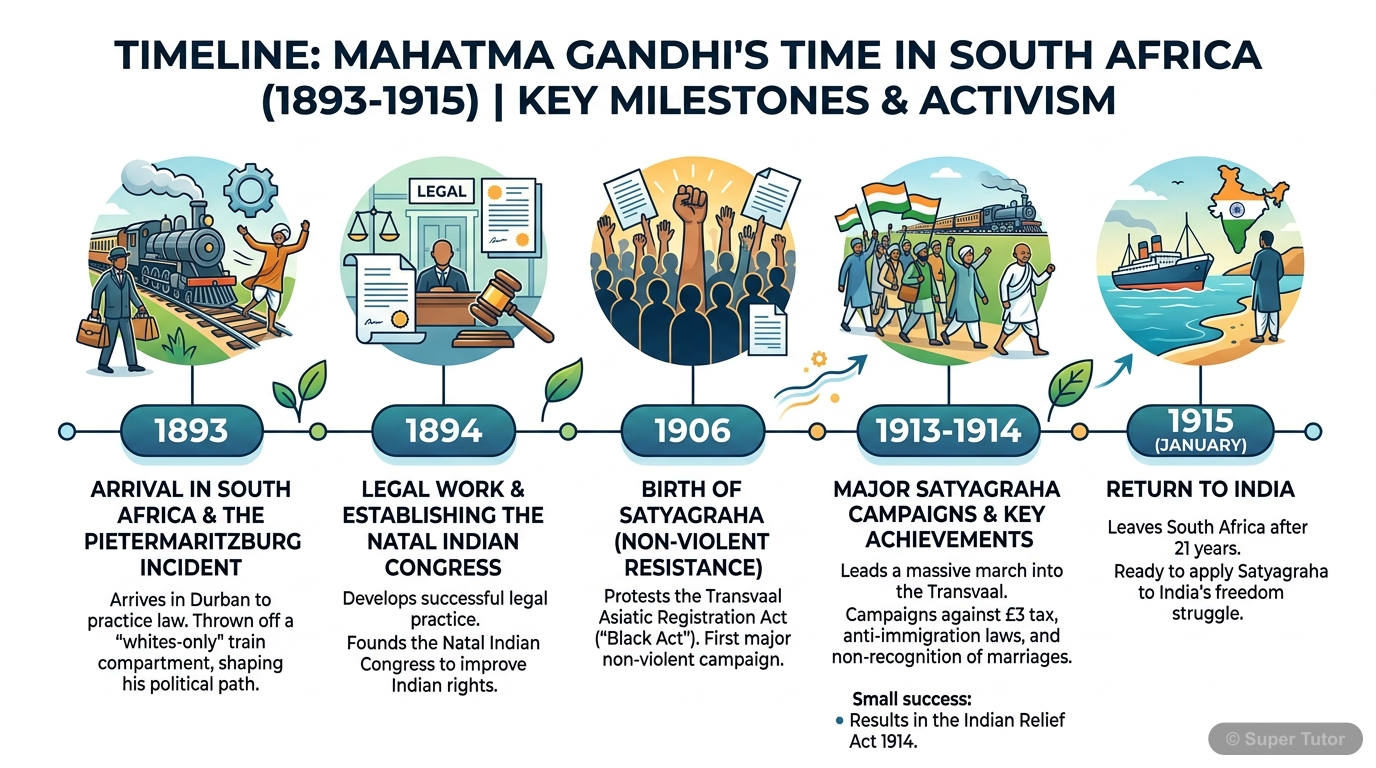
One of 11 illustrations for Mahatma Gandhi and the Nationalist Movement: Civil Disobedience and Beyond in Super Tutor — alongside flashcards, concept maps and practice questions.
See them allThe first 5 solutions are open to read. The other 4 are free with a Super Tutor account. Unlock all 9 free in Super Tutor
Answer in 100-150 Words
1How did Mahatma Gandhi seek to identify with the common people?Show solution
Gandhiji sought to identify with common people by living like them and dressing like them. He wore a simple dhoti or loincloth instead of formal clothes, shaved his head, and worked daily on the charkha. He also spoke in the mother tongue, travelled widely to know the land and its people, and stressed issues of peasants, workers, untouchables, and women. In this way he broke the distance between the leader and the ordinary people.
Not sure why a step works? check your working in Super Tutor
2How was Mahatma Gandhi perceived by the peasants?Show solution
The peasants saw Mahatma Gandhi as a saviour and often called him “Gandhi baba,” “Gandhi Maharaj,” or simply “Mahatma”. They believed he would rescue them from high taxes and oppressive officials and restore dignity and autonomy to their lives. Many also thought he had miraculous powers, such as the power to punish those who opposed him or to solve their problems.
Not sure why a step works? check your working in Super Tutor
3Why did the salt laws become an important issue of struggle?Show solution
The salt laws became an important issue of struggle because salt was indispensable in every Indian household, yet Indians were forbidden to make even salt for domestic use and had to buy it at a high price from the government. Gandhi chose salt because the state monopoly over salt was deeply unpopular and could mobilise widespread discontent against British rule. He also argued that the salt tax was especially oppressive because it taxed a vital necessity and burdened even a starving people.
Not sure why a step works? check your working in Super Tutor
4Why are newspapers an important source for the study of the national movement?Show solution
Newspapers are important because they tracked Mahatma Gandhi’s movements, reported on his activities, and reflected what ordinary Indians thought of him. They help historians see how events were publicly represented and how the movement spread in different regions. At the same time, newspapers show the political opinions, fears, and hopes of the people who wrote them, so they are valuable sources for understanding the national movement.
Not sure why a step works? check your working in Super Tutor
5Why was the charkha chosen as a symbol of nationalism?Show solution
The charkha was chosen as a symbol of nationalism because Gandhi saw it as a sign of a self-reliant India. Spinning could provide the poor with supplementary income, and khadi encouraged the use of cloth made by Indians themselves rather than imported mill cloth. Gandhi also used the charkha to symbolise opposition to the consumerist and machine-dominated modern world and to break the divide between mental and manual labour.
Not sure why a step works? check your working in Super Tutor
Write a Short Essay
Free with a Super Tutor account
Free with a Super Tutor account
Free with a Super Tutor account
Free with a Super Tutor account
4 more solved questions in Mahatma Gandhi and the Nationalist Movement: Civil Disobedience and Beyond
They are free with a Super Tutor account, along with practice quizzes and flashcards for this chapter. Free to start, no card needed.
Frequently Asked Questions
What are the important topics in Mahatma Gandhi and the Nationalist Movement: Civil Disobedience and Beyond for CBSE Class 12 History?
Are these NCERT Solutions for Mahatma Gandhi and the Nationalist Movement: Civil Disobedience and Beyond free?
How should I revise Mahatma Gandhi and the Nationalist Movement: Civil Disobedience and Beyond for the CBSE Class 12 board exam?
Sources & Official References
- NCERT Official — ncert.nic.in
- CBSE Academic — cbseacademic.nic.in
- CBSE Official — cbse.gov.in
- National Education Policy 2020 — education.gov.in
Content is aligned to the official syllabus. Refer to the board website for the latest curriculum.
More resources for Mahatma Gandhi and the Nationalist Movement: Civil Disobedience and Beyond
Practice Quiz
Test yourself with a quick quiz
Important Questions
Exam-style questions with answers
Revision Notes
Key points for last-minute revision
Chapter Summary
Understand the chapter at a glance
Concept Maps
See how topics connect
Study Plan
Step-by-step plan for this chapter
Flashcards
Quick-fire cards for active recall
Syllabus
What topics to cover
For serious students
Get the full Mahatma Gandhi and the Nationalist Movement: Civil Disobedience and Beyond chapter — start free.
Quizzes, flashcards, an AI doubt solver and a study plan for CBSE Class 12 History. Free to start, no card needed.