Rebels and the Raj: 1857 Revolt and its Representations — NCERT Solutions
CBSE · Class 12 · History
NCERT Solutions for Rebels and the Raj: 1857 Revolt and its Representations, CBSE Class 12 History: 10 textbook questions solved step by step.
Interactive on Super Tutor
Studying Rebels and the Raj: 1857 Revolt and its Representations? Get the full interactive chapter.
Quizzes, flashcards, AI doubt-solver and a step-by-step study plan — built for NCERT solutions and more.
Free trial, no card needed.
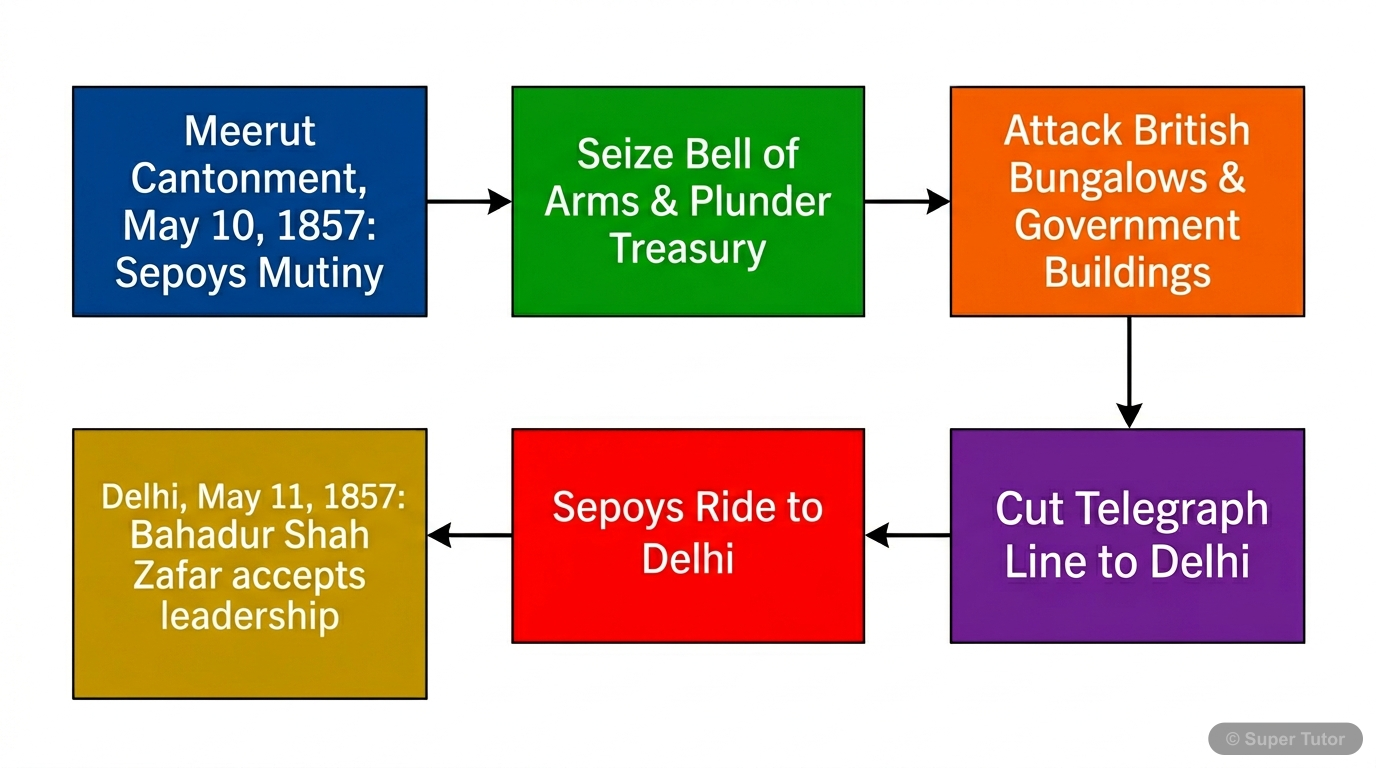
One of 12 illustrations for Rebels and the Raj: 1857 Revolt and its Representations in Super Tutor — alongside flashcards, concept maps and practice questions.
See them allThe first 5 solutions are open to read. The other 5 are free with a Super Tutor account. Unlock all 10 free in Super Tutor
Exercises
1Why did the mutinous sepoys in many places turn to erstwhile rulers to provide leadership to the revolt?Show solution
The mutinous sepoys turned to erstwhile rulers because they needed legitimacy, leadership and organisation for the revolt. The rebels often looked back to those who had ruled before the British conquest. In Delhi, the sepoys appealed to Bahadur Shah, the old Mughal emperor, and once he accepted even a nominal leadership, the rebellion gained legitimacy. In Kanpur, Nana Sahib was compelled to lead, and in Jhansi the rani was pushed by popular pressure to take charge. In Awadh, people hailed Birjis Qadr, the Nawab’s son, as leader. These rulers were seen as symbols of the pre-British order, so their names could unite different sections against firangi raj.
Not sure why a step works? check your working in Super Tutor
2Discuss the evidence that indicates planning and coordination on the part of the rebels.Show solution
There is evidence that the revolt was planned and coordinated. The chapter says sepoys communicated between cantonments: after the 7th Awadh Irregular Cavalry refused cartridges, they wrote to the 48th Native Infantry that they had acted for the faith and awaited orders. Sepoys and emissaries moved from one station to another. A similar pattern appeared in many places, suggesting common signals such as the firing of the evening gun or bugle. The incident of the panchayat in the Awadh Military Police also shows collective decision-making; Charles Ball noted panchayats were nightly occurrences in Kanpur sepoy lines. The conversation between Sisten and the tahsildar also suggests that plans were being discussed secretly. So, the rebels were not acting at random; some decisions were made collectively and communication spread the uprising from one place to another.
Not sure why a step works? check your working in Super Tutor
3Discuss the extent to which religious beliefs shaped the events of 1857.Show solution
Religious beliefs strongly influenced the events of 1857, though they were not the only cause. The immediate trigger was the rumour about cartridges greased with the fat of cows and pigs, which sepoys believed would destroy the faith of both Hindus and Muslims. Another rumour said British flour had been mixed with bone dust of cows and pigs, and people feared conversion to Christianity. Prophecies such as British rule ending on the centenary of Plassey and the circulation of chapattis also encouraged belief that something decisive was about to happen. Rebel proclamations appealed to both communities, asking them to fight under the standards of Muhammad and Mahavir. So religion shaped the revolt deeply, mainly by creating fear, unity and urgency, but it worked together with grievances about land, pay, and British policies.
Not sure why a step works? check your working in Super Tutor
4What were the measures taken to ensure unity among the rebels?Show solution
Unity among the rebels was encouraged in several ways. Rebel proclamations repeatedly appealed to Hindus and Muslims together and emphasised the common fight against firangi raj. They used Hindi, Urdu and Persian so that messages could reach many people. The proclamations invoked both Muhammad and Mahavir, and tried to revive memories of the pre-British Mughal past. Leaders also came from different social groups—princes, rajas, maulvis, fakirs, local chiefs and even ordinary villagers—so the revolt could connect many communities. In Awadh and elsewhere, rebels and peasants attacked moneylenders, traders and British symbols to create a shared opposition to oppression. The rebels also set up local command structures and tried to stop loot and plunder, showing an effort to keep the movement united and disciplined.
Not sure why a step works? check your working in Super Tutor
5What steps did the British take to quell the uprising?Show solution
The British used both law and military force to suppress the uprising. Before sending troops, they passed special acts in May and June 1857 that put North India under martial law and allowed military officers and even ordinary Britons to punish suspected rebels; rebellion was to be punished by death. They then launched a two-pronged military attack on Delhi, one force coming from Calcutta and the other from the Punjab. They reconquered territory village by village, since the countryside was hostile. In Awadh, they also tried to split rebels from local landholders by promising to restore estates to loyal landholders. Rebel landholders were dispossessed and the loyal rewarded. The British used this combination of repression, reinforcements, and divide-and-rule tactics to crush the revolt.
Not sure why a step works? check your working in Super Tutor
Free with a Super Tutor account
Free with a Super Tutor account
Free with a Super Tutor account
Free with a Super Tutor account
Free with a Super Tutor account
5 more solved questions in Rebels and the Raj: 1857 Revolt and its Representations
They are free with a Super Tutor account, along with practice quizzes and flashcards for this chapter. Free to start, no card needed.
Frequently Asked Questions
What are the important topics in Rebels and the Raj: 1857 Revolt and its Representations for CBSE Class 12 History?
Are these NCERT Solutions for Rebels and the Raj: 1857 Revolt and its Representations free?
How should I revise Rebels and the Raj: 1857 Revolt and its Representations for the CBSE Class 12 board exam?
Sources & Official References
- NCERT Official — ncert.nic.in
- CBSE Academic — cbseacademic.nic.in
- CBSE Official — cbse.gov.in
- National Education Policy 2020 — education.gov.in
Content is aligned to the official syllabus. Refer to the board website for the latest curriculum.
More resources for Rebels and the Raj: 1857 Revolt and its Representations
Practice Quiz
Test yourself with a quick quiz
Important Questions
Exam-style questions with answers
Revision Notes
Key points for last-minute revision
Chapter Summary
Understand the chapter at a glance
Concept Maps
See how topics connect
Study Plan
Step-by-step plan for this chapter
Flashcards
Quick-fire cards for active recall
Syllabus
What topics to cover
For serious students
Get the full Rebels and the Raj: 1857 Revolt and its Representations chapter — start free.
Quizzes, flashcards, an AI doubt solver and a study plan for CBSE Class 12 History. Free to start, no card needed.