Colonialism and the Countryside: Exploring Official Archives — NCERT Solutions
CBSE · Class 12 · History
NCERT Solutions for Colonialism and the Countryside: Exploring Official Archives, CBSE Class 12 History: 9 textbook questions solved step by step.
Interactive on Super Tutor
Studying Colonialism and the Countryside: Exploring Official Archives? Get the full interactive chapter.
Quizzes, flashcards, AI doubt-solver and a step-by-step study plan — built for NCERT solutions and more.
Free trial, no card needed.
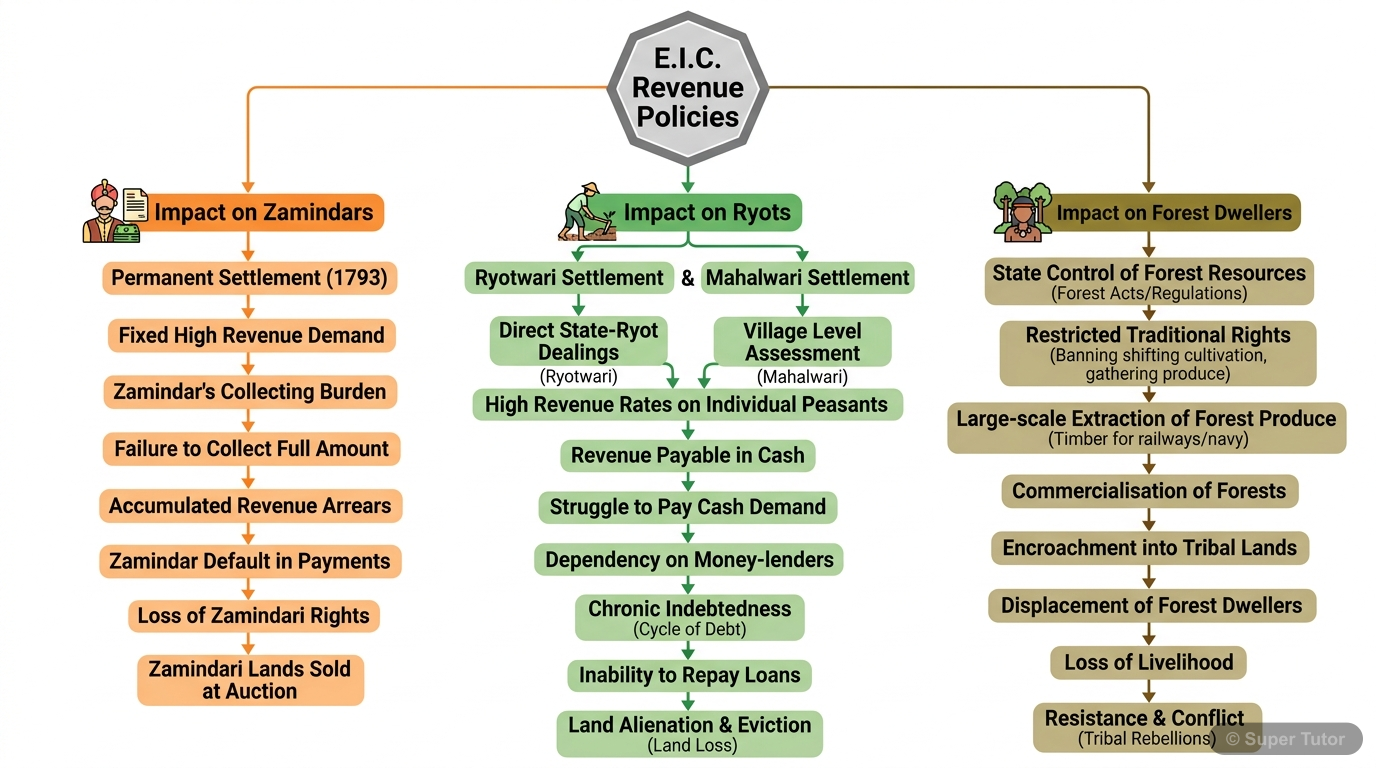
Learn better with visuals Super Tutor pairs illustrations like this with notes and quizzes for Colonialism and the Countryside: Exploring Official Archives.
Get startedThe first 5 solutions are open to read. The other 4 are free with a Super Tutor account. Unlock all 9 free in Super Tutor
Answer in 100-150 Words
1Why was the jotedar a powerful figure in many areas of rural Bengal?Show solution
The jotedars became powerful because they were rich peasants who had acquired vast areas of land, sometimes several thousand acres. They also controlled local trade and moneylending, so they had economic power over poorer cultivators. Much of their land was worked by sharecroppers who gave them half the produce. Since jotedars lived in the villages, unlike many zamindars who lived in towns, they had direct control over poor villagers. They could mobilise dependent ryots, resist zamindari attempts to raise revenue demand, and even buy estates when zamindaris were auctioned. All this made their power in rural Bengal stronger than that of the zamindars in many places.
Not sure why a step works? check your working in Super Tutor
2How did zamindars manage to retain control over their zamindaris?Show solution
Zamindars managed to retain control by using fictitious sales and other manipulations. For example, the Raja of Burdwan first transferred some property to his mother, because women’s property was not to be taken over. Then his agents manipulated auctions: they bought the estate, did not pay the purchase money, forced resale, and repeated this until the estate was bought back cheaply by the zamindar’s men. Zamindars also used lathyals to attack outsiders’ agents, and many ryots resisted outsiders because they felt loyal to their own zamindar as their proja or subject. Thus, even when estates were auctioned, zamindars often remained in effective control.
Not sure why a step works? check your working in Super Tutor
3How did the Paharias respond to the coming of outsiders?Show solution
The Paharias responded to outsiders with suspicion, hostility, and resistance. They often became apprehensive and unwilling to talk to officials, and sometimes deserted their villages. They resisted intrusion into their forests and lands, and when colonial pressure increased, they withdrew deeper into the hills to protect themselves. They also continued to raid the plains when necessary, both for survival and to assert their power over settled communities. In short, they did not accept outsiders passively; they resisted them through withdrawal, raiding, and refusal to give up their way of life.
Not sure why a step works? check your working in Super Tutor
4Why did the Santhals rebel against British rule?Show solution
The Santhals rebelled because they found that the land they had cleared was slipping away from them. The colonial state imposed heavy taxes on their land, moneylenders (dikus) charged high rates of interest and took over land when debts were not repaid, and zamindars began asserting control over the Damin area. The Santhals had earlier been encouraged to settle and cultivate, but later they faced oppression from all sides. By the 1850s they felt they had to rebel against the zamindars, moneylenders, and colonial rule to create an ideal world for themselves.
Not sure why a step works? check your working in Super Tutor
5What explains the anger of the Deccan ryots against the moneylenders?Show solution
The anger of the Deccan ryots came from indebtedness, harsh revenue demands, and the oppressive practices of moneylenders. Revenue was high and difficult to pay, especially when harvests failed and prices fell. To pay revenue, ryots had to borrow, but then debt kept mounting. Moneylenders charged high interest, refused loans when ryots needed them most, and used bonds, deeds, and false accounts to trap peasants further. They often did not give receipts, entered fictitious figures, and took peasants’ harvest and property. What enraged ryots was also the sense that moneylenders were violating customary norms of fairness, especially the idea that interest should not exceed the principal.
Not sure why a step works? check your working in Super Tutor
Write a Short Essay
Free with a Super Tutor account
Free with a Super Tutor account
Free with a Super Tutor account
Free with a Super Tutor account
4 more solved questions in Colonialism and the Countryside: Exploring Official Archives
They are free with a Super Tutor account, along with practice quizzes and flashcards for this chapter. Free to start, no card needed.
Frequently Asked Questions
What are the important topics in Colonialism and the Countryside: Exploring Official Archives for CBSE Class 12 History?
Are these NCERT Solutions for Colonialism and the Countryside: Exploring Official Archives free?
How should I revise Colonialism and the Countryside: Exploring Official Archives for the CBSE Class 12 board exam?
Sources & Official References
- NCERT Official — ncert.nic.in
- CBSE Academic — cbseacademic.nic.in
- CBSE Official — cbse.gov.in
- National Education Policy 2020 — education.gov.in
Content is aligned to the official syllabus. Refer to the board website for the latest curriculum.
More resources for Colonialism and the Countryside: Exploring Official Archives
Practice Quiz
Test yourself with a quick quiz
Important Questions
Exam-style questions with answers
Revision Notes
Key points for last-minute revision
Chapter Summary
Understand the chapter at a glance
Concept Maps
See how topics connect
Study Plan
Step-by-step plan for this chapter
Flashcards
Quick-fire cards for active recall
Syllabus
What topics to cover
For serious students
Get the full Colonialism and the Countryside: Exploring Official Archives chapter — start free.
Quizzes, flashcards, an AI doubt solver and a study plan for CBSE Class 12 History. Free to start, no card needed.