Peasants, Zamindars and the State: Agrarian Society and the Mughal Empire — NCERT Solutions
CBSE · Class 12 · History
NCERT Solutions for Peasants, Zamindars and the State: Agrarian Society and the Mughal Empire, CBSE Class 12 History: 9 textbook questions solved step by.
Interactive on Super Tutor
Studying Peasants, Zamindars and the State: Agrarian Society and the Mughal Empire? Get the full interactive chapter.
Quizzes, flashcards, AI doubt-solver and a step-by-step study plan — built for NCERT solutions and more.
Free trial, no card needed.
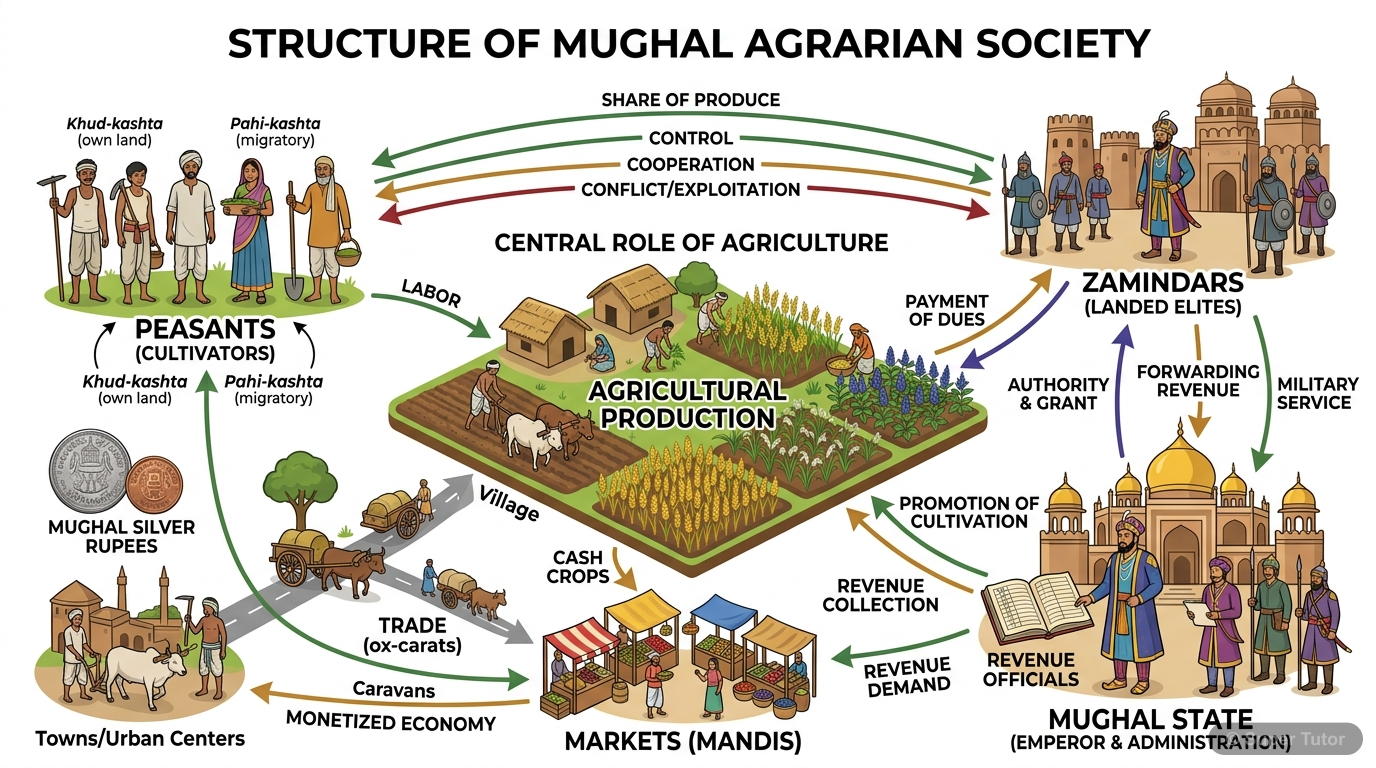
One of 11 illustrations for Peasants, Zamindars and the State: Agrarian Society and the Mughal Empire in Super Tutor — alongside flashcards, concept maps and practice questions.
See them allThe first 5 solutions are open to read. The other 4 are free with a Super Tutor account. Unlock all 9 free in Super Tutor
Answer in 100-150 Words
1What are the problems in using the Ain as a source for reconstructing agrarian history? How do historians deal with this situation?Show solution
The Ain-i Akbari is a very important source, but it has several limitations for reconstructing agrarian history:
- It is a court-sponsored text, so it presents a view from the top, not from peasants themselves.
- Its central purpose was to show Akbar’s empire as orderly and harmonious, so it may downplay conflict and resistance.
- The quantitative data are not uniform for all regions; for example, some subas have detailed caste information for zamindars, but Bengal and Orissa do not.
- Some figures contain minor arithmetic or transcription errors.
- Important data like prices and wages are not equally available for all regions, and some of what is given is mainly from areas around Agra.
Historians deal with these problems by cross-checking the Ain with other sources such as revenue records from Gujarat, Maharashtra and Rajasthan, and East India Company records from eastern India. They also compare it with regional sources to find instances of conflict and to understand peasants’ ideas of fairness. In this way, the Ain is used carefully, along with other evidence, rather than by itself.
Not sure why a step works? check your working in Super Tutor
2To what extent is it possible to characterise agricultural production in the sixteenth-seventeenth centuries as subsistence agriculture? Give reasons for your answer.Show solution
Agricultural production in the sixteenth and seventeenth centuries was not purely subsistence-based; it combined subsistence and commercial agriculture.
On the one hand, peasants cultivated basic food crops such as rice, wheat and millets, which fed the population. Most regions produced at least two crops a year because of the kharif and rabi seasons.
On the other hand, many crops were grown for the market. The text mentions jins-i kamil or “perfect crops,” which were encouraged by the Mughal state because they brought in more revenue. Examples are cotton and sugarcane, as well as oilseeds and pulses. New crops such as maize, tomatoes, potatoes, chillies, pineapple and papaya also appeared.
So agriculture was partly subsistence-oriented, but a large part of production was tied to trade, cash income and state revenue. Hence it is only partly correct to call it subsistence agriculture.
Not sure why a step works? check your working in Super Tutor
3Describe the role played by women in agricultural production.Show solution
Women played a crucial role in agricultural production. They worked alongside men in the fields: while men tilled and ploughed, women sowed, weeded, threshed and winnowed the harvest.
Women were also important in artisan and household production. They spun yarn, sifted and kneaded clay for pottery, and did embroidery. In commercialised production, women often worked even more intensively, not only in fields but also in the houses of employers or in markets.
The chapter also shows that women were valued as reproductive labour in a society dependent on labour, though this led to strict control over them. High mortality among women and the need for labour gave women social importance, and in some peasant and artisan communities bride-price and widow remarriage were common.
Among landed groups, women could also inherit and sell property, and some even held zamindaris. So women were not confined to domestic work; they were active economic participants in agrarian society.
Not sure why a step works? check your working in Super Tutor
4Discuss, with examples, the significance of monetary transactions during the period under consideration.Show solution
Monetary transactions were very significant in this period because cash entered rural life deeply.
- Revenue in the Mughal heartland was often assessed and collected in cash.
- Traders linked villages with towns, so agriculture was tied to markets.
- Artisans and commercial producers were often paid in cash; for example, weavers producing for export markets received advances or wages in money.
- The chapter notes that even in villages there were shroffs or money-changers, who acted like bankers and handled remittances and exchange.
- The circulation of silver rupya increased because silver bullion flowed into India through overseas trade.
Thus money was not limited to towns; it became part of village and agrarian life, helping trade, taxation and the expansion of the economy.
Not sure why a step works? check your working in Super Tutor
5Examine the evidence that suggests that land revenue was important for the Mughal fiscal system.Show solution
The chapter gives strong evidence that land revenue was the mainstay of Mughal finance.
- It says directly that revenue from land was the economic mainstay of the Mughal Empire.
- The state created a whole administrative apparatus for this purpose, including the diwan, amil-guzar, amins, record keepers and assessors.
- The state first tried to measure cultivated and cultivable land, and then fixed revenue through assessment and collection.
- The Ain lists land categories such as polaj, parauti, chachar and banjar, showing how carefully land was classified for taxation.
- Revenue was usually fixed at about one-third of the average produce for good lands.
- The state tried to realise revenue in cash, though payment in kind was also permitted.
- Aurangzeb’s order shows that officials were to survey villages peasant-wise and assess jama with attention to government interests and peasant welfare.
All this shows that the Mughal state paid close attention to land revenue because it was the chief source of income.
Not sure why a step works? check your working in Super Tutor
Write a Short Essay (about 250-300 Words) on the Following:
Free with a Super Tutor account
Free with a Super Tutor account
Free with a Super Tutor account
Free with a Super Tutor account
4 more solved questions in Peasants, Zamindars and the State: Agrarian Society and the Mughal Empire
They are free with a Super Tutor account, along with practice quizzes and flashcards for this chapter. Free to start, no card needed.
Frequently Asked Questions
What are the important topics in Peasants, Zamindars and the State: Agrarian Society and the Mughal Empire for CBSE Class 12 History?
Are these NCERT Solutions for Peasants, Zamindars and the State: Agrarian Society and the Mughal Empire free?
How should I revise Peasants, Zamindars and the State: Agrarian Society and the Mughal Empire for the CBSE Class 12 board exam?
Sources & Official References
- NCERT Official — ncert.nic.in
- CBSE Academic — cbseacademic.nic.in
- CBSE Official — cbse.gov.in
- National Education Policy 2020 — education.gov.in
Content is aligned to the official syllabus. Refer to the board website for the latest curriculum.
More resources for Peasants, Zamindars and the State: Agrarian Society and the Mughal Empire
Practice Quiz
Test yourself with a quick quiz
Important Questions
Exam-style questions with answers
Revision Notes
Key points for last-minute revision
Formula Sheet
The chapter's formulas in one place
Chapter Summary
Understand the chapter at a glance
Concept Maps
See how topics connect
Study Plan
Step-by-step plan for this chapter
Flashcards
Quick-fire cards for active recall
Syllabus
What topics to cover
For serious students
Get the full Peasants, Zamindars and the State: Agrarian Society and the Mughal Empire chapter — start free.
Quizzes, flashcards, an AI doubt solver and a study plan for CBSE Class 12 History. Free to start, no card needed.