Bhakti - Sufi Traditions: Changes in Religious Beliefs and Devotional Texts — NCERT Solutions
CBSE · Class 12 · History
NCERT Solutions for Bhakti - Sufi Traditions: Changes in Religious Beliefs and Devotional Texts, CBSE Class 12 History: 8 textbook questions solved step.
Interactive on Super Tutor
Studying Bhakti - Sufi Traditions: Changes in Religious Beliefs and Devotional Texts? Get the full interactive chapter.
Quizzes, flashcards, AI doubt-solver and a step-by-step study plan — built for NCERT solutions and more.
Free trial, no card needed.
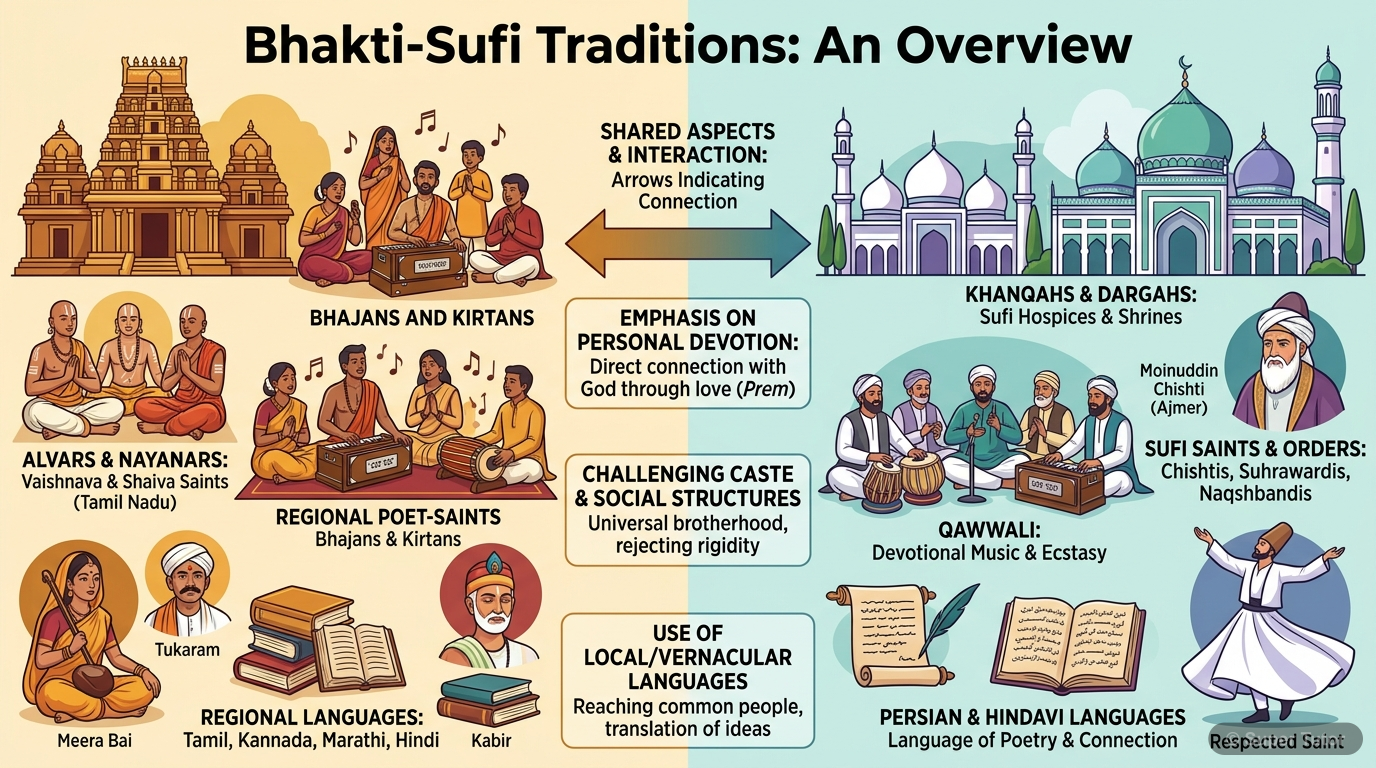
One of 15 illustrations for Bhakti - Sufi Traditions: Changes in Religious Beliefs and Devotional Texts in Super Tutor — alongside flashcards, concept maps and practice questions.
See them allThe first 4 solutions are open to read. The other 4 are free with a Super Tutor account. Unlock all 8 free in Super Tutor
Answer in 100-150 Words
1Explain with examples what historians mean by the integration of cults.Show solution
Historians use the phrase integration of cults to mean the process by which local religious beliefs and practices were absorbed into larger Brahmanical/Puranic traditions and reinterpreted within them. This happened through a continuous dialogue between “great” Sanskritic traditions and “little” local traditions.
For example:
- At Puri, the local deity Jagannatha was recognised by the twelfth century as a form of Vishnu.
- Local goddess worship, often of a stone smeared with ochre, was incorporated by identifying the goddess as the wife of a major deity, such as Lakshmi or Parvati.
- Tantric beliefs and practices, which were widespread and open to women and men, also influenced Shaivism and Buddhism.
So, integration of cults means that different religious practices did not remain separate; instead, they mixed, changed, and were brought within a wider Hindu framework over time.
Not sure why a step works? check your working in Super Tutor
2To what extent do you think the architecture of mosques in the subcontinent reflects a combination of universal ideals and local traditions?Show solution
The architecture of mosques in the subcontinent reflects both universal Islamic ideals and local traditions.
The universal features are the same everywhere:
- The mosque faces Mecca.
- It has a mihrab (prayer niche) and minbar (pulpit).
But there are also clear local variations:
- In Kerala, a mosque had a shikhara-like roof.
- In Bangladesh, the Atiya mosque was built with brick.
- In Kashmir, the Shah Hamadan mosque used wooden architecture, with a spire and carved eaves.
This shows that while the religious purpose of mosques remained the same, their building styles adapted to local materials, climate, and regional artistic traditions. So, mosque architecture in the subcontinent is a blend of a shared Islamic ideal and regional variety.
Not sure why a step works? check your working in Super Tutor
3What were the similarities and differences between the be-shari'a and ba-shari'a sufi traditions?Show solution
The be-shari'a and ba-shari'a traditions were both part of Sufism, but they differed in their attitude to Islamic law.
Similarities:
- Both sought closeness to God through devotion, asceticism, and spiritual discipline.
- Both belonged to the wider Sufi search for divine love and spiritual experience.
Differences:
- Ba-shari'a sufis followed the shari'a and accepted its rules.
- Be-shari'a sufis deliberately defied the shari'a.
- The be-shari'a mystics such as Qalandars, Madaris, Malangs and Haidaris rejected rituals, practised extreme asceticism, sometimes took to mendicancy, and observed celibacy.
- The ba-shari'a sufis worked within the framework of accepted Islamic law.
Thus, both were Sufis, but one group remained within the law while the other consciously moved outside it in search of spiritual truth.
Not sure why a step works? check your working in Super Tutor
4Discuss the ways in which the Alvars, Nayanars and Virashaivas expressed critiques of the caste system.Show solution
The Alvars, Nayanars and Virashaivas criticised the caste system by emphasising devotion over birth and by challenging Brahmanical ideas of purity and hierarchy.
- The Alvars and Nayanars came from varied backgrounds, including Brahmanas, artisans, cultivators and even “untouchable” castes. Their hymns showed that devotion was open to all.
- In the hymns of the Nayanars, saints sometimes rejected the importance of gotra, kula, and formal learning, and asked devotees simply to surrender to Shiva.
- Some Alvar compositions suggest that those who served Vishnu with love were better than learned Chaturvedins who lacked devotion.
- The Virashaivas or Lingayats directly challenged caste and the pollution attached to certain groups. They also rejected Brahmanical ideas like the authority of the Dharmashastras.
- They supported practices disapproved of by orthodox society, such as remarriage of widows and post-puberty marriage.
Overall, these movements argued that spiritual worth came from devotion and conduct, not caste birth.
Not sure why a step works? check your working in Super Tutor
Free with a Super Tutor account
Write a Short Essay (about 250-300 Words) on the Following:
Free with a Super Tutor account
Free with a Super Tutor account
Free with a Super Tutor account
4 more solved questions in Bhakti - Sufi Traditions: Changes in Religious Beliefs and Devotional Texts
They are free with a Super Tutor account, along with practice quizzes and flashcards for this chapter. Free to start, no card needed.
Frequently Asked Questions
What are the important topics in Bhakti - Sufi Traditions: Changes in Religious Beliefs and Devotional Texts for CBSE Class 12 History?
Are these NCERT Solutions for Bhakti - Sufi Traditions: Changes in Religious Beliefs and Devotional Texts free?
How should I revise Bhakti - Sufi Traditions: Changes in Religious Beliefs and Devotional Texts for the CBSE Class 12 board exam?
Sources & Official References
- NCERT Official — ncert.nic.in
- CBSE Academic — cbseacademic.nic.in
- CBSE Official — cbse.gov.in
- National Education Policy 2020 — education.gov.in
Content is aligned to the official syllabus. Refer to the board website for the latest curriculum.
More resources for Bhakti - Sufi Traditions: Changes in Religious Beliefs and Devotional Texts
Practice Quiz
Test yourself with a quick quiz
Important Questions
Exam-style questions with answers
Revision Notes
Key points for last-minute revision
Chapter Summary
Understand the chapter at a glance
Concept Maps
See how topics connect
Study Plan
Step-by-step plan for this chapter
Flashcards
Quick-fire cards for active recall
Syllabus
What topics to cover
For serious students
Get the full Bhakti - Sufi Traditions: Changes in Religious Beliefs and Devotional Texts chapter — start free.
Quizzes, flashcards, an AI doubt solver and a study plan for CBSE Class 12 History. Free to start, no card needed.