Kings, Farmers and Towns (Early States and Economies) (c.600 BCE-600 CE) — NCERT Solutions
CBSE · Class 12 · History
NCERT Solutions for Kings, Farmers and Towns (Early States and Economies) (c.600 BCE-600 CE), CBSE Class 12 History: 10 textbook questions solved step by.
Interactive on Super Tutor
Studying Kings, Farmers and Towns (Early States and Economies) (c.600 BCE-600 CE)? Get the full interactive chapter.
Quizzes, flashcards, AI doubt-solver and a step-by-step study plan — built for NCERT solutions and more.
Free trial, no card needed.
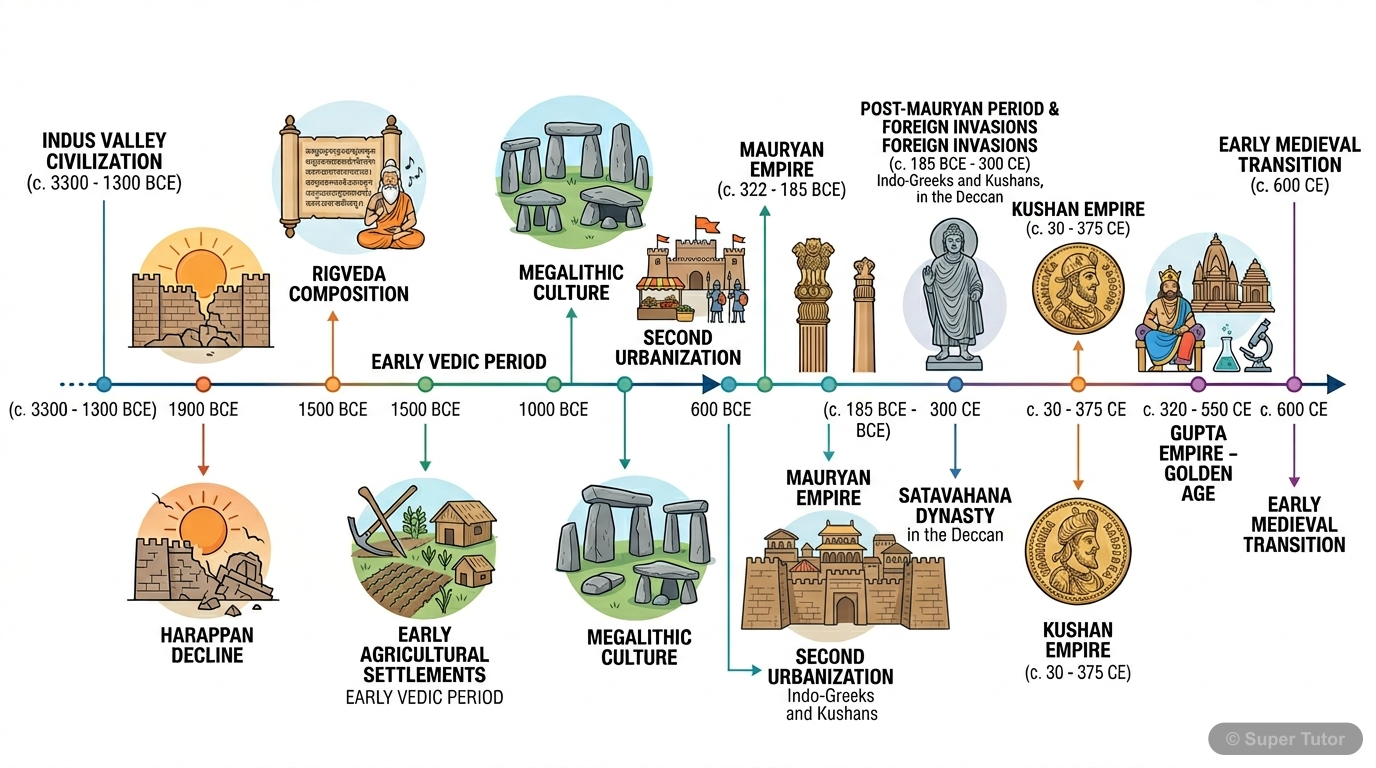
One of 18 illustrations for Kings, Farmers and Towns (Early States and Economies) (c.600 BCE-600 CE) in Super Tutor — alongside flashcards, concept maps and practice questions.
See them allThe first 5 solutions are open to read. The other 5 are free with a Super Tutor account. Unlock all 10 free in Super Tutor
Answer in 100-150 Words
1Discuss the evidence of craft production in Early Historic cities. In what ways is this different from the evidence from Harappan cities?Show solution
Evidence of craft production in early historic cities comes from votive inscriptions, artefacts and references to guilds. Inscriptions from the second century BCE mention people such as weavers, potters, goldsmiths, blacksmiths, carpenters, scribes, washing folk and merchants. Excavations have also yielded a wide range of objects made of gold, silver, copper, bronze, ivory, glass, shell and terracotta, showing specialised craft activity. Guilds or shrenis may have procured raw materials, regulated production and marketed finished goods.
This differs from Harappan evidence. In Harappan cities, craft production is known largely from archaeological remains such as workshops, tools, seals, beads and pottery, whereas for early historic cities we also have written evidence like inscriptions naming occupations and donors. Another difference is that Harappan urban craft production belongs to an earlier period, while early historic cities show craft production linked more closely with trade, urban elites and guild organisation.
Not sure why a step works? check your working in Super Tutor
2Describe the salient features of mahajanapadas.Show solution
The mahajanapadas were the sixteen important states mentioned in early Buddhist and Jaina texts. Their salient features were:
- They emerged around the sixth century BCE, a period of early states, cities, iron use and coinage.
- Each had a capital city, often fortified.
- Most were ruled by kings, but some were gana/sangha oligarchies where power was shared by a group of men called rajas.
- They needed resources to maintain fortified capitals, armies and bureaucracies.
- Rulers were advised to collect taxes and tribute from cultivators, traders and artisans, and sometimes by raids on neighbouring states.
- Some states, such as Magadha, became especially powerful because of productive agriculture, iron resources, elephants and good communication routes.
Important names mentioned in the text include Vajji, Magadha, Koshala, Kuru, Panchala, Gandhara and Avanti.
Not sure why a step works? check your working in Super Tutor
3How do historians reconstruct the lives of ordinary people?Show solution
Historians reconstruct the lives of ordinary people by using sources that record everyday social and economic life, not just kings. In this chapter, they use:
- Stories such as the Jatakas and Panchatantra, which probably began as oral tales.
- Sangam literature, which mentions different kinds of rural people such as vellalar, uzhavar and adimai.
- Inscriptions, especially votive inscriptions naming donors and their occupations.
- Legal texts such as the Manusmrti, which discuss disputes over land and boundaries.
- Land-grant inscriptions, like the record of Prabhavati Gupta, which reveal peasants, Brahmanas and dues owed.
- Travel accounts and literary texts, such as the Harshacharita and the Periplus, which describe villages, forests, trade and occupations.
Since ordinary people rarely wrote about themselves, historians compare many kinds of evidence to infer their lives, work, social status and relations with rulers.
Not sure why a step works? check your working in Super Tutor
4Compare and contrast the list of things given to the Pandyan chief (Source 3) with those produced in the village of Danguna (Source 8). Do you notice any similarities or differences?Show solution
The gifts to the Pandyan chief Senguttuvan in Source 3 and the produce of Danguna in Source 8 show both similarities and differences.
Similarities:
- Both lists include forest and agricultural products.
- Both mention items like fruits, honey, flowers, medicinal plants and other natural goods.
- Both suggest a close relationship between rulers/chiefs and rural or forest communities, who supplied goods.
Differences:
- Source 3 is a tribute list to a chief and includes many luxurious and exotic items such as ivory, fragrant wood, sandalwood, pepper, cardamom, gemstones, and even animals like tigers, elephants and monkeys.
- Source 8 lists the produce and dues of a village: grass, hides, charcoal, flowers, milk, salt-related rights, mines, trees, hidden treasures and taxes. It is more like an administrative record of rights and obligations.
- Source 3 is more about gifts and prestige, while Source 8 is about land revenue, exemptions and control over village resources.
So, the first is a literary description of tribute and abundance, while the second is a legal inscription about village production and taxation.
Not sure why a step works? check your working in Super Tutor
5List some of the problems faced by epigraphists.Show solution
Some of the main problems faced by epigraphists are:
- Letters may be faintly engraved or damaged, so reading is uncertain.
- Parts of inscriptions may be missing, making reconstruction difficult.
- The exact meaning of words may be unclear, especially when terms are specific to a place or period.
- Many inscriptions have not survived at all.
- Even surviving inscriptions give only a partial view of the past because they usually record grand events and the point of view of the person who commissioned them.
So epigraphists must carefully compare readings, use palaeography, and cross-check inscriptions with other sources.
Not sure why a step works? check your working in Super Tutor
Write a Short Essay (about 500 Words) on the Following:
Free with a Super Tutor account
"There is no aspect of life, culture and activities of
the Indians that is not reflected in inscriptions."
Discuss.
Free with a Super Tutor account
post-Mauryan period.
Free with a Super Tutor account
transformed in the period under consideration?
Free with a Super Tutor account
Map Work
that might have been included in the Mauryan
Empire. Are any Asokan inscriptions found in these
areas?
Free with a Super Tutor account
5 more solved questions in Kings, Farmers and Towns (Early States and Economies) (c.600 BCE-600 CE)
They are free with a Super Tutor account, along with practice quizzes and flashcards for this chapter. Free to start, no card needed.
Frequently Asked Questions
What are the important topics in Kings, Farmers and Towns (Early States and Economies) (c.600 BCE-600 CE) for CBSE Class 12 History?
Are these NCERT Solutions for Kings, Farmers and Towns (Early States and Economies) (c.600 BCE-600 CE) free?
How should I revise Kings, Farmers and Towns (Early States and Economies) (c.600 BCE-600 CE) for the CBSE Class 12 board exam?
Sources & Official References
- NCERT Official — ncert.nic.in
- CBSE Academic — cbseacademic.nic.in
- CBSE Official — cbse.gov.in
- National Education Policy 2020 — education.gov.in
Content is aligned to the official syllabus. Refer to the board website for the latest curriculum.
More resources for Kings, Farmers and Towns (Early States and Economies) (c.600 BCE-600 CE)
Practice Quiz
Test yourself with a quick quiz
Important Questions
Exam-style questions with answers
Revision Notes
Key points for last-minute revision
Chapter Summary
Understand the chapter at a glance
Concept Maps
See how topics connect
Study Plan
Step-by-step plan for this chapter
Flashcards
Quick-fire cards for active recall
Syllabus
What topics to cover
For serious students
Get the full Kings, Farmers and Towns (Early States and Economies) (c.600 BCE-600 CE) chapter — start free.
Quizzes, flashcards, an AI doubt solver and a study plan for CBSE Class 12 History. Free to start, no card needed.