Atoms
CBSE · Class 12 · Physics
NCERT Solutions for Atoms — CBSE Class 12 Physics.
Interactive on Super Tutor
Studying Atoms? Get the full interactive chapter.
Quizzes, flashcards, AI doubt-solver and a step-by-step study plan — built for ncert solutions and more.
1,000+ Class 12 students started this chapter today
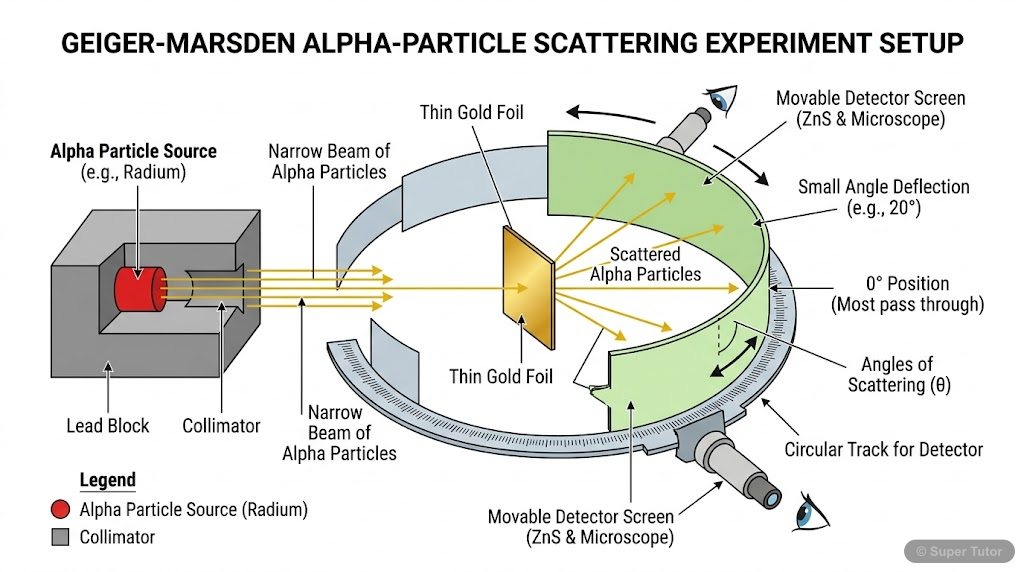
Learn better with visuals Super Tutor has hundreds of illustrations like this across every chapter — all free to try.
Get started7 worked solutions below. Unlock all 14 free in Super Tutor
EXERCISES
12.1(a)The size of the atom in Thomson's model is ... the atomic size in Rutherford's model.Show solution
Not sure why a step works? check your working in Super Tutor
12.1(b)In the ground state of ... electrons are in stable equilibrium, while in ... electrons always experience a net force.Show solution
Not sure why a step works? check your working in Super Tutor
12.1(c)A classical atom based on ... is doomed to collapse.Show solution
Not sure why a step works? check your working in Super Tutor
12.1(d)An atom has a nearly continuous mass distribution in a ... but has a highly non-uniform mass distribution in ...Show solution
Not sure why a step works? check your working in Super Tutor
12.1(e)The positively charged part of the atom possesses most of the mass in ...Show solution
Not sure why a step works? check your working in Super Tutor
12.2Suppose you are given a chance to repeat the alpha-particle scattering experiment using a thin sheet of solid hydrogen in place of the gold foil. (Hydrogen is a solid at temperatures below 14 K.) What results do you expect?Show solution
Not sure why a step works? check your working in Super Tutor
12.3A difference of 2.3 eV separates two energy levels in an atom. What is the frequency of radiation emitted when the atom make a transition from the upper level to the lower level?Show solution
Given energy difference, .
Convert to joules:
Now,
So the frequency is about ****.
Not sure why a step works? check your working in Super Tutor
7 more solved questions in Atoms
Every remaining exercise is solved step by step in Super Tutor, plus practice quizzes and flashcards for this chapter. Free to start.
Stuck on a step?
Ask Super Tutor AI to explain any solution on this page in a simpler way — free, 24x7.
Ask a Doubt FreeFrequently Asked Questions
What are the important topics in Atoms for CBSE Class 12 Physics?
How to score full marks in Atoms — CBSE Class 12 Physics?
Where can I get free NCERT Solutions for Atoms Class 12 Physics?
Sources & Official References
- NCERT Official — ncert.nic.in
- CBSE Academic — cbseacademic.nic.in
- CBSE Official — cbse.gov.in
- National Education Policy 2020 — education.gov.in
Content is aligned to the official syllabus. Refer to the board website for the latest curriculum.
More resources for Atoms
Practice Quiz
Test yourself with a quick quiz
Important Questions
Practice with board exam-style questions
Revision Notes
Key points for last-minute revision
Formula Sheet
All formulas in one place
Chapter Summary
Understand the chapter at a glance
Concept Maps
See how topics connect visually
Study Plan
Step-by-step plan to ace this chapter
Flashcards
Quick-fire cards for active recall
Syllabus
What topics to cover
For serious students
Get the full Atoms chapter — for free.
Quizzes, flashcards, AI doubt-solver and a step-by-step study plan for CBSE Class 12 Physics.