Electrostatic Potential and Capacitance
CBSE · Class 12 · Physics
NCERT Solutions for Electrostatic Potential and Capacitance — CBSE Class 12 Physics.
Interactive on Super Tutor
Studying Electrostatic Potential and Capacitance? Get the full interactive chapter.
Quizzes, flashcards, AI doubt-solver and a step-by-step study plan — built for ncert solutions and more.
1,000+ Class 12 students started this chapter today
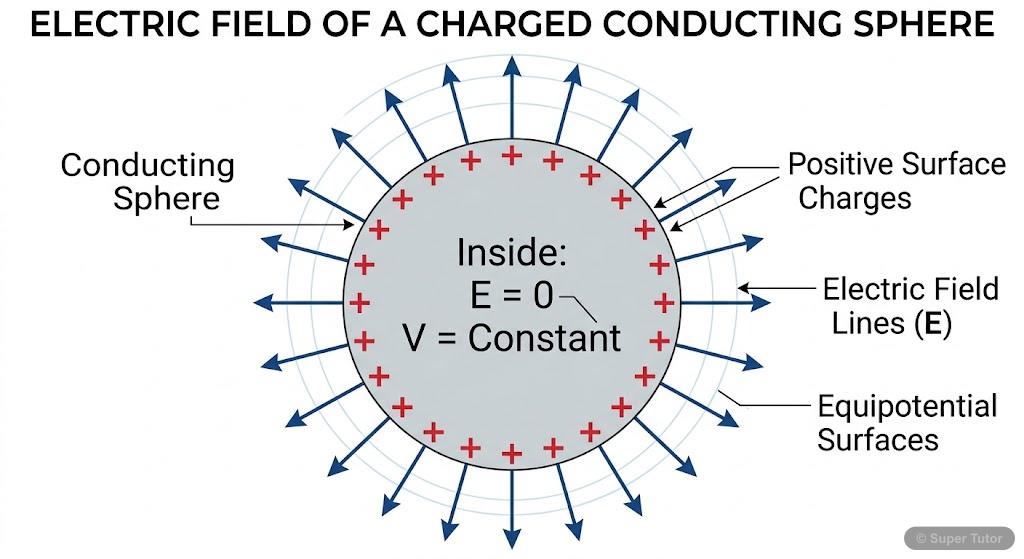
Super Tutor has 24+ illustrations like this for Electrostatic Potential and Capacitance alone — flashcards, concept maps, and step-by-step visuals.
See them all7 worked solutions below. Unlock all 14 free in Super Tutor
EXERCISES
2.1Two charges 5 × 10⁻⁸ C and -3 × 10⁻⁸ C are located 16 cm apart. At what point(s) on the line joining the two charges is the electric potential zero? Take the potential at infinity to be zero.Show solution
because the potentials must cancel.
There are two possible points on the line:
1. Between the charges: if the point is cm from the positive charge, then it is cm from the negative charge.
2. On the extension beyond the negative charge: if the point is cm from the positive charge, then its distance from the negative charge is .
So the points are 10 cm from the positive charge between the charges, and 40 cm from the positive charge on the side of the negative charge.
If the printed options do not include these exact values, the computed answer stands.
Not sure why a step works? check your working in Super Tutor
2.2A regular hexagon of side 10 cm has a charge 5 μC at each of its vertices. Calculate the potential at the centre of the hexagon.Show solution
from the centre.
Potential due to one charge:
There are 6 identical charges, so total potential is
Not sure why a step works? check your working in Super Tutor
2.3(a)Identify an equipotential surface of the system.Show solution
Not sure why a step works? check your working in Super Tutor
2.3(b)What is the direction of the electric field at every point on this surface?Show solution
Not sure why a step works? check your working in Super Tutor
2.4A spherical conductor of radius 12 cm has a charge of 1.6 × 10⁻⁷C distributed uniformly on its surface. What is the electric field
(a) inside the sphere
(b) just outside the sphere
(c) at a point 18 cm from the centre of the sphere?Show solution
For a conductor:
- inside the conductor, ;
- just outside the surface,
- outside at distance from the centre,
### (a) Inside the sphere
### (b) Just outside the sphere
### (c) At 18 cm from the centre
Here .
The field is radially outward because the charge is positive.
If the book’s printed options are absent, these computed values are the correct ones.
Not sure why a step works? check your working in Super Tutor
2.5A parallel plate capacitor with air between the plates has a capacitance of 8 pF (1pF = 10⁻¹² F). What will be the capacitance if the distance between the plates is reduced by half, and the space between them is filled with a substance of dielectric constant 6?Show solution
Initially the capacitance is with air, so the new capacitance changes by the factor
Therefore,
Not sure why a step works? check your working in Super Tutor
2.6(a)What is the total capacitance of the combination?Show solution
For series combination,
With ,
Hence,
Not sure why a step works? check your working in Super Tutor
(a) while the voltage supply remained connected.
(b) after the supply was disconnected.
7 more solved questions in Electrostatic Potential and Capacitance
Every remaining exercise is solved step by step in Super Tutor, plus practice quizzes and flashcards for this chapter. Free to start.
Stuck on a step?
Ask Super Tutor AI to explain any solution on this page in a simpler way — free, 24x7.
Ask a Doubt FreeFrequently Asked Questions
What are the important topics in Electrostatic Potential and Capacitance for CBSE Class 12 Physics?
How to score full marks in Electrostatic Potential and Capacitance — CBSE Class 12 Physics?
Where can I get free NCERT Solutions for Electrostatic Potential and Capacitance Class 12 Physics?
Sources & Official References
- NCERT Official — ncert.nic.in
- CBSE Academic — cbseacademic.nic.in
- CBSE Official — cbse.gov.in
- National Education Policy 2020 — education.gov.in
Content is aligned to the official syllabus. Refer to the board website for the latest curriculum.
More resources for Electrostatic Potential and Capacitance
Practice Quiz
Test yourself with a quick quiz
Important Questions
Practice with board exam-style questions
Revision Notes
Key points for last-minute revision
Formula Sheet
All formulas in one place
Chapter Summary
Understand the chapter at a glance
Concept Maps
See how topics connect visually
Study Plan
Step-by-step plan to ace this chapter
Flashcards
Quick-fire cards for active recall
Syllabus
What topics to cover
For serious students
Get the full Electrostatic Potential and Capacitance chapter — for free.
Quizzes, flashcards, AI doubt-solver and a step-by-step study plan for CBSE Class 12 Physics.