Electromagnetic Induction
CBSE · Class 12 · Physics
NCERT Solutions for Electromagnetic Induction — CBSE Class 12 Physics.
Interactive on Super Tutor
Studying Electromagnetic Induction? Get the full interactive chapter.
Quizzes, flashcards, AI doubt-solver and a step-by-step study plan — built for ncert solutions and more.
1,000+ Class 12 students started this chapter today
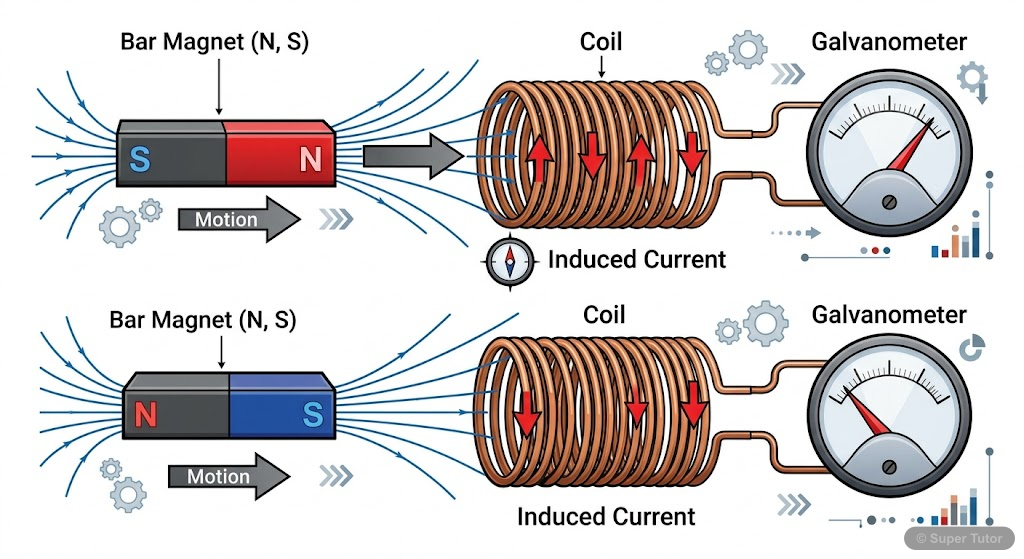
This is just one of 18+ visuals inside Super Tutor's Electromagnetic Induction chapter
Explore the full set4 worked solutions below. Unlock all 8 free in Super Tutor
EXERCISES
6.1Predict the direction of induced current in the situations described by the following Figs. 6.15(a) to (f).Show solution
Not sure why a step works? check your working in Super Tutor
6.2Use Lenz's law to determine the direction of induced current in the situations described by Fig. 6.16:Show solution
Not sure why a step works? check your working in Super Tutor
6.3A long solenoid with 15 turns per cm has a small loop of area 2.0 cm² placed inside the solenoid normal to its axis. If the current carried by the solenoid changes steadily from 2.0 A to 4.0 A in 0.1 s, what is the induced emf in the loop while the current is changing?Show solution
So the flux through the small loop is
Hence induced emf is
Given:
- turns per cm = 15, so
- area
- current change
- time
So
Now
So the induced emf is about .
Not sure why a step works? check your working in Super Tutor
6.4A rectangular wire loop of sides 8 cm and 2 cm with a small cut is moving out of a region of uniform magnetic field of magnitude 0.3 T directed normal to the loop. What is the emf developed across the cut if the velocity of the loop is 1 cm s⁻¹ in a direction normal to the (a) longer side, (b) shorter side of the loop? For how long does the induced voltage last in each case?Show solution
Here
-
- velocity
The length is the side perpendicular to the motion.
### (a) Motion normal to the longer side
Then the side cutting the field lines is the longer side, .
Time for the loop to leave the field region equals width in direction of motion divided by speed. If it moves normal to the longer side, it crosses the shorter side width :
### (b) Motion normal to the shorter side
Then the effective length is the shorter side, .
Now the loop crosses the longer side width :
So the induced voltage is for 2 s in (a), and for 8 s in (b).
Not sure why a step works? check your working in Super Tutor
4 more solved questions in Electromagnetic Induction
Every remaining exercise is solved step by step in Super Tutor, plus practice quizzes and flashcards for this chapter. Free to start.
Stuck on a step?
Ask Super Tutor AI to explain any solution on this page in a simpler way — free, 24x7.
Ask a Doubt FreeFrequently Asked Questions
What are the important topics in Electromagnetic Induction for CBSE Class 12 Physics?
How to score full marks in Electromagnetic Induction — CBSE Class 12 Physics?
Where can I get free NCERT Solutions for Electromagnetic Induction Class 12 Physics?
Sources & Official References
- NCERT Official — ncert.nic.in
- CBSE Academic — cbseacademic.nic.in
- CBSE Official — cbse.gov.in
- National Education Policy 2020 — education.gov.in
Content is aligned to the official syllabus. Refer to the board website for the latest curriculum.
More resources for Electromagnetic Induction
Practice Quiz
Test yourself with a quick quiz
Important Questions
Practice with board exam-style questions
Revision Notes
Key points for last-minute revision
Formula Sheet
All formulas in one place
Chapter Summary
Understand the chapter at a glance
Concept Maps
See how topics connect visually
Study Plan
Step-by-step plan to ace this chapter
Flashcards
Quick-fire cards for active recall
Syllabus
What topics to cover
For serious students
Get the full Electromagnetic Induction chapter — for free.
Quizzes, flashcards, AI doubt-solver and a step-by-step study plan for CBSE Class 12 Physics.