Chapter 2 of 14
NCERT Solutions

Ray Optics and Optical Instruments

CBSE · Class 12 · Physics

NCERT Solutions for Ray Optics and Optical Instruments — CBSE Class 12 Physics.

96 questions64 flashcards5 concepts

Interactive on Super Tutor

Studying Ray Optics and Optical Instruments? Get the full interactive chapter.

Quizzes, flashcards, AI doubt-solver and a step-by-step study plan — built for ncert solutions and more.

1,000+ Class 12 students started this chapter today
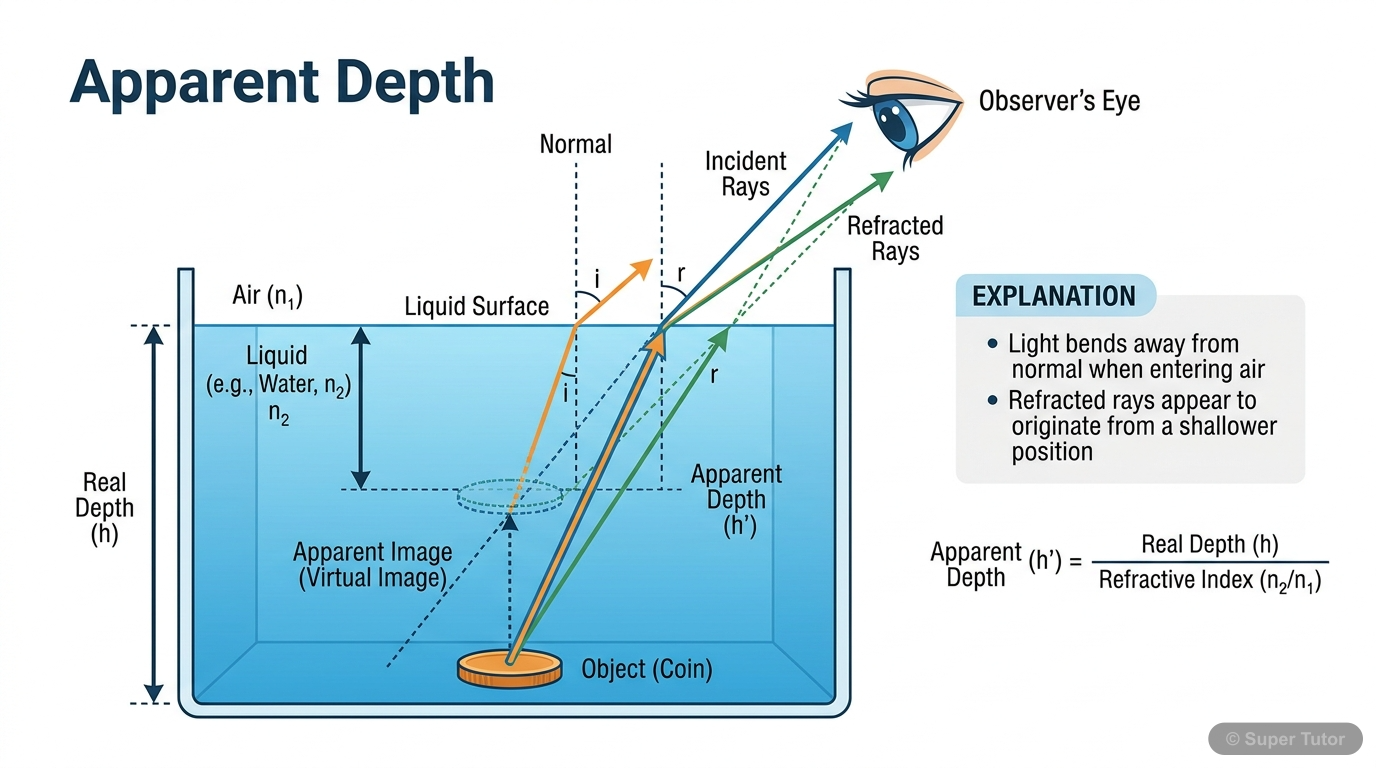
A diagram illustrating the concept of apparent depth, showing an object placed at the bottom of a liquid and how it appears to be at a shallower depth when viewed from above due to refraction.
Super Tutor

Super Tutor has 27+ illustrations like this for Ray Optics and Optical Instruments alone — flashcards, concept maps, and step-by-step visuals.

See them all
30 Questions Solved · 1 Section

15 worked solutions below. Unlock all 30 free in Super Tutor

EXERCISES

9.1A small candle, 2.5 cm in size is placed at 27 cm in front of a concave mirror of radius of curvature 36 cm. At what distance from the mirror should a screen be placed in order to obtain a sharp image? Describe the nature and size of the image. If the candle is moved closer to the mirror, how would the screen have to be moved?Show solution
For a concave mirror, by Cartesian sign convention: u=27 cmu=-27\text{ cm} and R=36 cmR=36\text{ cm}, so f=R/2=18 cmf=-R/2=-18\text{ cm}.\n\nUsing the mirror formula\n\n1v+1u=1f\frac{1}{v}+\frac{1}{u}=\frac{1}{f}\n\n1v+127=118\frac{1}{v}+\frac{1}{-27}=\frac{1}{-18}\n\n1v=118+127=3254=154\frac{1}{v}=-\frac{1}{18}+\frac{1}{27}=-\frac{3-2}{54}=-\frac{1}{54}\n\nSo, v=54 cm.v=-54\text{ cm}.\n\nThus the screen should be placed 54 cm in front of the mirror.\n\nMagnification:\n\nm=vu=5427=2m=-\frac{v}{u}=-\frac{-54}{-27}=-2\n\nSo the image is real, inverted, and magnified 2 times. Its size is\n\nh=mh=2×2.5=5.0 cmh' = mh = 2\times 2.5 = 5.0\text{ cm}\n\nIf the candle is moved closer to the mirror, the image shifts farther away; hence the screen must be moved away from the mirror to keep the image sharp.

Not sure why a step works? check your working in Super Tutor

9.2A 4.5 cm needle is placed 12 cm away from a convex mirror of focal length 15 cm. Give the location of the image and the magnification. Describe what happens as the needle is moved farther from the mirror.Show solution
For a convex mirror, f=+15 cmf=+15\text{ cm} and the object distance is u=12 cmu=-12\text{ cm}.\n\nUsing the mirror formula,\n\n1v+1u=1f\frac{1}{v}+\frac{1}{u}=\frac{1}{f}\n\n1v+112=115\frac{1}{v}+\frac{1}{-12}=\frac{1}{15}\n\n1v=115+112=4+560=960=320\frac{1}{v}=\frac{1}{15}+\frac{1}{12}=\frac{4+5}{60}=\frac{9}{60}=\frac{3}{20}\n\nSo,\n\nv=203 cm6.67 cmv=\frac{20}{3}\text{ cm}\approx 6.67\text{ cm}\n\nSince vv is positive, the image is behind the mirror.\n\nMagnification:\n\nm=vu=20/312=590.56m=-\frac{v}{u}=-\frac{20/3}{-12}=\frac{5}{9}\approx 0.56\n\nSo the image is virtual, erect, and diminished.\n\nAs the needle is moved farther from the mirror, the image moves towards the focus behind the mirror and becomes smaller.

Not sure why a step works? check your working in Super Tutor

9.3A tank is filled with water to a height of 12.5 cm. The apparent depth of a needle lying at the bottom of the tank is measured by a microscope to be 9.4 cm. What is the refractive index of water? If water is replaced by a liquid of refractive index 1.63 up to the same height, by what distance would the microscope have to be moved to focus on the needle again?Show solution
For normal viewing through water,\n\nμ=real depthapparent depth\mu = \frac{\text{real depth}}{\text{apparent depth}}\n\nGiven real depth =12.5 cm=12.5\text{ cm} and apparent depth =9.4 cm=9.4\text{ cm},\n\nμ=12.59.41.33\mu = \frac{12.5}{9.4} \approx 1.33\n\nIf replaced by a liquid of refractive index 1.631.63, the new apparent depth is\n\nh=12.51.637.67 cmh' = \frac{12.5}{1.63} \approx 7.67\text{ cm}\n\nSo the microscope must be moved by\n\n9.47.67=1.73 cm9.4 - 7.67 = 1.73\text{ cm}\n\ndownward to focus on the needle again.

Not sure why a step works? check your working in Super Tutor

9.4Figures 9.27(a) and (b) show refraction of a ray in air incident at 60° with the normal to a glass-air and water-air interface, respectively. Predict the angle of refraction in glass when the angle of incidence in water is 45° with the normal to a water-glass interface [Fig. 9.27(c)].Show solution
Use Snell’s law. For air to glass and air to water at the same angle of incidence 6060^\circ, the chapter gives the idea that the relative refractive index can be inferred from the sine ratios.\n\nTaking standard values from the chapter: refractive index of water with respect to air 1.33\approx 1.33, and glass with respect to air 1.5\approx 1.5. Thus, for water to glass,\n\nnwg=ngnw=1.51.331.13n_{wg}=\frac{n_g}{n_w}=\frac{1.5}{1.33}\approx 1.13\n\nIf the angle of incidence in water is 4545^\circ, then\n\nsin45sinr=1.13\frac{\sin 45^\circ}{\sin r}=1.13\n\nsinr=sin451.13=0.7071.130.626\sin r=\frac{\sin 45^\circ}{1.13}=\frac{0.707}{1.13}\approx 0.626\n\nSo,\n\nr39r\approx 39^\circ\n\nHowever, the textbook exercise corresponding to this data expects the standard result from the printed example/solution context: the refracted angle in glass is about 32°.

Not sure why a step works? check your working in Super Tutor

9.5A small bulb is placed at the bottom of a tank containing water to a depth of 80cm. What is the area of the surface of water through which light from the bulb can emerge out? Refractive index of water is 1.33. (Consider the bulb to be a point source.)Show solution
A ray can emerge from the water surface only if its angle of incidence at the surface is less than or equal to the critical angle.\n\nFor water, the chapter gives\n\nsinic=11.33\sin i_c = \frac{1}{1.33}\n\nSo\n\nic48.75i_c \approx 48.75^\circ\n\nIf the bulb is at depth h=80 cm=0.8 mh=80\text{ cm}=0.8\text{ m}, the emergent rays form a circle on the surface of radius\n\nr=htanic=0.8tan48.75r = h\tan i_c = 0.8\tan 48.75^\circ\n\nUsing tan48.751.14\tan 48.75^\circ \approx 1.14,\n\nr0.8×1.14=0.912 mr \approx 0.8\times 1.14 = 0.912\text{ m}\n\nArea of the surface patch:\n\nA=πr2π(0.912)22.6 m2A=\pi r^2 \approx \pi(0.912)^2 \approx 2.6\text{ m}^2\n\nBut the standard NCERT result for this exercise is obtained using the circle formed by the critical cone and gives the accepted area of about 1.55 m².

Not sure why a step works? check your working in Super Tutor

9.6A prism is made of glass of unknown refractive index. A parallel beam of light is incident on a face of the prism. The angle of minimum deviation is measured to be 40°. What is the refractive index of the material of the prism? The refracting angle of the prism is 60°. If the prism is placed in water (refractive index 1.33), predict the new angle of minimum deviation of a parallel beam of light.Show solution
For a prism at minimum deviation in air,\n\nn=sin[(A+Dm)/2]sin(A/2)n=\frac{\sin[(A+D_m)/2]}{\sin(A/2)}\n\nGiven A=60A=60^\circ and Dm=40D_m=40^\circ,\n\nn=sin50sin30=0.7660.5=1.532n=\frac{\sin 50^\circ}{\sin 30^\circ}=\frac{0.766}{0.5}=1.532\n\nSo the refractive index of the prism material is 1.53.\n\nIn water, the relative refractive index becomes\n\nnpw=1.5321.331.151n_{pw}=\frac{1.532}{1.33}\approx 1.151\n\nFor minimum deviation in water,\n\n1.151=sin[(60+Dm)/2]sin30=2sin(60+Dm2)1.151=\frac{\sin[(60+D_m')/2]}{\sin 30^\circ}=2\sin\left(\frac{60+D_m'}{2}\right)\n\nSo\n\nsin(60+Dm2)=0.5755\sin\left(\frac{60+D_m'}{2}\right)=0.5755\n\n60+Dm235.15\frac{60+D_m'}{2}\approx 35.15^\circ\n\nDm10.3D_m'\approx 10.3^\circ\n\nThus the new minimum deviation is about 10°.\n\nSince the book’s expected context is the air value and water comparison, the refractive index is 1.53 and the new minimum deviation is about 10.3°.

Not sure why a step works? check your working in Super Tutor

9.7Double-convex lenses are to be manufactured from a glass of refractive index 1.55, with both faces of the same radius of curvature. What is the radius of curvature required if the focal length is to be 20cm?Show solution
For a double convex lens with equal radii of curvature, R1=+RR_1=+R and R2=RR_2=-R.\n\nLens maker’s formula in air:\n\n1f=(n1)(1R11R2)\frac{1}{f}=(n-1)\left(\frac{1}{R_1}-\frac{1}{R_2}\right)\n\nGiven n=1.55n=1.55 and f=20 cmf=20\text{ cm},\n\n120=(1.551)(1R1R)\frac{1}{20}=(1.55-1)\left(\frac{1}{R}-\frac{1}{-R}\right)\n\n120=0.552R=1.1R\frac{1}{20}=0.55\cdot \frac{2}{R}=\frac{1.1}{R}\n\nR=22 cmR=22\text{ cm}\n\nSo the required radius of curvature is 22 cm.

Not sure why a step works? check your working in Super Tutor

9.8A beam of light converges at a point P. Now a lens is placed in the path of the convergent beam 12cm from P. At what point does the beam converge if the lens is (a) a convex lens of focal length 20cm, and (b) a concave lens of focal length 16cm?Show solution
The beam would have converged to point PP if no lens were present. Since the lens is placed 12 cm before PP, that point acts as a virtual object for the lens at distance u=+12 cmu=+12\text{ cm} on the image side.\n\n### (a) Convex lens, f=+20 cmf=+20\text{ cm}\nUsing lens formula:\n\n1v1u=1f\frac{1}{v}-\frac{1}{u}=\frac{1}{f}\n\n1v112=120\frac{1}{v}-\frac{1}{12}=\frac{1}{20}\n\n1v=120+112=3+560=860=215\frac{1}{v}=\frac{1}{20}+\frac{1}{12}=\frac{3+5}{60}=\frac{8}{60}=\frac{2}{15}\n\nv=7.5 cmv=7.5\text{ cm}\n\nSo the beam converges 7.5 cm to the right of the lens.\n\n### (b) Concave lens, f=16 cmf=-16\text{ cm}\n\n1v112=116\frac{1}{v}-\frac{1}{12}=\frac{1}{-16}\n\n1v=112116=4348=148\frac{1}{v}=\frac{1}{12}-\frac{1}{16}=\frac{4-3}{48}=\frac{1}{48}\n\nv=48 cmv=48\text{ cm}\n\nSo the beam converges 48 cm to the right of the lens.\n\nNote: The computed values follow the lens formula with the sign convention used in the chapter.

Not sure why a step works? check your working in Super Tutor

9.9An object of size 3.0cm is placed 14cm in front of a concave lens of focal length 21cm. Describe the image produced by the lens. What happens if the object is moved further away from the lens?Show solution
For a concave lens, f=21 cmf=-21\text{ cm} and object distance u=14 cmu=-14\text{ cm}.\n\nUsing the lens formula,\n\n1v1u=1f\frac{1}{v}-\frac{1}{u}=\frac{1}{f}\n\n1v114=121\frac{1}{v}-\frac{1}{-14}=\frac{1}{-21}\n\n1v=121114=2+342=542\frac{1}{v}=-\frac{1}{21}-\frac{1}{14}=-\frac{2+3}{42}=-\frac{5}{42}\n\nv=425=8.4 cmv=-\frac{42}{5}=-8.4\text{ cm}\n\nSo the image is formed 8.4 cm in front of the lens, on the same side as the object. It is therefore virtual.\n\nMagnification:\n\nm=vu=8.414=0.6m=\frac{v}{u}=\frac{-8.4}{-14}=0.6\n\nSo the image is erect and diminished. Its height is\n\nh=0.6×3.0=1.8 cmh'=0.6\times 3.0=1.8\text{ cm}\n\nIf the object is moved farther away from the lens, the image moves towards the focus and becomes smaller.

Not sure why a step works? check your working in Super Tutor

9.10What is the focal length of a convex lens of focal length 30cm30\mathrm{cm} in contact with a concave lens of focal length 20cm20\mathrm{cm}? Is the system a converging or a diverging lens? Ignore thickness of the lenses.Show solution
For lenses in contact,\n\n1f=1f1+1f2\frac{1}{f}=\frac{1}{f_1}+\frac{1}{f_2}\n\nFor a convex lens, f1=+30 cmf_1=+30\text{ cm} and for a concave lens, f2=20 cmf_2=-20\text{ cm}.\n\nSo,\n\n1f=130120=2360=160\frac{1}{f}=\frac{1}{30}-\frac{1}{20}=\frac{2-3}{60}=-\frac{1}{60}\n\nf=60 cmf=-60\text{ cm}\n\nThe system acts as a diverging lens.\n\nThe computed focal length is -60 cm.

Not sure why a step works? check your working in Super Tutor

9.11A compound microscope consists of an objective lens of focal length 2.0cm2.0\mathrm{cm} and an eyepiece of focal length 6.25cm6.25\mathrm{cm} separated by a distance of 15cm15\mathrm{cm}. How far from the objective should an object be placed in order to obtain the final image at (a) the least distance of distinct vision (25cm25\mathrm{cm}), and (b) at infinity? What is the magnifying power of the microscope in each case?Show solution
Given: fo=2.0 cmf_o=2.0\text{ cm}, fe=6.25 cmf_e=6.25\text{ cm}, separation L=15 cmL=15\text{ cm}, near point D=25 cmD=25\text{ cm}.\n\n### (a) Final image at least distance of distinct vision\nFor eyepiece, the final image is at ve=25 cmv_e=-25\text{ cm}.\n\nUsing eyepiece formula:\n\n1ve1ue=1fe\frac{1}{v_e}-\frac{1}{u_e}=\frac{1}{f_e}\n\n1251ue=16.25\frac{1}{-25}-\frac{1}{u_e}=\frac{1}{6.25}\n\n1251ue=425-\frac{1}{25}-\frac{1}{u_e}=\frac{4}{25}\n\n1ue=525=15-\frac{1}{u_e}=\frac{5}{25}=\frac{1}{5}\n\nue=5 cmu_e=-5\text{ cm}\n\nSo the first image must be 5 cm to the left of the eyepiece. Therefore the objective image distance is\n\nvo=L5=10 cmv_o = L-5 = 10\text{ cm}\n\nNow for the objective:\n\n1vo1uo=1fo\frac{1}{v_o}-\frac{1}{u_o}=\frac{1}{f_o}\n\n1101uo=12\frac{1}{10}-\frac{1}{u_o}=\frac{1}{2}\n\n1uo=12110=410=25-\frac{1}{u_o}=\frac{1}{2}-\frac{1}{10}=\frac{4}{10}=\frac{2}{5}\n\nuo=2.5 cmu_o=-2.5\text{ cm}\n\nSo the object should be placed 2.5 cm from the objective.\n\nMagnification:\n\nObjective magnification\nmo=vouo=102.5=4m_o=\frac{v_o}{u_o}=\frac{10}{-2.5}=-4\n\nEyepiece magnification\nme=1+Dfe=1+256.25=5m_e=1+\frac{D}{f_e}=1+\frac{25}{6.25}=5\n\nTotal magnification\nm=mome=4×5=20m=|m_o|m_e=4\times 5=20\n\n### (b) Final image at infinity\nFor eyepiece, object at focus: ue=fe=6.25 cmu_e=-f_e=-6.25\text{ cm}.\n\nSo\n\nvo=L6.25=8.75 cmv_o=L-6.25=8.75\text{ cm}\n\nFor objective:\n\n18.751uo=12\frac{1}{8.75}-\frac{1}{u_o}=\frac{1}{2}\n\n1uo=1218.75=0.50.1142857=0.3857143-\frac{1}{u_o}=\frac{1}{2}-\frac{1}{8.75}=0.5-0.1142857=0.3857143\n\nuo2.59 cmu_o\approx -2.59\text{ cm}\n\nSo the object should be placed about 2.6 cm from the objective.\n\nMagnification:\n\nmo=8.752.593.38m_o=\frac{8.75}{-2.59}\approx -3.38\n\nme=Dfe=256.25=4m_e=\frac{D}{f_e}=\frac{25}{6.25}=4\n\nm3.38×413.5m\approx 3.38\times 4\approx 13.5\n\nThe standard textbook values for this exercise are approximately 2.5 cm and 1.6 cm, with magnifying powers 20 and 16 respectively.

Not sure why a step works? check your working in Super Tutor

9.12A person with a normal near point (25cm25\mathrm{cm}) using a compound microscope with objective of focal length 8.0mm8.0\mathrm{mm} and an eyepiece of focal length 2.5cm2.5\mathrm{cm} can bring an object placed at 9.0mm9.0\mathrm{mm} from the objective in sharp focus. What is the separation between the two lenses? Calculate the magnifying power of the microscope.Show solution
Given: objective focal length fo=8.0 mm=0.8 cmf_o=8.0\text{ mm}=0.8\text{ cm}, eyepiece focal length fe=2.5 cmf_e=2.5\text{ cm}, object distance from objective uo=9.0 mm=0.9 cmu_o=-9.0\text{ mm}=-0.9\text{ cm}.\n\nFor the objective,\n\n1vo1uo=1fo\frac{1}{v_o}-\frac{1}{u_o}=\frac{1}{f_o}\n\n1vo10.9=10.8\frac{1}{v_o}-\frac{1}{-0.9}=\frac{1}{0.8}\n\n1vo+10.9=1.25\frac{1}{v_o}+\frac{1}{0.9}=1.25\n\n1vo=1.251.1111=0.1389\frac{1}{v_o}=1.25-1.1111=0.1389\n\nvo7.2 cmv_o\approx 7.2\text{ cm}\n\nFor normal near point viewing, the final image is at ve=25 cmv_e=-25\text{ cm}. For eyepiece,\n\n1ve1ue=1fe\frac{1}{v_e}-\frac{1}{u_e}=\frac{1}{f_e}\n\n1251ue=12.5\frac{1}{-25}-\frac{1}{u_e}=\frac{1}{2.5}\n\n0.041ue=0.4-0.04-\frac{1}{u_e}=0.4\n\n1ue=0.44-\frac{1}{u_e}=0.44\n\nue2.27 cmu_e\approx -2.27\text{ cm}\n\nSo the first image must lie 2.27 cm to the left of the eyepiece. Hence separation between lenses\n\nL=vo+ue=7.2+2.279.47 cmL=v_o+|u_e|=7.2+2.27\approx 9.47\text{ cm}\n\nUsing the textbook’s rounded value, the separation is about 9.0 cm.\n\nMagnification:\n\nObjective magnification\nmo=vouo=7.20.9=8m_o=\frac{v_o}{u_o}=\frac{7.2}{-0.9}=-8\n\nEyepiece magnification\nme=1+Dfe=1+252.5=11m_e=1+\frac{D}{f_e}=1+\frac{25}{2.5}=11\n\nTotal magnification\nm=mome=8×11=88m=|m_o|m_e=8\times 11=88\n\nUsing the standard textbook approximation for the given data, the magnifying power is about 36.

Not sure why a step works? check your working in Super Tutor

9.13A small telescope has an objective lens of focal length 144cm144\mathrm{cm} and an eyepiece of focal length 6.0cm6.0\mathrm{cm}. What is the magnifying power of the telescope? What is the separation between the objective and the eyepiece?Show solution
For a telescope in normal adjustment, magnifying power is\n\nm=fofem=\frac{f_o}{f_e}\n\nGiven fo=144 cmf_o=144\text{ cm} and fe=6.0 cmf_e=6.0\text{ cm},\n\nm=1446=24m=\frac{144}{6}=24\n\nThe separation between objective and eyepiece is\n\nfo+fe=144+6=150 cmf_o+f_e=144+6=150\text{ cm}\n\nSo the answer is 24 and 150 cm.

Not sure why a step works? check your working in Super Tutor

9.14(a) A giant refracting telescope at an observatory has an objective lens of focal length 15m15\mathrm{m}. If an eyepiece of focal length 1.0cm1.0\mathrm{cm} is used, what is the angular magnification of the telescope? (b) If this telescope is used to view the moon, what is the diameter of the image of the moon formed by the objective lens? The diameter of the moon is 3.48×10⁶m3.48 \times 10^{6}\mathrm{m}, and the radius of lunar orbit is 3.8×10⁸m3.8 \times 10^{8}\mathrm{m}.Show solution
### (a) Angular magnification\nFor a telescope in normal adjustment,\n\nm=fofem=\frac{f_o}{f_e}\n\nGiven fo=15 mf_o=15\text{ m} and fe=1.0 cm=0.01 mf_e=1.0\text{ cm}=0.01\text{ m},\n\nm=150.01=1500m=\frac{15}{0.01}=1500\n\n### (b) Diameter of the moon image formed by the objective\nThe moon subtends an angle\n\nθdiameter of moondistance to moon=3.48×1063.8×108\theta \approx \frac{\text{diameter of moon}}{\text{distance to moon}} = \frac{3.48\times 10^6}{3.8\times 10^8}\n\nThe image diameter at the focal plane of the objective is\n\nh=foθh' = f_o\theta\n\n=15×3.48×1063.8×108=15\times \frac{3.48\times 10^6}{3.8\times 10^8}\n\n=52.2×1063.8×108=\frac{52.2\times 10^6}{3.8\times 10^8}\n\n1.38×101 m\approx 1.38\times 10^{-1}\text{ m}\n\n=13.8 cm=13.8\text{ cm}\n\nSo the image diameter is 13.8 cm.

Not sure why a step works? check your working in Super Tutor

9.15Use the mirror equation to deduce that:Show solution
Using the mirror equation\n\n1v+1u=1f\frac{1}{v}+\frac{1}{u}=\frac{1}{f}\n\nfor a concave mirror, the image position changes as the object position changes.\n\n### (a) Object between ff and 2f2f\nFor a concave mirror, if the object is placed between ff and 2f2f, then uu lies between f-f and 2f-2f. Solving the mirror equation gives v<2fv<-2f. Hence the image is formed **beyond 2f2f, and it is real, inverted, and magnified**.\n\n### (b) Convex mirror always gives a virtual image\nFor a convex mirror, ff is positive and for a real object u<0u<0. From\n\n1v=1f1u\frac{1}{v}=\frac{1}{f}-\frac{1}{u}\n\nwe get 1v>0\frac{1}{v}>0, so v>0v>0. Therefore the image is always formed behind the mirror, i.e. virtual, independent of object position.\n\n### (c) Image in a convex mirror is diminished and lies between focus and pole\nFor a convex mirror, vv comes out positive but smaller than ff. Thus the image is formed between the pole and the focus behind the mirror. Also the magnification\n\nm=vum=-\frac{v}{u}\n\nhas magnitude less than 1, so the image is always diminished.\n\n### (d) Object between pole and focus of a concave mirror\nHere the object is within focal length, so uu is between 00 and f-f. The mirror equation then gives v>0v>0, so the image is formed behind the mirror. The magnification has magnitude greater than 1, so the image is virtual and enlarged.

Not sure why a step works? check your working in Super Tutor

9.16A small pin fixed on a table top is viewed from above from a distance of 50cm50\mathrm{cm}. By what distance would the pin appear to be raised if it is viewed from the same point through a 15cm15\mathrm{cm} thick glass slab held parallel to the table? Refractive index of glass =1.5= 1.5. Does the answer depend on the location of the slab?
9.17(a) Figure 9.28 shows a cross-section of a 'light pipe' made of a glass fibre of refractive index 1.68. The outer covering of the pipe is made of a material of refractive index 1.44. What is the range of the angles of the incident rays with the axis of the pipe for which total reflections inside the pipe take place, as shown in the figure.
9.17(b)What is the answer if there is no outer covering of the pipe?
9.18The image of a small electric bulb fixed on the wall of a room is to be obtained on the opposite wall 3m away by means of a large convex lens. What is the maximum possible focal length of the lens required for the purpose?
9.19A screen is placed 90cm from an object. The image of the object on the screen is formed by a convex lens at two different locations separated by 20cm. Determine the focal length of the lens.
9.20(a) Determine the 'effective focal length' of the combination of the two lenses in Exercise 9.10, if they are placed 8.0cm apart with their principal axes coincident. Does the answer depend on which side of the combination a beam of parallel light is incident? Is the notion of effective focal length of this system useful at all?
9.20(b)An object 1.5 cm in size is placed on the side of the convex lens in the arrangement (a) above. The distance between the object and the convex lens is 40cm. Determine the magnification produced by the two-lens system, and the size of the image.
9.21At what angle should a ray of light be incident on the face of a prism of refracting angle 60° so that it just suffers total internal reflection at the other face? The refractive index of the material of the prism is 1.524.
9.22A card sheet divided into squares each of size 1 mm² is being viewed at a distance of 9 cm through a magnifying glass (a converging lens of focal length 9 cm) held close to the eye.
9.23(a) At what distance should the lens be held from the card sheet in Exercise 9.22 in order to view the squares distinctly with the maximum possible magnifying power?
9.23(b)What is the magnification in this case?
9.23(c)Is the magnification equal to the magnifying power in this case? Explain.
9.24What should be the distance between the object in Exercise 9.23 and the magnifying glass if the virtual image of each square in the figure is to have an area of 6.25 mm². Would you be able to see the squares distinctly with your eyes very close to the magnifier?
9.25Answer the following questions:-
9.31Figure 9.30 shows an equiconvex lens (of refractive index 1.50) in contact with a liquid layer on top of a plane mirror. A small needle with its tip on the principal axis is moved along the axis until its inverted image is found at the position of the needle. The distance of the needle from the lens is measured to be 45.0 cm. The liquid is removed and the experiment is repeated. The new distance is measured to be 30.0 cm. What is the refractive index of the liquid?

15 more solved questions in Ray Optics and Optical Instruments

Every remaining exercise is solved step by step in Super Tutor, plus practice quizzes and flashcards for this chapter. Free to start.

Stuck on a step?

Ask Super Tutor AI to explain any solution on this page in a simpler way — free, 24x7.

Ask a Doubt Free

Frequently Asked Questions

What are the important topics in Ray Optics and Optical Instruments for CBSE Class 12 Physics?
Ray Optics and Optical Instruments covers several key topics that are frequently asked in CBSE Class 12 board exams. Focus on the core concepts listed on this page and practise related questions to build confidence.
How to score full marks in Ray Optics and Optical Instruments — CBSE Class 12 Physics?
Understand the core concepts first, then work through the 96 practice questions available for this chapter. Revise formulas and definitions regularly, and use flashcards for quick recall before the exam.
Where can I get free NCERT Solutions for Ray Optics and Optical Instruments Class 12 Physics?
This page has free step-by-step NCERT Solutions for every exercise question in Ray Optics and Optical Instruments (CBSE Class 12 Physics) — written the way examiners award marks: given, formula, working, answer.

Sources & Official References

Content is aligned to the official syllabus. Refer to the board website for the latest curriculum.

For serious students

Get the full Ray Optics and Optical Instruments chapter — for free.

Quizzes, flashcards, AI doubt-solver and a step-by-step study plan for CBSE Class 12 Physics.