Chapter 14 of 14
NCERT Solutions

Electromagnetic Waves

CBSE · Class 12 · Physics

NCERT Solutions for Electromagnetic Waves — CBSE Class 12 Physics.

44 questions22 flashcards5 concepts

Interactive on Super Tutor

Studying Electromagnetic Waves? Get the full interactive chapter.

Quizzes, flashcards, AI doubt-solver and a step-by-step study plan — built for ncert solutions and more.

1,000+ Class 12 students started this chapter today
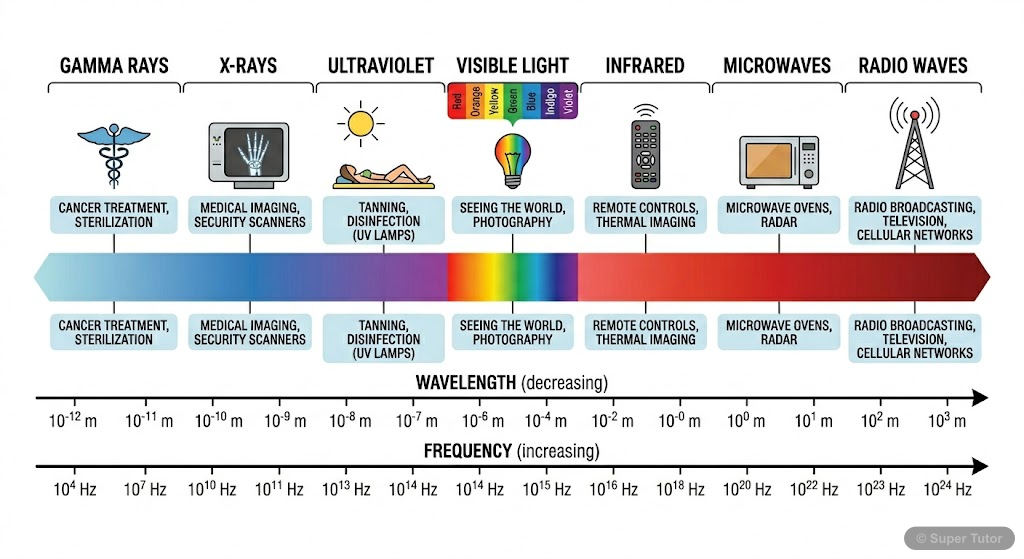
A comprehensive infographic displaying the entire electromagnetic spectrum, ordered by increasing wavelength and decreasing frequency (or vice-versa). It should include different regions like Gamma ra
Super Tutor

Super Tutor has 11+ illustrations like this for Electromagnetic Waves alone — flashcards, concept maps, and step-by-step visuals.

See them all
10 Questions Solved · 1 Section

EXERCISES

8.1Figure 8.5 shows a capacitor made of two circular plates each of radius 12 cm, and separated by 5.0 cm. The capacitor is being charged by an external source (not shown in the figure). The charging current is constant and equal to 0.15 A.
(a) Calculate the capacitance and the rate of change of potential difference between the plates.
(b) Obtain the displacement current across the plates.
(c) Is Kirchhoff's first rule (junction rule) valid at each plate of the capacitor? Explain.
Show solution
Given:
- Radius of each plate: r=12 cm=0.12 mr = 12\text{ cm} = 0.12\text{ m}
- Separation between plates: d=5.0 cm=0.05 md = 5.0\text{ cm} = 0.05\text{ m}
- Charging current: I=0.15 AI = 0.15\text{ A} (constant)

---

(a) Capacitance and rate of change of potential difference:

Formula for capacitance of a parallel plate capacitor:
C=ε0AdC = \frac{\varepsilon_0 A}{d}

Area of circular plates:
A=πr2=π×(0.12)2=π×0.0144=4.524×10² m2A = \pi r^2 = \pi \times (0.12)^2 = \pi \times 0.0144 = 4.524 \times 10^{-2}\text{ m}^2

C=8.854×1012×4.524×1020.05C = \frac{8.854 \times 10^{-12} \times 4.524 \times 10^{-2}}{0.05}

C=4.006×10130.058.0×1012 F=80 pFC = \frac{4.006 \times 10^{-13}}{0.05} \approx 8.0 \times 10^{-12}\text{ F} = 80\text{ pF}

Rate of change of potential difference:

Since Q=CVQ = CV, differentiating with respect to time:
I=CdVdtI = C\frac{dV}{dt}

dVdt=IC=0.158.0×1012\frac{dV}{dt} = \frac{I}{C} = \frac{0.15}{8.0 \times 10^{-12}}

dVdt=1.875×10¹⁰ V s11.9×1010 V s1\boxed{\frac{dV}{dt} = 1.875 \times 10^{10}\text{ V s}^{-1} \approx 1.9 \times 10^{10}\text{ V s}^{-1}}

---

(b) Displacement current across the plates:

The displacement current idi_d is given by:
id=ε0dΦEdt=ε0d(EA)dt=ε0Addt(Vd)=ε0AddVdt=CdVdti_d = \varepsilon_0 \frac{d\Phi_E}{dt} = \varepsilon_0 \frac{d(EA)}{dt} = \varepsilon_0 A \frac{d}{dt}\left(\frac{V}{d}\right) = \frac{\varepsilon_0 A}{d}\frac{dV}{dt} = C\frac{dV}{dt}

Therefore:
id=I=0.15 Ai_d = I = 0.15\text{ A}

id=0.15 A\boxed{i_d = 0.15\text{ A}}

The displacement current equals the conduction current.

---

(c) Validity of Kirchhoff's junction rule:

Yes, Kirchhoff's first rule (junction rule) is valid at each plate of the capacitor, provided we generalise the concept of current to include displacement current. At each plate, the conduction current arriving (or leaving) equals the displacement current leaving (or arriving) through the gap between the plates. Thus, the total current (conduction + displacement) is continuous, and the junction rule holds in its generalised form.
8.2A parallel plate capacitor made of circular plates each of radius R=6.0 cmR = 6.0\text{ cm} has a capacitance C=100 pFC = 100\text{ pF}. The capacitor is connected to a 230 V ac supply with a (angular) frequency of 300 rad s1300\text{ rad s}^{-1}.
(a) What is the rms value of the conduction current?
(b) Is the conduction current equal to the displacement current?
(c) Determine the amplitude of B\mathbf{B} at a point 3.0 cm from the axis between the plates.
Show solution
Given:
- Radius of plates: R=6.0 cm=0.06 mR = 6.0\text{ cm} = 0.06\text{ m}
- Capacitance: C=100 pF=100×1012 FC = 100\text{ pF} = 100 \times 10^{-12}\text{ F}
- rms voltage: Vrms=230 VV_{rms} = 230\text{ V}
- Angular frequency: ω=300 rad s1\omega = 300\text{ rad s}^{-1}
- Point of interest: r=3.0 cm=0.03 mr = 3.0\text{ cm} = 0.03\text{ m} from axis

---

(a) rms value of conduction current:

The capacitive reactance is:
XC=1ωC=1300×100×1012=13×108=3.33×10⁷ ΩX_C = \frac{1}{\omega C} = \frac{1}{300 \times 100 \times 10^{-12}} = \frac{1}{3 \times 10^{-8}} = 3.33 \times 10^{7}\text{ }\Omega

rms conduction current:
Irms=VrmsXC=2303.33×107I_{rms} = \frac{V_{rms}}{X_C} = \frac{230}{3.33 \times 10^7}

Irms=6.9×10⁶ A6.9 μA\boxed{I_{rms} = 6.9 \times 10^{-6}\text{ A} \approx 6.9\text{ }μA}

---

(b) Is conduction current equal to displacement current?

Yes. At any instant, the displacement current between the plates equals the conduction current in the external circuit. This is a consequence of Maxwell's modification of Ampere's law — the displacement current id=ε0dΦEdti_d = \varepsilon_0 \frac{d\Phi_E}{dt} ensures continuity of current. So:
id=ic=6.9 μA (rms)i_d = i_c = 6.9\text{ }μA\text{ (rms)}

---

(c) Amplitude of B\mathbf{B} at r=3.0 cmr = 3.0\text{ cm} from the axis:

Since r = 3.0\text{ cm} < R = 6.0\text{ cm}, the point lies inside the capacitor plates.

Using Ampere's law with displacement current, for a circular path of radius rr inside the capacitor:
B×2πr=μ0×id(enclosed)B \times 2\pi r = \mu_0 \times i_d(\text{enclosed})

The displacement current enclosed within radius rr (assuming uniform distribution):
id(enclosed)=id×πr2πR2=id×r2R2i_d(\text{enclosed}) = i_d \times \frac{\pi r^2}{\pi R^2} = i_d \times \frac{r^2}{R^2}

Amplitude of current:
I0=2Irms=2×6.9×106=9.76×10⁶ AI_0 = \sqrt{2}\, I_{rms} = \sqrt{2} \times 6.9 \times 10^{-6} = 9.76 \times 10^{-6}\text{ A}

Amplitude of BB:
B0=μ0I0r2πR2B_0 = \frac{\mu_0 I_0 r}{2\pi R^2}

B0=4π×107×9.76×106×0.032π×(0.06)2B_0 = \frac{4\pi \times 10^{-7} \times 9.76 \times 10^{-6} \times 0.03}{2\pi \times (0.06)^2}

B0=4π×107×9.76×106×0.032π×3.6×103B_0 = \frac{4\pi \times 10^{-7} \times 9.76 \times 10^{-6} \times 0.03}{2\pi \times 3.6 \times 10^{-3}}

B0=2×107×9.76×106×0.033.6×103B_0 = \frac{2 \times 10^{-7} \times 9.76 \times 10^{-6} \times 0.03}{3.6 \times 10^{-3}}

B0=5.856×10143.6×103=1.63×1011 TB_0 = \frac{5.856 \times 10^{-14}}{3.6 \times 10^{-3}} = 1.63 \times 10^{-11}\text{ T}

B01.63×1011 T\boxed{B_0 \approx 1.63 \times 10^{-11}\text{ T}}
8.3What physical quantity is the same for X-rays of wavelength 1010 m10^{-10}\text{ m}, red light of wavelength 6800 Å and radiowaves of wavelength 500 m?Show solution
Concept: All electromagnetic waves, regardless of their wavelength or frequency, travel through vacuum (free space) with the same speed.

The physical quantity that is the same for all three is the speed in vacuum (free space).

c=3×10⁸ m s1c = 3 \times 10^8\text{ m s}^{-1}

This is because X-rays, visible light (red light), and radio waves are all electromagnetic waves, and all electromagnetic waves travel with the same speed c=1μ0ε0=3×10⁸ m s1c = \frac{1}{\sqrt{\mu_0 \varepsilon_0}} = 3 \times 10^8\text{ m s}^{-1} in vacuum, irrespective of their wavelength or frequency.
8.4A plane electromagnetic wave travels in vacuum along zz-direction. What can you say about the directions of its electric and magnetic field vectors? If the frequency of the wave is 30 MHz, what is its wavelength?Show solution
Direction of field vectors:

In an electromagnetic wave, the electric field E\mathbf{E} and magnetic field B\mathbf{B} are both perpendicular to the direction of propagation and perpendicular to each other.

Since the wave travels along the zz-direction, the electric field E\mathbf{E} and magnetic field B\mathbf{B} lie in the xyxy-plane (i.e., they are transverse to the zz-direction). E\mathbf{E} and B\mathbf{B} are mutually perpendicular to each other and to the zz-axis.

For example, E\mathbf{E} could be along the xx-direction and B\mathbf{B} along the yy-direction.

---

Wavelength:

Given: Frequency ν=30 MHz=30×106 Hz=3×10⁷ Hz\nu = 30\text{ MHz} = 30 \times 10^6\text{ Hz} = 3 \times 10^7\text{ Hz}

Formula: c=νλc = \nu\lambda

λ=cν=3×1083×107\lambda = \frac{c}{\nu} = \frac{3 \times 10^8}{3 \times 10^7}

λ=10 m\boxed{\lambda = 10\text{ m}}
8.5A radio can tune in to any station in the 7.5 MHz to 12 MHz band. What is the corresponding wavelength band?Show solution
Given:
- Frequency range: ν1=7.5 MHz=7.5×10⁶ Hz\nu_1 = 7.5\text{ MHz} = 7.5 \times 10^6\text{ Hz} to ν2=12 MHz=12×106 Hz\nu_2 = 12\text{ MHz} = 12 \times 10^6\text{ Hz}
- Speed of electromagnetic waves: c=3×10⁸ m s1c = 3 \times 10^8\text{ m s}^{-1}

Formula: λ=cν\lambda = \dfrac{c}{\nu}

Wavelength corresponding to ν1=7.5 MHz\nu_1 = 7.5\text{ MHz}:
λ1=3×1087.5×106=3×1087.5×106=40 m\lambda_1 = \frac{3 \times 10^8}{7.5 \times 10^6} = \frac{3 \times 10^8}{7.5 \times 10^6} = 40\text{ m}

Wavelength corresponding to ν2=12 MHz\nu_2 = 12\text{ MHz}:
λ2=3×10812×106=25 m\lambda_2 = \frac{3 \times 10^8}{12 \times 10^6} = 25\text{ m}

Corresponding wavelength band: 25 m to 40 m\boxed{\text{Corresponding wavelength band: } 25\text{ m to } 40\text{ m}}
8.6A charged particle oscillates about its mean equilibrium position with a frequency of 109 Hz10^9\text{ Hz}. What is the frequency of the electromagnetic waves produced by the oscillator?Show solution
Concept: An oscillating charged particle acts as an oscillating electric dipole and produces electromagnetic waves. The frequency of the electromagnetic waves produced equals the frequency of oscillation of the charged particle.

Given: Frequency of oscillation of charged particle =109 Hz= 10^9\text{ Hz}

Frequency of electromagnetic waves produced=109 Hz=1 GHz\boxed{\text{Frequency of electromagnetic waves produced} = 10^9\text{ Hz} = 1\text{ GHz}}

This lies in the microwave region of the electromagnetic spectrum.
8.7The amplitude of the magnetic field part of a harmonic electromagnetic wave in vacuum is B0=510 nTB_0 = 510\text{ nT}. What is the amplitude of the electric field part of the wave?Show solution
Given:
- Amplitude of magnetic field: B0=510 nT=510×109 TB_0 = 510\text{ nT} = 510 \times 10^{-9}\text{ T}
- Speed of light in vacuum: c=3×10⁸ m s1c = 3 \times 10^8\text{ m s}^{-1}

Formula: In an electromagnetic wave, the amplitudes of electric and magnetic fields are related by:
E0B0=c\frac{E_0}{B_0} = c

E0=c×B0=3×108×510×109E_0 = c \times B_0 = 3 \times 10^8 \times 510 \times 10^{-9}

E0=3×108×5.10×107E_0 = 3 \times 10^8 \times 5.10 \times 10^{-7}

E0=15.3×101=153 N/CE_0 = 15.3 \times 10^{1} = 153\text{ N/C}

E0=153 N C1\boxed{E_0 = 153\text{ N C}^{-1}}
8.8Suppose that the electric field amplitude of an electromagnetic wave is E0=120 N/CE_0 = 120\text{ N/C} and that its frequency is ν=50.0 MHz\nu = 50.0\text{ MHz}.
(a) Determine B0B_0, ω\omega, kk, and λ\lambda.
(b) Find expressions for E\mathbf{E} and B\mathbf{B}.
Show solution
Given:
- E0=120 N/CE_0 = 120\text{ N/C}
- ν=50.0 MHz=5.0×10⁷ Hz\nu = 50.0\text{ MHz} = 5.0 \times 10^7\text{ Hz}
- c=3×10⁸ m s1c = 3 \times 10^8\text{ m s}^{-1}

---

(a) Determination of B0B_0, ω\omega, kk, and λ\lambda:

Amplitude of magnetic field B0B_0:
B0=E0c=1203×108=4×10⁷ T=400 nTB_0 = \frac{E_0}{c} = \frac{120}{3 \times 10^8} = 4 \times 10^{-7}\text{ T} = 400\text{ nT}

Angular frequency ω\omega:
ω=2πν=2π×5.0×107\omega = 2\pi\nu = 2\pi \times 5.0 \times 10^7
ω=3.14×10⁸ rad s1\omega = 3.14 \times 10^8\text{ rad s}^{-1}

Wavelength λ\lambda:
λ=cν=3×1085.0×107=6.0 m\lambda = \frac{c}{\nu} = \frac{3 \times 10^8}{5.0 \times 10^7} = 6.0\text{ m}

Wave number kk:
k=2πλ=2π6.0=π31.05 rad m1k = \frac{2\pi}{\lambda} = \frac{2\pi}{6.0} = \frac{\pi}{3} \approx 1.05\text{ rad m}^{-1}

Summary:
B0=4×10⁷ T,ω=3.14×10⁸ rad s1,k1.05 rad m1,λ=6.0 m\boxed{B_0 = 4 \times 10^{-7}\text{ T},\quad \omega = 3.14 \times 10^8\text{ rad s}^{-1},\quad k \approx 1.05\text{ rad m}^{-1},\quad \lambda = 6.0\text{ m}}

---

(b) Expressions for E\mathbf{E} and B\mathbf{B}:

Assuming the wave propagates along the zz-direction, with E\mathbf{E} along the xx-direction and B\mathbf{B} along the yy-direction:

E=E0sin(kzωt)x^\mathbf{E} = E_0 \sin(kz - \omega t)\,\hat{x}
E=120sin(1.05z3.14×108t)x^ N/C\mathbf{E} = 120\sin(1.05\,z - 3.14 \times 10^8\,t)\,\hat{x}\text{ N/C}

B=B0sin(kzωt)y^\mathbf{B} = B_0 \sin(kz - \omega t)\,\hat{y}
B=4×10⁷sin(1.05z3.14×108t)y^ T\mathbf{B} = 4 \times 10^{-7}\sin(1.05\,z - 3.14 \times 10^8\,t)\,\hat{y}\text{ T}
8.9The terminology of different parts of the electromagnetic spectrum is given in the text. Use the formula E=hνE = h\nu (for energy of a quantum of radiation: photon) and obtain the photon energy in units of eV for different parts of the electromagnetic spectrum. In what way are the different scales of photon energies that you obtain related to the sources of electromagnetic radiation?Show solution
Given:
- Planck's constant: h=6.626×1034 J sh = 6.626 \times 10^{-34}\text{ J s}
- 1 eV=1.6×10¹⁹ J1\text{ eV} = 1.6 \times 10^{-19}\text{ J}
- Speed of light: c=3×10⁸ m s1c = 3 \times 10^8\text{ m s}^{-1}
- Formula: E=hν=hcλE = h\nu = \dfrac{hc}{\lambda}

Photon energies for different regions of the EM spectrum:

Using E(eV)=hcλ×1.6×10¹⁹E(\text{eV}) = \dfrac{hc}{\lambda \times 1.6 \times 10^{-19}}:

| Region | Wavelength range | Frequency range | Photon Energy (approx.) |
|---|---|---|---|
| Radio waves | 106 m\sim 10^6\text{ m} to 0.1 m0.1\text{ m} | 102\sim 10^2 to 3×10⁹ Hz3\times10^9\text{ Hz} | 109\sim 10^{-9} to 105 eV10^{-5}\text{ eV} |
| Microwaves | 0.1 m\sim 0.1\text{ m} to 1 mm1\text{ mm} | 3×10⁹\sim 3\times10^9 to 3×10¹¹ Hz3\times10^{11}\text{ Hz} | 105\sim 10^{-5} to 103 eV10^{-3}\text{ eV} |
| Infrared | 1 mm\sim 1\text{ mm} to 700 nm700\text{ nm} | 3×10¹¹\sim 3\times10^{11} to 4×10¹⁴ Hz4\times10^{14}\text{ Hz} | 103\sim 10^{-3} to 2 eV2\text{ eV} |
| Visible | 700 nm\sim 700\text{ nm} to 400 nm400\text{ nm} | 4×10¹⁴\sim 4\times10^{14} to 7×10¹⁴ Hz7\times10^{14}\text{ Hz} | 2\sim 2 to 3 eV3\text{ eV} |
| Ultraviolet | 400 nm\sim 400\text{ nm} to 1 nm1\text{ nm} | 7×10¹⁴\sim 7\times10^{14} to 3×10¹⁷ Hz3\times10^{17}\text{ Hz} | 3\sim 3 to 103 eV10^3\text{ eV} |
| X-rays | 1 nm\sim 1\text{ nm} to 103 nm10^{-3}\text{ nm} | 3×10¹⁷\sim 3\times10^{17} to 3×10²⁰ Hz3\times10^{20}\text{ Hz} | 103\sim 10^3 to 106 eV10^6\text{ eV} |
| Gamma rays | < 10^{-3}\text{ nm} | > 3\times10^{20}\text{ Hz} | > 10^6\text{ eV} |

Relation to sources:

- Radio waves (very low photon energy 109\sim 10^{-9} to 10510^{-5} eV): produced by oscillating electrons in antennas/circuits — energy transitions are very small.
- Microwaves (103\sim 10^{-3} eV): produced by special vacuum tubes; correspond to molecular rotational energy transitions.
- Infrared (103\sim 10^{-3} to 22 eV): produced by hot bodies and molecules; correspond to molecular vibrational transitions.
- Visible light (2\sim 2 to 33 eV): produced by atomic electron transitions in the outer shells of atoms.
- Ultraviolet (3\sim 3 to 10310^3 eV): produced by atoms with high-energy electron transitions (e.g., the sun, arc lamps).
- X-rays (103\sim 10^3 to 10610^6 eV): produced by inner-shell electron transitions in heavy atoms or by deceleration of fast electrons.
- Gamma rays (> 10^6 eV): produced by nuclear transitions — the highest energy photons, originating from atomic nuclei.

Conclusion: The photon energy scale directly reflects the energy scale of the source. Higher energy sources (nuclear transitions, inner-shell atomic transitions) produce higher frequency, shorter wavelength, higher photon energy radiation.
8.10In a plane electromagnetic wave, the electric field oscillates sinusoidally at a frequency of 2.0×10¹⁰ Hz2.0 \times 10^{10}\text{ Hz} and amplitude 48 V m148\text{ V m}^{-1}.
(a) What is the wavelength of the wave?
(b) What is the amplitude of the oscillating magnetic field?
(c) Show that the average energy density of the E\mathbf{E} field equals the average energy density of the B\mathbf{B} field. [c=3×10⁸ m s1][c = 3\times 10^8\text{ m s}^{-1}]
Show solution
Given:
- Frequency: ν=2.0×10¹⁰ Hz\nu = 2.0 \times 10^{10}\text{ Hz}
- Amplitude of electric field: E0=48 V m1E_0 = 48\text{ V m}^{-1}
- c=3×10⁸ m s1c = 3 \times 10^8\text{ m s}^{-1}

---

(a) Wavelength of the wave:

λ=cν=3×1082.0×1010\lambda = \frac{c}{\nu} = \frac{3 \times 10^8}{2.0 \times 10^{10}}

λ=1.5×10² m=0.015 m=1.5 cm\boxed{\lambda = 1.5 \times 10^{-2}\text{ m} = 0.015\text{ m} = 1.5\text{ cm}}

This wave lies in the microwave region.

---

(b) Amplitude of the oscillating magnetic field:

Using the relation E0B0=c\dfrac{E_0}{B_0} = c:

B0=E0c=483×108B_0 = \frac{E_0}{c} = \frac{48}{3 \times 10^8}

B0=1.6×10⁷ T=160 nT\boxed{B_0 = 1.6 \times 10^{-7}\text{ T} = 160\text{ nT}}

---

(c) Show that average energy density of E\mathbf{E} field equals that of B\mathbf{B} field:

Average energy density of the electric field:
uE=12ε0E2u_E = \frac{1}{2}\varepsilon_0 E^2

For a sinusoidally varying field, the time-average of E2E^2 is E022\dfrac{E_0^2}{2}:
uE=12ε0E022=ε0E024\langle u_E \rangle = \frac{1}{2}\varepsilon_0 \cdot \frac{E_0^2}{2} = \frac{\varepsilon_0 E_0^2}{4}

Average energy density of the magnetic field:
uB=B22μ0u_B = \frac{B^2}{2\mu_0}

Similarly:
uB=12μ0B022=B024μ0\langle u_B \rangle = \frac{1}{2\mu_0} \cdot \frac{B_0^2}{2} = \frac{B_0^2}{4\mu_0}

Now, using E0=cB0E_0 = cB_0 and c=1μ0ε0c = \dfrac{1}{\sqrt{\mu_0\varepsilon_0}}, so c2=1μ0ε0c^2 = \dfrac{1}{\mu_0\varepsilon_0}:

uB=B024μ0=14μ0E02c2=E024μ0μ0ε0=ε0E024\langle u_B \rangle = \frac{B_0^2}{4\mu_0} = \frac{1}{4\mu_0} \cdot \frac{E_0^2}{c^2} = \frac{E_0^2}{4\mu_0} \cdot \mu_0\varepsilon_0 = \frac{\varepsilon_0 E_0^2}{4}

Therefore:
uE=ε0E024=uB\langle u_E \rangle = \frac{\varepsilon_0 E_0^2}{4} = \langle u_B \rangle

uE=uB\boxed{\langle u_E \rangle = \langle u_B \rangle}

Hence, the average energy density of the electric field equals the average energy density of the magnetic field in an electromagnetic wave. Proved.

Stuck on a step?

Ask Super Tutor AI to explain any solution on this page in a simpler way — free, 24x7.

Ask a Doubt Free

Frequently Asked Questions

What are the important topics in Electromagnetic Waves for CBSE Class 12 Physics?
Electromagnetic Waves covers several key topics that are frequently asked in CBSE Class 12 board exams. Focus on the core concepts listed on this page and practise related questions to build confidence.
How to score full marks in Electromagnetic Waves — CBSE Class 12 Physics?
Understand the core concepts first, then work through the 44 practice questions available for this chapter. Revise formulas and definitions regularly, and use flashcards for quick recall before the exam.
Where can I get free NCERT Solutions for Electromagnetic Waves Class 12 Physics?
This page has free step-by-step NCERT Solutions for every exercise question in Electromagnetic Waves (CBSE Class 12 Physics) — written the way examiners award marks: given, formula, working, answer.

Sources & Official References

Content is aligned to the official syllabus. Refer to the board website for the latest curriculum.

For serious students

Get the full Electromagnetic Waves chapter — for free.

Quizzes, flashcards, AI doubt-solver and a step-by-step study plan for CBSE Class 12 Physics.