Chapter 1 of 14
NCERT Solutions

Electric Charges and Fields

CBSE · Class 12 · Physics

NCERT Solutions for Electric Charges and Fields — CBSE Class 12 Physics.

74 questions20 flashcards5 concepts

Interactive on Super Tutor

Studying Electric Charges and Fields? Get the full interactive chapter.

Quizzes, flashcards, AI doubt-solver and a step-by-step study plan — built for ncert solutions and more.

1,000+ Class 12 students started this chapter today
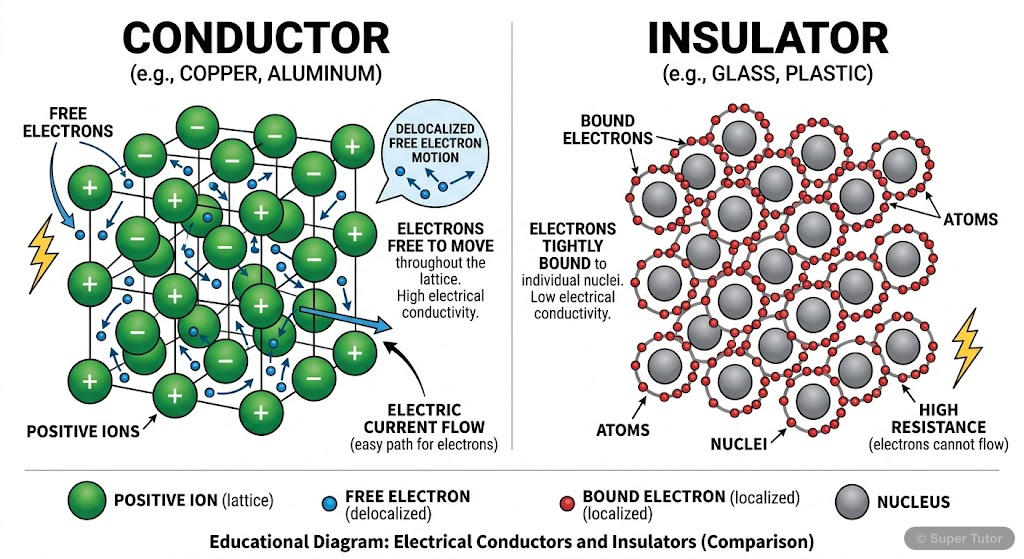
A comparison diagram illustrating the key difference between conductors and insulators at an atomic level, focusing on the availability and movement of free electrons.
Super Tutor

This is just one of 23+ visuals inside Super Tutor's Electric Charges and Fields chapter

Explore the full set
23 Questions Solved · 1 Section

EXERCISES

1.1What is the force between two small charged spheres having charges of 2×1072 \times 10^{-7} C and 3×1073 \times 10^{-7} C placed 30 cm apart in air?Show solution
Given:
- q1=2×10⁷q_1 = 2 \times 10^{-7} C
- q2=3×10⁷q_2 = 3 \times 10^{-7} C
- r=30r = 30 cm =0.30= 0.30 m
- k=9×10⁹k = 9 \times 10^9 N m² C⁻²

Formula (Coulomb's Law):
F=kq1q2r2F = k\frac{q_1 q_2}{r^2}

Calculation:
F=9×109×(2×107)(3×10⁷)(0.30)2F = 9 \times 10^9 \times \frac{(2 \times 10^{-7})(3 \times 10^{-7})}{(0.30)^2}
F=9×109×6×10149×102F = 9 \times 10^9 \times \frac{6 \times 10^{-14}}{9 \times 10^{-2}}
F=9×109×69×1012F = 9 \times 10^9 \times \frac{6}{9} \times 10^{-12}
F=6×10³ NF = 6 \times 10^{-3} \text{ N}

Result: The force between the two spheres is 6×1036 \times 10^{-3} N. Since both charges are positive, the force is repulsive.
1.2The electrostatic force on a small sphere of charge 0.4μ0.4\,\muC due to another small sphere of charge 0.8μ-0.8\,\muC in air is 0.20.2 N. (a) What is the distance between the two spheres? (b) What is the force on the second sphere due to the first?Show solution
Given:
- q1=0.4μC=0.4×10⁶q_1 = 0.4\,\mu\text{C} = 0.4 \times 10^{-6} C
- q2=0.8μC=0.8×10⁶q_2 = -0.8\,\mu\text{C} = -0.8 \times 10^{-6} C
- F=0.2F = 0.2 N
- k=9×10⁹k = 9 \times 10^9 N m² C⁻²

(a) Distance between the spheres:

Using Coulomb's law:
F=kq1q2r2F = k\frac{|q_1||q_2|}{r^2}
r2=kq1q2Fr^2 = k\frac{|q_1||q_2|}{F}
r2=9×109×0.4×106×0.8×1060.2r^2 = \frac{9 \times 10^9 \times 0.4 \times 10^{-6} \times 0.8 \times 10^{-6}}{0.2}
r2=9×109×3.2×10130.2r^2 = \frac{9 \times 10^9 \times 3.2 \times 10^{-13}}{0.2}
r2=2.88×1030.2=1.44×10²r^2 = \frac{2.88 \times 10^{-3}}{0.2} = 1.44 \times 10^{-2}
r=0.12 m=12 cmr = 0.12 \text{ m} = 12 \text{ cm}

(b) Force on the second sphere due to the first:

By Newton's Third Law, the force on the second sphere due to the first is equal in magnitude and opposite in direction to the force on the first sphere due to the second.

F=0.2 N (attractive, directed towards the first sphere)\boxed{F = 0.2 \text{ N (attractive, directed towards the first sphere)}}
1.3Check that the ratio ke2/Gmempke^2/Gm_em_p is dimensionless. Look up a Table of Physical Constants and determine the value of this ratio. What does the ratio signify?Show solution
Checking dimensions:

- k=14πε0k = \frac{1}{4\pi\varepsilon_0} has dimensions [M L3T4A2][\text{M L}^3 \text{T}^{-4} \text{A}^{-2}]
- ee (charge) has dimensions [A T][\text{A T}]
- GG (gravitational constant) has dimensions [M1L3T2][\text{M}^{-1}\text{L}^3\text{T}^{-2}]
- mem_e, mpm_p (masses) have dimensions [M][\text{M}]

Dimensions of numerator ke2ke^2:
[M L3T4A2][A2T2]=[M L3T2][\text{M L}^3 \text{T}^{-4} \text{A}^{-2}][\text{A}^2\text{T}^2] = [\text{M L}^3 \text{T}^{-2}]

Dimensions of denominator GmempGm_em_p:
[M1L3T2][M][M]=[M L3T2][\text{M}^{-1}\text{L}^3\text{T}^{-2}][\text{M}][\text{M}] = [\text{M L}^3 \text{T}^{-2}]

Since numerator and denominator have the same dimensions, the ratio is dimensionless. ✓

Numerical value:

Using standard values:
- k=9×10⁹k = 9 \times 10^9 N m² C⁻²
- e=1.6×10¹⁹e = 1.6 \times 10^{-19} C
- G=6.67×10¹¹G = 6.67 \times 10^{-11} N m² kg⁻²
- me=9.11×1031m_e = 9.11 \times 10^{-31} kg
- mp=1.67×1027m_p = 1.67 \times 10^{-27} kg

ke2Gmemp=9×109×(1.6×1019)26.67×1011×9.11×1031×1.67×1027\frac{ke^2}{Gm_em_p} = \frac{9\times10^9 \times (1.6\times10^{-19})^2}{6.67\times10^{-11}\times9.11\times10^{-31}\times1.67\times10^{-27}}

=9×109×2.56×10386.67×9.11×1.67×1069= \frac{9\times10^9 \times 2.56\times10^{-38}}{6.67\times9.11\times1.67\times10^{-69}}

=2.304×10281.016×10672.27×1039= \frac{2.304\times10^{-28}}{1.016\times10^{-67}} \approx 2.27 \times 10^{39}

Significance: This ratio (2.4×1039\approx 2.4 \times 10^{39}) represents the ratio of the electrostatic force to the gravitational force between a proton and an electron. It shows that the electric force between an electron and a proton is about 2.4×10392.4 \times 10^{39} times stronger than the gravitational force between them.
1.4(a) Explain the meaning of the statement 'electric charge of a body is quantised'. (b) Why can one ignore quantisation of electric charge when dealing with macroscopic i.e., large scale charges?Show solution
(a) Quantisation of electric charge:

The statement means that the electric charge on any body is always an integral multiple of the basic unit of charge ee (the charge of an electron or proton, e=1.6×10¹⁹e = 1.6 \times 10^{-19} C).

Mathematically: q=neq = ne, where n=0,±1,±2,±3,n = 0, \pm1, \pm2, \pm3, \ldots

This means charge cannot take arbitrary values — it can only exist in discrete packets of ee. Charge can neither be created nor destroyed, and it always appears as an integer multiple of ee.

(b) Why quantisation can be ignored at macroscopic scale:

At the macroscopic level, the charges involved are enormously large compared to the elementary charge e=1.6×10¹⁹e = 1.6 \times 10^{-19} C. For example, even 1μC=1061\,\mu\text{C} = 10^{-6} C corresponds to n=1061.6×10196.25×1012n = \frac{10^{-6}}{1.6\times10^{-19}} \approx 6.25 \times 10^{12} elementary charges.

When nn is such a large number, the discreteness (step size ee) becomes negligibly small compared to the total charge, and the charge appears to vary continuously. Hence, quantisation can be ignored for macroscopic charges.
1.5When a glass rod is rubbed with a silk cloth, charges appear on both. A similar phenomenon is observed with many other pairs of bodies. Explain how this observation is consistent with the law of conservation of charge.Show solution
Explanation:

Before rubbing, both the glass rod and the silk cloth are electrically neutral — the total charge of the system is zero.

When the glass rod is rubbed with silk, electrons are transferred from the glass rod to the silk cloth. As a result:
- The glass rod loses electrons and acquires a positive charge +q+q.
- The silk cloth gains electrons and acquires a negative charge q-q.

The charges on the two bodies are equal in magnitude and opposite in sign.

Total charge after rubbing =+q+(q)=0= +q + (-q) = 0

This equals the total charge before rubbing (zero). Hence, no charge is created or destroyed — charge is only transferred from one body to another.

This is perfectly consistent with the law of conservation of charge, which states that the total charge of an isolated system remains constant.
1.6Four point charges qA=2μq_A = 2\,\muC, qB=5μq_B = -5\,\muC, qC=2μq_C = 2\,\muC, and qD=5μq_D = -5\,\muC are located at the corners of a square ABCD of side 10 cm. What is the force on a charge of 1μ1\,\muC placed at the centre of the square?Show solution
Given:
- qA=2μCq_A = 2\,\mu\text{C}, qB=5μCq_B = -5\,\mu\text{C}, qC=2μCq_C = 2\,\mu\text{C}, qD=5μCq_D = -5\,\mu\text{C}
- Side of square =10= 10 cm =0.1= 0.1 m
- Test charge q0=1μCq_0 = 1\,\mu\text{C} at centre O

Distance from each corner to centre:
r=diagonal2=0.122=0.120.0707 mr = \frac{\text{diagonal}}{2} = \frac{0.1\sqrt{2}}{2} = \frac{0.1}{\sqrt{2}} \approx 0.0707 \text{ m}

Analysis by symmetry:

The charges at the corners are:
- qA=qC=+2μCq_A = q_C = +2\,\mu\text{C} (at diagonally opposite corners A and C)
- qB=qD=5μCq_B = q_D = -5\,\mu\text{C} (at diagonally opposite corners B and D)

Since qA=qCq_A = q_C and they are at diagonally opposite corners, the forces on q0q_0 due to qAq_A and qCq_C are equal in magnitude but opposite in direction (along diagonal AC). They cancel each other.

Similarly, since qB=qDq_B = q_D and they are at diagonally opposite corners, the forces on q0q_0 due to qBq_B and qDq_D are equal in magnitude but opposite in direction (along diagonal BD). They cancel each other.

Therefore, the net force on the charge at the centre is zero.

Fnet=0\boxed{F_{\text{net}} = 0}
1.7(a) An electrostatic field line is a continuous curve. That is, a field line cannot have sudden breaks. Why not? (b) Explain why two field lines never cross each other at any point?Show solution
(a) Why field lines cannot have sudden breaks:

An electric field line represents the path along which a positive test charge would move under the influence of the electric field. The electric field exists at every point in space (except at the location of a source charge). If a field line had a sudden break at some point, it would imply that the electric field is zero or undefined at that point (with no charge present there), which is physically impossible in a region free of charges. Therefore, field lines must be continuous curves — they start from positive charges and end on negative charges (or go to infinity), without any breaks in between.

(b) Why two field lines never cross each other:

At any given point in space, the electric field has a unique direction (a single resultant direction). An electric field line is drawn such that the tangent at any point gives the direction of the electric field at that point.

If two field lines were to cross at a point, it would mean that the electric field at that point has two different directions simultaneously — one along the tangent to each field line. This is physically impossible since the electric field at any point can have only one unique direction.

Hence, two field lines can never cross each other.
1.8Two point charges qA=3μq_A = 3\,\muC and qB=3μq_B = -3\,\muC are located 20 cm apart in vacuum. (a) What is the electric field at the midpoint O of the line AB joining the two charges? (b) If a negative test charge of magnitude 1.5×1091.5 \times 10^{-9} C is placed at this point, what is the force experienced by the test charge?Show solution
Given:
- qA=+3μC=3×10⁶q_A = +3\,\mu\text{C} = 3 \times 10^{-6} C
- qB=3μC=3×10⁶q_B = -3\,\mu\text{C} = -3 \times 10^{-6} C
- Distance AB =20= 20 cm, so r=10r = 10 cm =0.1= 0.1 m (distance from each charge to midpoint O)

(a) Electric field at midpoint O:

Electric field at O due to qAq_A (positive charge, directed away from qAq_A, i.e., from A towards B):
EA=kqAr2=9×109×3×106(0.1)2=2.7×1040.01=2.7×10⁶ N/CE_A = k\frac{q_A}{r^2} = \frac{9\times10^9 \times 3\times10^{-6}}{(0.1)^2} = \frac{2.7\times10^4}{0.01} = 2.7\times10^6 \text{ N/C}
Direction: from A to B (let's call this the positive x-direction).

Electric field at O due to qBq_B (negative charge, directed towards qBq_B, i.e., from O towards B, same direction as EAE_A):
EB=kqBr2=9×109×3×106(0.1)2=2.7×10⁶ N/CE_B = k\frac{|q_B|}{r^2} = \frac{9\times10^9 \times 3\times10^{-6}}{(0.1)^2} = 2.7\times10^6 \text{ N/C}
Direction: from A to B (towards qBq_B).

Both fields point in the same direction (from A to B):
Enet=EA+EB=2.7×10⁶+2.7×106=5.4×10⁶ N/CE_{\text{net}} = E_A + E_B = 2.7\times10^6 + 2.7\times10^6 = 5.4\times10^6 \text{ N/C}

The electric field at O is 5.4×1065.4 \times 10^6 N/C directed from A to B (from positive to negative charge).

(b) Force on the test charge:

- Test charge q0=1.5×10⁹q_0 = -1.5 \times 10^{-9} C (negative)

F=q0×Enet=1.5×109×5.4×106=8.1×10³ NF = |q_0| \times E_{\text{net}} = 1.5\times10^{-9} \times 5.4\times10^6 = 8.1\times10^{-3} \text{ N}

Since the test charge is negative, the force on it is opposite to the direction of the electric field, i.e., directed from B to A.

The force on the test charge is 8.1×1038.1 \times 10^{-3} N directed from B to A (opposite to the electric field direction).
1.9A system has two charges qA=2.5×10⁷q_A = 2.5 \times 10^{-7} C and qB=2.5×10⁷q_B = -2.5 \times 10^{-7} C located at points A: (0, 0, −15 cm) and B: (0, 0, +15 cm), respectively. What are the total charge and electric dipole moment of the system?Show solution
Given:
- qA=+2.5×10⁷q_A = +2.5 \times 10^{-7} C at A: (0,0,15 cm)=(0,0,0.15 m)(0, 0, -15\text{ cm}) = (0, 0, -0.15\text{ m})
- qB=2.5×10⁷q_B = -2.5 \times 10^{-7} C at B: (0,0,+15 cm)=(0,0,+0.15 m)(0, 0, +15\text{ cm}) = (0, 0, +0.15\text{ m})

Total charge:
qtotal=qA+qB=2.5×10⁷+(2.5×10⁷)=0q_{\text{total}} = q_A + q_B = 2.5\times10^{-7} + (-2.5\times10^{-7}) = 0

Electric dipole moment:

The dipole moment vector p\mathbf{p} is directed from the negative charge to the positive charge.

- Negative charge qBq_B is at B: (0,0,+0.15)(0, 0, +0.15) m
- Positive charge qAq_A is at A: (0,0,0.15)(0, 0, -0.15) m

So p\mathbf{p} points from B to A, i.e., in the negative z-direction.

Magnitude of dipole moment:
p=q×2a|\mathbf{p}| = q \times 2a
where q=2.5×10⁷q = 2.5 \times 10^{-7} C and 2a2a = distance between charges =30= 30 cm =0.30= 0.30 m.

p=2.5×107×0.30=7.5×10⁸ C m|\mathbf{p}| = 2.5\times10^{-7} \times 0.30 = 7.5\times10^{-8} \text{ C m}

The electric dipole moment is p=7.5×10⁸\mathbf{p} = 7.5 \times 10^{-8} C m directed along the negative z-axis (from B towards A, i.e., from q-q to +q+q).
1.10An electric dipole with dipole moment 4×1094 \times 10^{-9} C m is aligned at 30°30° with the direction of a uniform electric field of magnitude 5×1045 \times 10^4 NC1^{-1}. Calculate the magnitude of the torque acting on the dipole.Show solution
Given:
- Dipole moment p=4×10⁹p = 4 \times 10^{-9} C m
- Electric field E=5×10⁴E = 5 \times 10^4 N/C
- Angle θ=30°\theta = 30°

Formula:
τ=pEsinθ\tau = pE\sin\theta

Calculation:
τ=4×109×5×104×sin30°\tau = 4\times10^{-9} \times 5\times10^4 \times \sin 30°
τ=4×109×5×104×0.5\tau = 4\times10^{-9} \times 5\times10^4 \times 0.5
τ=4×109×2.5×104\tau = 4\times10^{-9} \times 2.5\times10^4
τ=104 N m\tau = 10^{-4} \text{ N m}

The magnitude of the torque acting on the dipole is 10410^{-4} N m.
1.11A polythene piece rubbed with wool is found to have a negative charge of 3×1073 \times 10^{-7} C. (a) Estimate the number of electrons transferred (from which to which?) (b) Is there a transfer of mass from wool to polythene?Show solution
Given:
- Charge on polythene =3×107= -3 \times 10^{-7} C
- Charge on electron e=1.6×10¹⁹e = 1.6 \times 10^{-19} C

(a) Number of electrons transferred:

Since polythene has acquired a negative charge, electrons have been transferred from wool to polythene.

n=qe=3×1071.6×1019n = \frac{q}{e} = \frac{3\times10^{-7}}{1.6\times10^{-19}}
n=1.875×10121.9×1012 electronsn = 1.875 \times 10^{12} \approx 1.9 \times 10^{12} \text{ electrons}

Approximately 1.9×10121.9 \times 10^{12} electrons are transferred from wool to polythene.

(b) Transfer of mass:

Yes, since electrons (which have mass) are transferred from wool to polythene, there is indeed a transfer of mass.

Mass of one electron me=9.11×1031m_e = 9.11 \times 10^{-31} kg

Mass transferred =n×me=1.875×1012×9.11×1031= n \times m_e = 1.875\times10^{12} \times 9.11\times10^{-31}
=1.71×10¹⁸ kg= 1.71 \times 10^{-18} \text{ kg}

This is an extremely small (negligible) mass, but technically yes, there is a transfer of mass from wool to polythene.
1.12(a) Two insulated charged copper spheres A and B have their centres separated by a distance of 50 cm. What is the mutual force of electrostatic repulsion if the charge on each is 6.5×1076.5 \times 10^{-7} C? The radii of A and B are negligible compared to the distance of separation. (b) What is the force of repulsion if each sphere is charged double the above amount, and the distance between them is halved?Show solution
Given:
- qA=qB=6.5×10⁷q_A = q_B = 6.5 \times 10^{-7} C
- r=50r = 50 cm =0.5= 0.5 m
- k=9×10⁹k = 9 \times 10^9 N m² C⁻²

(a) Initial force:
F=kqAqBr2=9×109×(6.5×107)2(0.5)2F = k\frac{q_A q_B}{r^2} = \frac{9\times10^9 \times (6.5\times10^{-7})^2}{(0.5)^2}
=9×109×4.225×10130.25= \frac{9\times10^9 \times 4.225\times10^{-13}}{0.25}
=3.8025×1030.25= \frac{3.8025\times10^{-3}}{0.25}
=1.521×10² N1.52×102 N= 1.521 \times 10^{-2} \text{ N} \approx 1.52 \times 10^{-2} \text{ N}

(b) New force when charge is doubled and distance is halved:

- New charge: q=2×6.5×107=1.3×10⁶q' = 2 \times 6.5\times10^{-7} = 1.3\times10^{-6} C
- New distance: r=0.5/2=0.25r' = 0.5/2 = 0.25 m

F=kq2r2=9×109×(1.3×106)2(0.25)2F' = k\frac{q'^2}{r'^2} = \frac{9\times10^9 \times (1.3\times10^{-6})^2}{(0.25)^2}
=9×109×1.69×10120.0625= \frac{9\times10^9 \times 1.69\times10^{-12}}{0.0625}
=1.521×1020.0625=0.2434 N0.243 N= \frac{1.521\times10^{-2}}{0.0625} = 0.2434 \text{ N} \approx 0.243 \text{ N}

Alternatively, note that Fq2r2F \propto \frac{q^2}{r^2}. When q2qq \to 2q and rr/2r \to r/2:
F=F×(2)2(1/2)2=F×41/4=16F=16×1.521×1020.243 NF' = F \times \frac{(2)^2}{(1/2)^2} = F \times \frac{4}{1/4} = 16F = 16 \times 1.521\times10^{-2} \approx 0.243 \text{ N}

The new force of repulsion is approximately 0.2430.243 N.
1.13Figure 1.30 shows tracks of three charged particles in a uniform electrostatic field. Give the signs of the three charges. Which particle has the highest charge to mass ratio?Show solution
Note: The figure shows three particle tracks in a uniform electric field. Based on the standard version of this figure in NCERT:
- Particles 1 and 2 curve towards the positive plate (upward, assuming field points upward)
- Particle 3 curves towards the negative plate

Signs of charges:

- Particle 1: Curves towards the positive plate → it is a negative charge.
- Particle 2: Curves towards the positive plate → it is a negative charge.
- Particle 3: Curves towards the negative plate → it is a positive charge.

*(In the standard NCERT figure: particles 1 and 2 deflect in one direction and particle 3 deflects in the opposite direction.)*

Highest charge-to-mass ratio:

The deflection of a charged particle in an electric field is given by:
y=12qEmt2y = \frac{1}{2}\frac{qE}{m}t^2

Greater deflection (more curved track) for the same initial velocity implies a higher q/mq/m ratio.

From the figure, particle 3 shows the greatest curvature (sharpest deflection), so it has the highest charge-to-mass ratio.
1.14Consider a uniform electric field E=3×10³i^\mathbf{E} = 3 \times 10^3\,\hat{i} N/C. (a) What is the flux of this field through a square of 10 cm on a side whose plane is parallel to the yzyz plane? (b) What is the flux through the same square if the normal to its plane makes a 60°60° angle with the xx-axis?Show solution
Given:
- E=3×10³i^\mathbf{E} = 3\times10^3\,\hat{i} N/C
- Side of square =10= 10 cm =0.1= 0.1 m
- Area A=(0.1)2=0.01A = (0.1)^2 = 0.01

(a) Plane parallel to the yzyz-plane:

If the plane is parallel to the yzyz-plane, the normal to the plane is along the xx-axis (i.e., n^=i^\hat{n} = \hat{i}).

Angle between E\mathbf{E} and n^\hat{n}: θ=0°\theta = 0°

ϕ=EAcosθ=3×103×0.01×cos0°\phi = E \cdot A \cos\theta = 3\times10^3 \times 0.01 \times \cos 0°
ϕ=3×103×0.01×1=30 N m2/C\phi = 3\times10^3 \times 0.01 \times 1 = 30 \text{ N m}^2/\text{C}

(b) Normal makes 60°60° with the xx-axis:

ϕ=EAcosθ=3×103×0.01×cos60°\phi = E \cdot A \cos\theta = 3\times10^3 \times 0.01 \times \cos 60°
ϕ=30×0.5=15 N m2/C\phi = 30 \times 0.5 = 15 \text{ N m}^2/\text{C}
1.15What is the net flux of the uniform electric field of Exercise 1.14 through a cube of side 20 cm oriented so that its faces are parallel to the coordinate planes?Show solution
Given:
- E=3×10³i^\mathbf{E} = 3\times10^3\,\hat{i} N/C (uniform field along xx-axis)
- Cube of side 20 cm with faces parallel to coordinate planes

Concept: For a uniform electric field, the net flux through any closed surface is zero, because the field is the same everywhere and the total charge enclosed is zero.

Detailed reasoning:

For a cube with faces parallel to coordinate planes:
- The two faces perpendicular to the xx-axis (left and right faces) have normals along ±i^\pm\hat{i}.
- Flux through right face: ϕ1=E×A=3×103×(0.2)2=3×103×0.04=120\phi_1 = E \times A = 3\times10^3 \times (0.2)^2 = 3\times10^3 \times 0.04 = 120 N m²/C (outward)
- Flux through left face: ϕ2=E×A=120\phi_2 = -E \times A = -120 N m²/C (inward, so negative)
- The four faces parallel to the xx-axis have normals perpendicular to E\mathbf{E}, so flux through each = 0.

Net flux:
ϕnet=ϕ1+ϕ2=120+(120)=0\phi_{\text{net}} = \phi_1 + \phi_2 = 120 + (-120) = 0

The net flux through the cube is zero. This is consistent with Gauss's law since there is no charge enclosed inside the cube.
1.16Careful measurement of the electric field at the surface of a black box indicates that the net outward flux through the surface of the box is 8.0×1038.0 \times 10^3 Nm²/C. (a) What is the net charge inside the box? (b) If the net outward flux through the surface of the box were zero, could you conclude that there were no charges inside the box? Why or Why not?Show solution
Given:
- Net outward flux ϕ=8.0×10³\phi = 8.0 \times 10^3 N m²/C
- ε0=8.854×10¹²\varepsilon_0 = 8.854 \times 10^{-12} C² N⁻¹ m⁻²

(a) Net charge inside the box:

By Gauss's law:
ϕ=qencε0\phi = \frac{q_{\text{enc}}}{\varepsilon_0}
qenc=ϕ×ε0=8.0×103×8.854×1012q_{\text{enc}} = \phi \times \varepsilon_0 = 8.0\times10^3 \times 8.854\times10^{-12}
qenc=7.08×10⁸ C0.07μCq_{\text{enc}} = 7.08\times10^{-8} \text{ C} \approx 0.07\,\mu\text{C}

The net charge inside the box is approximately 0.07μ0.07\,\muC (or 7.08×1087.08 \times 10^{-8} C).

(b) If net flux were zero:

No, we cannot conclude that there are no charges inside the box.

A zero net flux only means that the net charge enclosed is zero. It is possible that there are equal amounts of positive and negative charges inside the box that cancel each other out, giving a net charge of zero and hence zero net flux. For example, a positive charge +q+q and a negative charge q-q inside the box would give zero net flux, yet charges are present inside.
1.17A point charge +10μ+10\,\muC is a distance 5 cm directly above the centre of a square of side 10 cm, as shown in Fig. 1.31. What is the magnitude of the electric flux through the square? (Hint: Think of the square as one face of a cube with edge 10 cm.)Show solution
Given:
- Point charge q=+10μC=10×106q = +10\,\mu\text{C} = 10\times10^{-6} C
- The charge is 5 cm above the centre of a square of side 10 cm

Using the hint:

Imagine the square as one face of a cube with edge 10 cm. The point charge is at the centre of this cube (since it is 5 cm above the centre of the bottom face, and the cube has edge 10 cm, so the charge is at the centre).

By Gauss's law, the total flux through the entire cube:
ϕtotal=qε0=10×1068.854×1012=1.13×10⁶ N m2/C\phi_{\text{total}} = \frac{q}{\varepsilon_0} = \frac{10\times10^{-6}}{8.854\times10^{-12}} = 1.13\times10^6 \text{ N m}^2/\text{C}

By symmetry, the flux is distributed equally through all 6 faces of the cube.

Flux through one face (the given square):
ϕsquare=ϕtotal6=1.13×1066\phi_{\text{square}} = \frac{\phi_{\text{total}}}{6} = \frac{1.13\times10^6}{6}
ϕsquare=10×1066×8.854×10121.88×105 N m2/C\phi_{\text{square}} = \frac{10\times10^{-6}}{6\times8.854\times10^{-12}} \approx 1.88\times10^5 \text{ N m}^2/\text{C}

The magnitude of the electric flux through the square is approximately 1.88×1051.88 \times 10^5 N m²/C.
1.18A point charge of 2.0μ2.0\,\muC is at the centre of a cubic Gaussian surface 9.0 cm on edge. What is the net electric flux through the surface?Show solution
Given:
- Point charge q=2.0μC=2.0×10⁶q = 2.0\,\mu\text{C} = 2.0\times10^{-6} C at the centre of a cube
- ε0=8.854×10¹²\varepsilon_0 = 8.854\times10^{-12} C² N⁻¹ m⁻²

By Gauss's Law:

The net electric flux through any closed surface depends only on the total charge enclosed, regardless of the shape or size of the surface.

ϕ=qencε0=2.0×1068.854×1012\phi = \frac{q_{\text{enc}}}{\varepsilon_0} = \frac{2.0\times10^{-6}}{8.854\times10^{-12}}
ϕ=2.26×10⁵ N m2/C\phi = 2.26\times10^5 \text{ N m}^2/\text{C}

The net electric flux through the cubic surface is 2.26×1052.26 \times 10^5 N m²/C.

Note: The size of the cube (9.0 cm edge) does not affect the answer — only the enclosed charge matters.
1.19A point charge causes an electric flux of 1.0×10³-1.0 \times 10^3 Nm²/C to pass through a spherical Gaussian surface of 10.0 cm radius centred on the charge. (a) If the radius of the Gaussian surface were doubled, how much flux would pass through the surface? (b) What is the value of the point charge?Show solution
Given:
- Electric flux ϕ=1.0×10³\phi = -1.0\times10^3 N m²/C
- Radius of Gaussian surface r=10.0r = 10.0 cm

(a) Flux when radius is doubled:

By Gauss's law, the flux through a closed surface depends only on the charge enclosed, not on the size or shape of the surface. Doubling the radius does not change the enclosed charge.

ϕ=ϕ=1.0×10³ N m2/C\phi' = \phi = -1.0\times10^3 \text{ N m}^2/\text{C}

The flux remains 1.0×10³-1.0 \times 10^3 N m²/C.

(b) Value of the point charge:

Using Gauss's law:
ϕ=qε0\phi = \frac{q}{\varepsilon_0}
q=ϕ×ε0=1.0×103×8.854×1012q = \phi \times \varepsilon_0 = -1.0\times10^3 \times 8.854\times10^{-12}
q=8.854×10⁹ C8.85 nCq = -8.854\times10^{-9} \text{ C} \approx -8.85 \text{ nC}

The value of the point charge is approximately 8.85-8.85 nC. The negative sign indicates the charge is negative, which is consistent with the inward (negative) flux.
1.20A conducting sphere of radius 10 cm has an unknown charge. If the electric field 20 cm from the centre of the sphere is 1.5×1031.5 \times 10^3 N/C and points radially inward, what is the net charge on the sphere?Show solution
Given:
- Radius of sphere R=10R = 10 cm =0.1= 0.1 m
- Distance from centre r=20r = 20 cm =0.2= 0.2 m
- Electric field E=1.5×10³E = 1.5\times10^3 N/C (radially inward)
- ε0=8.854×10¹²\varepsilon_0 = 8.854\times10^{-12} C² N⁻¹ m⁻²

Since r > R, the sphere behaves as a point charge at the centre.

Using Gauss's law (or Coulomb's law for a sphere):
E=q4πε0r2E = \frac{|q|}{4\pi\varepsilon_0 r^2}
q=E×4πε0r2=E×r2k|q| = E \times 4\pi\varepsilon_0 r^2 = \frac{E \times r^2}{k}
q=1.5×103×(0.2)29×109|q| = \frac{1.5\times10^3 \times (0.2)^2}{9\times10^9}
q=1.5×103×0.049×109=609×109=6.67×10⁹ C|q| = \frac{1.5\times10^3 \times 0.04}{9\times10^9} = \frac{60}{9\times10^9} = 6.67\times10^{-9} \text{ C}

Since the electric field points radially inward, the charge on the sphere is negative.

q=6.67×10⁹ C6.67 nCq = -6.67\times10^{-9} \text{ C} \approx -6.67 \text{ nC}

The net charge on the sphere is approximately 6.67-6.67 nC.
1.21A uniformly charged conducting sphere of 2.4 m diameter has a surface charge density of 80.0μ80.0\,\muC/m². (a) Find the charge on the sphere. (b) What is the total electric flux leaving the surface of the sphere?Show solution
Given:
- Diameter =2.4= 2.4 m, so radius R=1.2R = 1.2 m
- Surface charge density σ=80.0μC/m2=80.0×106\sigma = 80.0\,\mu\text{C/m}^2 = 80.0\times10^{-6} C/m²

(a) Total charge on the sphere:

q=σ×4πR2q = \sigma \times 4\pi R^2
q=80.0×106×4π×(1.2)2q = 80.0\times10^{-6} \times 4\pi \times (1.2)^2
q=80.0×106×4π×1.44q = 80.0\times10^{-6} \times 4\pi \times 1.44
q=80.0×106×18.096q = 80.0\times10^{-6} \times 18.096
q=1.448×10³ C1.45×103 Cq = 1.448\times10^{-3} \text{ C} \approx 1.45\times10^{-3} \text{ C}

(b) Total electric flux leaving the surface:

By Gauss's law:
ϕ=qε0=1.448×1038.854×1012\phi = \frac{q}{\varepsilon_0} = \frac{1.448\times10^{-3}}{8.854\times10^{-12}}
ϕ=1.63×10⁸ N m2/C\phi = 1.63\times10^{8} \text{ N m}^2/\text{C}

The total charge on the sphere is 1.45×10³\approx 1.45 \times 10^{-3} C and the total electric flux leaving the surface is 1.63×10⁸\approx 1.63 \times 10^8 N m²/C.
1.22An infinite line charge produces a field of 9×1049 \times 10^4 N/C at a distance of 2 cm. Calculate the linear charge density.Show solution
Given:
- Electric field E=9×10⁴E = 9\times10^4 N/C
- Distance r=2r = 2 cm =0.02= 0.02 m
- ε0=8.854×10¹²\varepsilon_0 = 8.854\times10^{-12} C² N⁻¹ m⁻²

Formula for electric field due to an infinite line charge:
E=λ2πε0rE = \frac{\lambda}{2\pi\varepsilon_0 r}

Solving for linear charge density λ\lambda:
λ=E×2πε0r\lambda = E \times 2\pi\varepsilon_0 r
λ=9×104×2π×8.854×1012×0.02\lambda = 9\times10^4 \times 2\pi \times 8.854\times10^{-12} \times 0.02
λ=9×104×2×3.1416×8.854×1012×0.02\lambda = 9\times10^4 \times 2 \times 3.1416 \times 8.854\times10^{-12} \times 0.02
λ=9×104×1.113×1012\lambda = 9\times10^4 \times 1.113\times10^{-12}

Let me compute step by step:
2πε0=2×3.1416×8.854×1012=5.563×10112\pi\varepsilon_0 = 2 \times 3.1416 \times 8.854\times10^{-12} = 5.563\times10^{-11}
λ=9×104×5.563×1011×0.02\lambda = 9\times10^4 \times 5.563\times10^{-11} \times 0.02
λ=9×104×1.113×1012\lambda = 9\times10^4 \times 1.113\times10^{-12}
λ=107 C/m=0.1μC/m\lambda = 10^{-7} \text{ C/m} = 0.1\,\mu\text{C/m}

The linear charge density is λ=107\lambda = 10^{-7} C/m =0.1μ= 0.1\,\muC/m.
1.23Two large, thin metal plates are parallel and close to each other. On their inner faces, the plates have surface charge densities of opposite signs and of magnitude 17.0×102217.0 \times 10^{-22} C/m². What is E\mathbf{E}: (a) in the outer region of the first plate, (b) in the outer region of the second plate, and (c) between the plates?Show solution
Given:
- Surface charge density on each plate: σ=17.0×10²²\sigma = 17.0\times10^{-22} C/m²
- One plate has +σ+\sigma and the other has σ-\sigma on their inner faces.
- ε0=8.854×10¹²\varepsilon_0 = 8.854\times10^{-12} C² N⁻¹ m⁻²

Concept: For two parallel plates with equal and opposite surface charge densities:
- The electric field between the plates adds up.
- The electric field outside the plates cancels out.

Each plate alone produces a field E=σ2ε0E = \frac{\sigma}{2\varepsilon_0} on each side.

(a) Outer region of the first plate:

In the outer region of the positive plate, the field due to the positive plate points outward (++) and the field due to the negative plate points inward (towards the negative plate, which is also outward from the positive plate's perspective — but they cancel).

For two plates with +σ+\sigma and σ-\sigma:
- Outside both plates: fields from the two plates are equal and opposite → they cancel.

Eouter=0E_{\text{outer}} = 0

(b) Outer region of the second plate:

By the same argument:
Eouter=0E_{\text{outer}} = 0

(c) Between the plates:

Between the plates, the fields from both plates point in the same direction (from ++ plate to - plate) and add up:
Ebetween=σ2ε0+σ2ε0=σε0E_{\text{between}} = \frac{\sigma}{2\varepsilon_0} + \frac{\sigma}{2\varepsilon_0} = \frac{\sigma}{\varepsilon_0}
Ebetween=17.0×10228.854×1012E_{\text{between}} = \frac{17.0\times10^{-22}}{8.854\times10^{-12}}
Ebetween=1.92×10¹⁰ N/C1.9×1010 N/CE_{\text{between}} = 1.92\times10^{-10} \text{ N/C} \approx 1.9\times10^{-10} \text{ N/C}

Summary:
- (a) E=0E = 0 in the outer region of the first plate
- (b) E=0E = 0 in the outer region of the second plate
- (c) E1.9×1010E \approx 1.9 \times 10^{-10} N/C between the plates, directed from the positive to the negative plate.

Stuck on a step?

Ask Super Tutor AI to explain any solution on this page in a simpler way — free, 24x7.

Ask a Doubt Free

Frequently Asked Questions

What are the important topics in Electric Charges and Fields for CBSE Class 12 Physics?
Electric Charges and Fields covers several key topics that are frequently asked in CBSE Class 12 board exams. Focus on the core concepts listed on this page and practise related questions to build confidence.
How to score full marks in Electric Charges and Fields — CBSE Class 12 Physics?
Understand the core concepts first, then work through the 74 practice questions available for this chapter. Revise formulas and definitions regularly, and use flashcards for quick recall before the exam.
Where can I get free NCERT Solutions for Electric Charges and Fields Class 12 Physics?
This page has free step-by-step NCERT Solutions for every exercise question in Electric Charges and Fields (CBSE Class 12 Physics) — written the way examiners award marks: given, formula, working, answer.

Sources & Official References

Content is aligned to the official syllabus. Refer to the board website for the latest curriculum.

For serious students

Get the full Electric Charges and Fields chapter — for free.

Quizzes, flashcards, AI doubt-solver and a step-by-step study plan for CBSE Class 12 Physics.