Nucle
CBSE · Class 12 · Physics
NCERT Solutions for Nucle — CBSE Class 12 Physics.
Interactive on Super Tutor
Studying Nucle? Get the full interactive chapter.
Quizzes, flashcards, AI doubt-solver and a step-by-step study plan — built for ncert solutions and more.
1,000+ Class 12 students started this chapter today
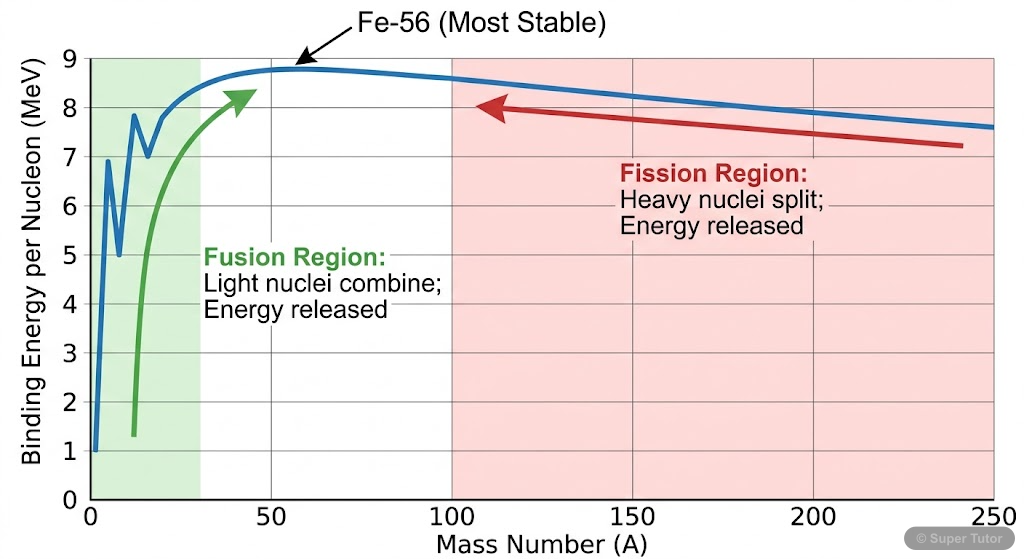
This is just one of 15+ visuals inside Super Tutor's Nucle chapter
Explore the full set5 worked solutions below. Unlock all 10 free in Super Tutor
EXERCISES
13.1Obtain the binding energy (in MeV) of a nitrogen nucleus , given Show solution
Mass defect:
Using the given atomic masses, it is easier to use
because the electron masses cancel.
Binding energy:
So the binding energy is about 105 MeV.
Not sure why a step works? check your working in Super Tutor
13.2Obtain the binding energy of the nuclei and in units of MeV from the following data:Show solution
### For
### For
So the binding energies are approximately 492 MeV and 1.64\times 10^3 MeV.
Not sure why a step works? check your working in Super Tutor
13.3A given coin has a mass of . Calculate the nuclear energy that would be required to separate all the neutrons and protons from each other. For simplicity assume that the coin is entirely made of atoms (of mass 62.92960 u).Show solution
Energy required for one nucleus:
Number of atoms in 3.0 g of copper:
Total energy:
Convert to joules using :
So the required nuclear energy is of order ** J; more precisely about J**.
If one uses the textbook-style approximate binding energy per nucleon more crudely, the answer is still in the same order, – J. The calculated value above is the best estimate from the given chapter data and standard nuclear binding-energy reasoning.
Not sure why a step works? check your working in Super Tutor
13.4Obtain approximately the ratio of the nuclear radii of the gold isotope and the silver isotope .Show solution
So the ratio of radii is
Therefore, the radius of gold nucleus is about 1.21 times that of silver nucleus.
Not sure why a step works? check your working in Super Tutor
13.5The value of a nuclear reaction is defined byShow solution
It is also equal to the difference between final and initial kinetic energies:
If , the reaction is exothermic; if , it is endothermic.
Not sure why a step works? check your working in Super Tutor
5 more solved questions in Nucle
Every remaining exercise is solved step by step in Super Tutor, plus practice quizzes and flashcards for this chapter. Free to start.
Stuck on a step?
Ask Super Tutor AI to explain any solution on this page in a simpler way — free, 24x7.
Ask a Doubt FreeFrequently Asked Questions
What are the important topics in Nucle for CBSE Class 12 Physics?
How to score full marks in Nucle — CBSE Class 12 Physics?
Where can I get free NCERT Solutions for Nucle Class 12 Physics?
Sources & Official References
- NCERT Official — ncert.nic.in
- CBSE Academic — cbseacademic.nic.in
- CBSE Official — cbse.gov.in
- National Education Policy 2020 — education.gov.in
Content is aligned to the official syllabus. Refer to the board website for the latest curriculum.
More resources for Nucle
Practice Quiz
Test yourself with a quick quiz
Important Questions
Practice with board exam-style questions
Revision Notes
Key points for last-minute revision
Formula Sheet
All formulas in one place
Chapter Summary
Understand the chapter at a glance
Concept Maps
See how topics connect visually
Study Plan
Step-by-step plan to ace this chapter
Flashcards
Quick-fire cards for active recall
Syllabus
What topics to cover
For serious students
Get the full Nucle chapter — for free.
Quizzes, flashcards, AI doubt-solver and a step-by-step study plan for CBSE Class 12 Physics.