Wave Optics
CBSE · Class 12 · Physics
NCERT Solutions for Wave Optics — CBSE Class 12 Physics.
Interactive on Super Tutor
Studying Wave Optics? Get the full interactive chapter.
Quizzes, flashcards, AI doubt-solver and a step-by-step study plan — built for ncert solutions and more.
1,000+ Class 12 students started this chapter today
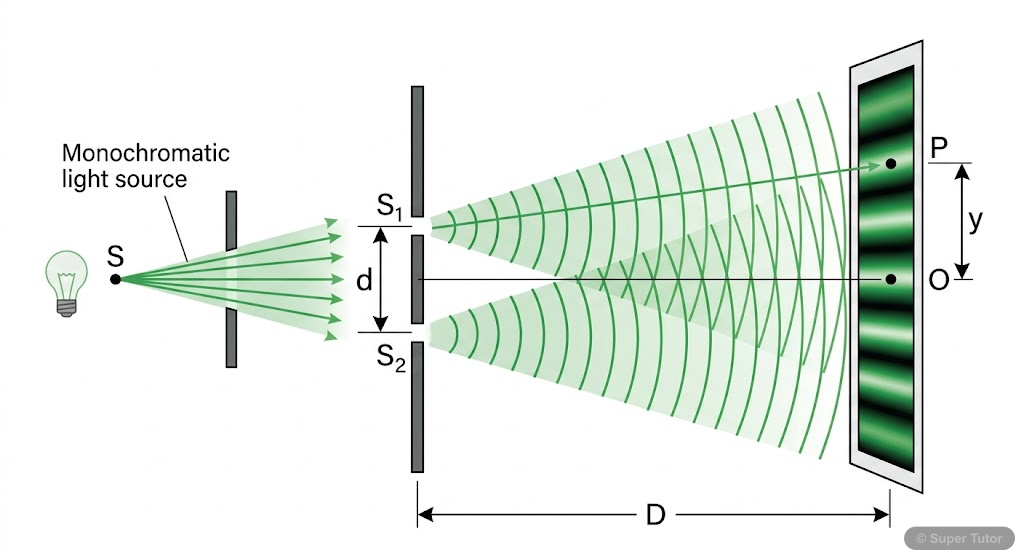
This is just one of 17+ visuals inside Super Tutor's Wave Optics chapter
Explore the full set4 worked solutions below. Unlock all 7 free in Super Tutor
EXERCISES
10.1Monochromatic light of wavelength 589 nm is incident from air on a water surface. What are the wavelength, frequency and speed of (a) reflected, and (b) refracted light? Refractive index of water is 1.33.Show solution
- Frequency remains unchanged on reflection and refraction.
- In air, wavelength is given as .
### (a) Reflected light
Since reflection does not change the medium,
- wavelength =
- frequency =
- speed =
### (b) Refracted light in water
Using ,
Frequency remains the same, so
Wavelength in water is
So the refracted light has smaller wavelength and lower speed, but the same frequency.
Not sure why a step works? check your working in Super Tutor
10.2What is the shape of the wavefront in each of the following cases:Show solution
(a) Light diverging from a point source: a spherical wavefront.
(b) Light emerging out of a convex lens when a point source is placed at its focus: a plane wavefront.
(c) The portion of the wavefront of light from a distant star intercepted by the Earth: a plane wavefront.
Not sure why a step works? check your working in Super Tutor
10.3(a)The refractive index of glass is 1.5. What is the speed of light in glass? (Speed of light in vacuum is 3.0 × 10⁸ m s⁻¹)Show solution
Given and ,
So the speed of light in glass is ****.
Not sure why a step works? check your working in Super Tutor
10.3(b)Is the speed of light in glass independent of the colour of light? If not, which of the two colours red and violet travels slower in a glass prism?Show solution
Between red and violet, violet travels slower in a glass prism, and red travels faster.
Not sure why a step works? check your working in Super Tutor
3 more solved questions in Wave Optics
Every remaining exercise is solved step by step in Super Tutor, plus practice quizzes and flashcards for this chapter. Free to start.
Stuck on a step?
Ask Super Tutor AI to explain any solution on this page in a simpler way — free, 24x7.
Ask a Doubt FreeFrequently Asked Questions
What are the important topics in Wave Optics for CBSE Class 12 Physics?
How to score full marks in Wave Optics — CBSE Class 12 Physics?
Where can I get free NCERT Solutions for Wave Optics Class 12 Physics?
Sources & Official References
- NCERT Official — ncert.nic.in
- CBSE Academic — cbseacademic.nic.in
- CBSE Official — cbse.gov.in
- National Education Policy 2020 — education.gov.in
Content is aligned to the official syllabus. Refer to the board website for the latest curriculum.
More resources for Wave Optics
Practice Quiz
Test yourself with a quick quiz
Important Questions
Practice with board exam-style questions
Revision Notes
Key points for last-minute revision
Formula Sheet
All formulas in one place
Chapter Summary
Understand the chapter at a glance
Concept Maps
See how topics connect visually
Study Plan
Step-by-step plan to ace this chapter
Flashcards
Quick-fire cards for active recall
Syllabus
What topics to cover
For serious students
Get the full Wave Optics chapter — for free.
Quizzes, flashcards, AI doubt-solver and a step-by-step study plan for CBSE Class 12 Physics.