Analytical chemistry — Flashcards
ICSE · Class 10 · Chemistry
38 flashcards for Analytical chemistry (ICSE Class 10 Chemistry) to test yourself on key terms and facts. Sample: "What is analytical chemistry?"
Interactive on Super Tutor
Studying Analytical chemistry? Get the full interactive chapter.
Quizzes, flashcards, AI doubt-solver and a step-by-step study plan — built for flashcards and more.
Free trial, no card needed.
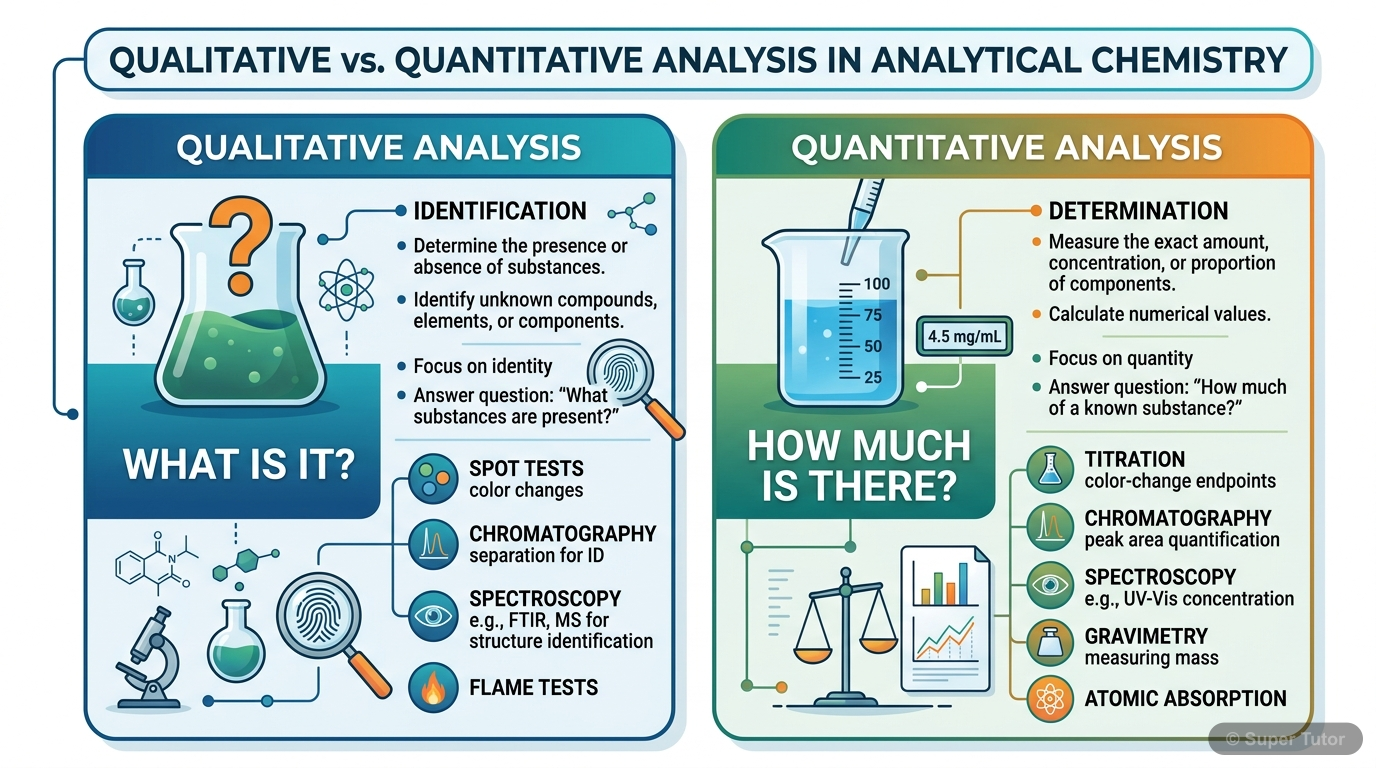
Learn better with visuals Super Tutor pairs illustrations like this with notes and quizzes for Analytical chemistry.
Get startedWhat is analytical chemistry?
Answer
The branch of chemistry which deals with the analysis of a chemical substance or its solution to explore its nature, composition and constitution is called Analytical chemistry.
What is qualitative analysis?
Answer
In qualitative analysis, the nature and quality of the substance under examination are determined.
What is quantitative analysis?
Answer
It deals with the determination of constituents of a chemical substance or mixture.
Why is a salt coloured or colourless?
Answer
The colour of a salt is due to the presence of a coloured ion in it. Ions of normal elements are colourless, while ions of transitional elements, lanthanides and actinides are generally coloured. Exam…
What are basic radical and acidic radical?
Answer
A positively charged ion is called a cation or a basic radical because it comes from the base during neutralisation. A negatively charged ion is called an anion or an acidic radical because it comes f…
What is precipitation in chemistry?
Answer
Precipitation is the process which involves the formation of an insoluble substance on mixing two or more solutions together. The insoluble substance formed is called a precipitate.
What is the use of ammonium hydroxide in qualitative analysis?
Answer
Ammonium hydroxide is used for precipitation of metal cations, formation of complex salts, making the medium weakly basic, and providing ammonia.
What happens when calcium chloride solution is treated with ammonium hydroxide?
Answer
CaCl2 + 2NH4OH → Ca(OH)2 ↓ (dull white) + 2NH4Cl. A dull white precipitate of calcium hydroxide is formed and it remains insoluble in excess ammonium hydroxide.
+30 more flashcards
Practise AllFrequently Asked Questions
What are the important topics in Analytical chemistry for ICSE Class 10 Chemistry?
How many flashcards are available for Analytical chemistry?
How should I revise Analytical chemistry for the ICSE Class 10 board exam?
Sources & Official References
Content is aligned to the official syllabus. Refer to the board website for the latest curriculum.
More resources for Analytical chemistry
Practice Quiz
Test yourself with a quick quiz
Important Questions
Exam-style questions with answers
Revision Notes
Key points for last-minute revision
Formula Sheet
The chapter's formulas in one place
Chapter Summary
Understand the chapter at a glance
Concept Maps
See how topics connect
Study Plan
Step-by-step plan for this chapter
Syllabus
What topics to cover
For serious students
Get the full Analytical chemistry chapter — start free.
Quizzes, flashcards, an AI doubt solver and a study plan for ICSE Class 10 Chemistry. Free to start, no card needed.