Analytical chemistry
ICSE · Class 10 · Chemistry
Quick revision notes for Analytical chemistry — ICSE Class 10 Chemistry. Key concepts, formulas, and definitions for last-minute revision.
Interactive on Super Tutor
Studying Analytical chemistry? Get the full interactive chapter.
Quizzes, flashcards, AI doubt-solver and a step-by-step study plan — built for revision notes and more.
1,000+ Class 10 students started this chapter today
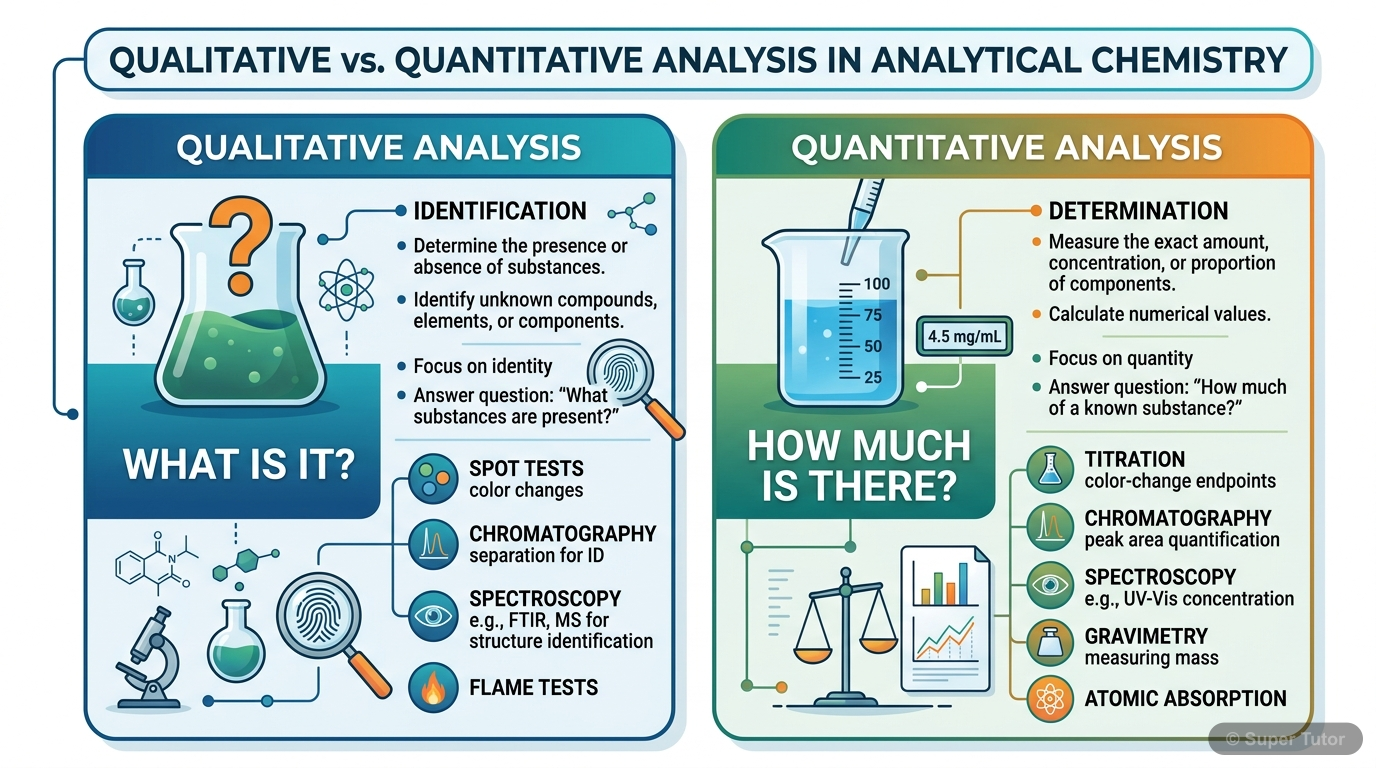
Learn better with visuals Super Tutor has hundreds of illustrations like this across every chapter — all free to try.
Get startedKey Topics to Revise
1. Basics of Analytical Chemistry
- Analytical chemistry deals with qualitative and quantitative analysis.
- Qualitative analysis determines the nature and quality of the substance under examination.
- Quantitative analysis determines the constituents of a chemical substance or mixture.
2. Action of Ammonium Hydroxide on Salt Solutions
- Ammonium hydroxide is used for precipitation of metal cations as hydroxides, formation of complex salts, making the medium weakly basic, and providing ammonia.
- Precipitation means formation of an insoluble substance when two or more solutions are mixed.
- Some precipitated metallic hydroxides become soluble in excess ammonium hydroxide because of complex salt formation.
3. Action of Sodium Hydroxide on Salt Solutions
- Sodium hydroxide is mainly used for precipitation of insoluble hydroxides from metallic salt solutions.
- Some precipitated metallic hydroxides dissolve in excess NaOH to form soluble complex salts.
- Calcium salt solutions give dull white Ca(OH)2 precipitate with NaOH, insoluble in excess.
4. Action of Caustic Alkalis on Metals
- Caustic alkalis such as NaOH and KOH react with some metals and their oxides.
- Zinc dissolves in hot and concentrated caustic alkalis to form colourless soluble zincates with hydrogen gas evolution.
- Aluminium reacts with boiling caustic alkalis to form colourless aluminates with hydrogen gas evolution.
Get complete notes with diagrams and examples
Full NotesKey Concepts
Frequently Asked Questions
What are the important topics in Analytical chemistry for ICSE Class 10 Chemistry?
How to score full marks in Analytical chemistry — ICSE Class 10 Chemistry?
Sources & Official References
Content is aligned to the official syllabus. Refer to the board website for the latest curriculum.
More resources for Analytical chemistry
Practice Quiz
Test yourself with a quick quiz
Important Questions
Practice with board exam-style questions
Formula Sheet
All formulas in one place
Chapter Summary
Understand the chapter at a glance
Concept Maps
See how topics connect visually
Study Plan
Step-by-step plan to ace this chapter
Flashcards
Quick-fire cards for active recall
Syllabus
What topics to cover
NCERT Solutions
Every textbook question solved step by step
For serious students
Get the full Analytical chemistry chapter — for free.
Quizzes, flashcards, AI doubt-solver and a step-by-step study plan for ICSE Class 10 Chemistry.