Analytical chemistry
ICSE · Class 10 · Chemistry
Summary of Analytical chemistry for ICSE Class 10 Chemistry. Key concepts, important points, and chapter overview.
Interactive on Super Tutor
Studying Analytical chemistry? Get the full interactive chapter.
Quizzes, flashcards, AI doubt-solver and a step-by-step study plan — built for chapter summary and more.
1,000+ Class 10 students started this chapter today
Learn better with visuals Super Tutor has hundreds of illustrations like this across every chapter — all free to try.
Get startedOverview
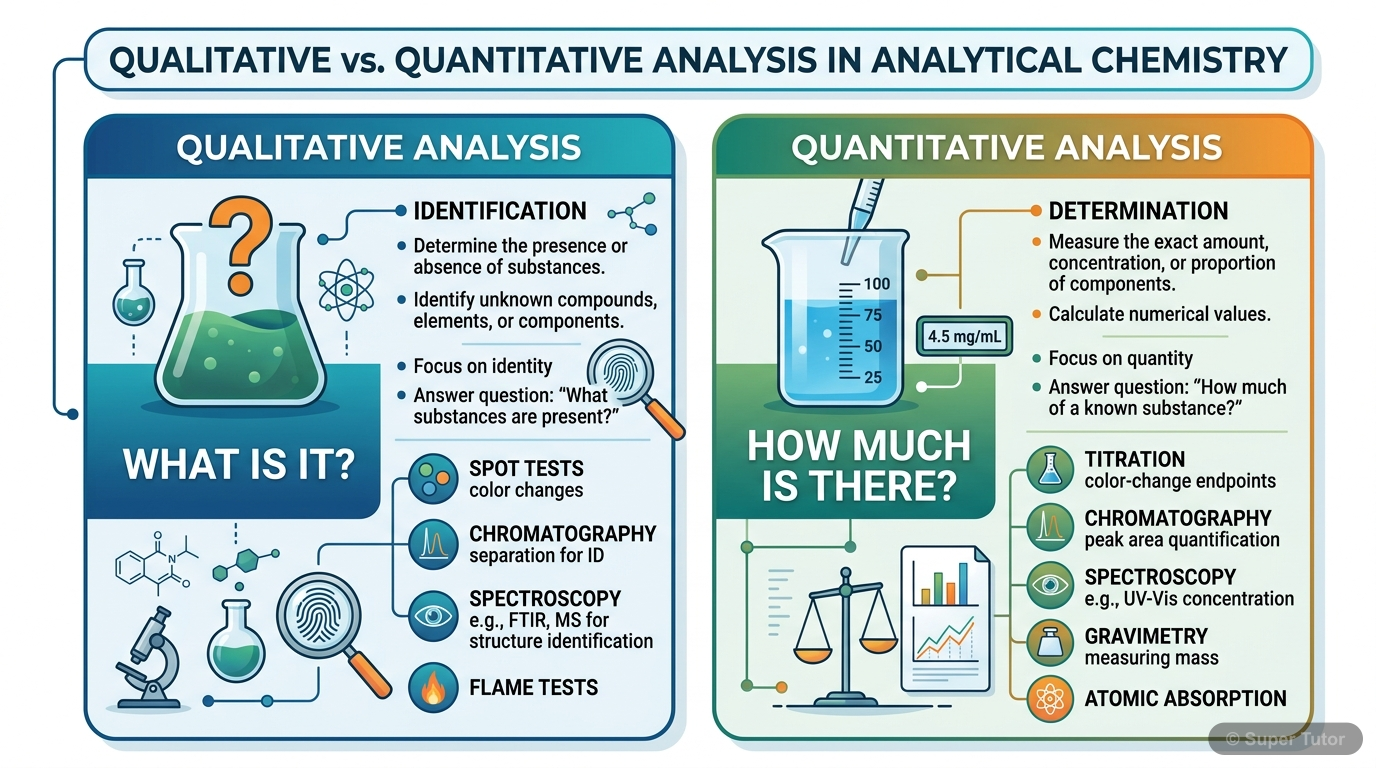
Analytical chemistry is the branch of chemistry that deals with the analysis of a chemical substance or its solution to explore its nature, composition and constitution. It includes qualitative analysis, which determines the nature and quality of a substance, and quantitative analysis, which determi
Key Concepts
Analytical chemistry deals with the analysis
Analytical chemistry deals with the analysis of a chemical substance or its solution to find its nature, composition and constitution. It includes qua
Qualitative analysis determines the nature
Qualitative analysis determines the nature and quality of the substance under examination.
Quantitative analysis deals with the determination
Quantitative analysis deals with the determination of constituents of a chemical substance or mixture.
The colour of a salt
The colour of a salt is due to the presence of a coloured ion in it. Ions of normal elements are colourless, while ions of transitional elements, lant
Ammonium hydroxide is a weak base
Ammonium hydroxide is a weak base used in qualitative analysis for precipitation of metal cations, formation of complex salts, making the medium weakl
Learning Objectives
- Understand the meaning of analytical chemistry, qualitative analysis and quantitative analysis.
- Identify colourless and coloured ions in salt solutions.
- Predict the action of ammonium hydroxide on salt solutions of calcium, iron, lead, copper, zinc and magnesium.
- Predict the action of sodium hydroxide on salt solutions of calcium, iron, lead, copper, zinc and magnesium.
- Recognise the special behaviour of copper(II) salts with excess ammonium hydroxide and zinc salts with excess ammonium hydroxide or sodium hydroxide.
Frequently Asked Questions
What are the important topics in Analytical chemistry for ICSE Class 10 Chemistry?
How to score full marks in Analytical chemistry — ICSE Class 10 Chemistry?
Sources & Official References
Content is aligned to the official syllabus. Refer to the board website for the latest curriculum.
More resources for Analytical chemistry
Practice Quiz
Test yourself with a quick quiz
Important Questions
Practice with board exam-style questions
Revision Notes
Key points for last-minute revision
Formula Sheet
All formulas in one place
Concept Maps
See how topics connect visually
Study Plan
Step-by-step plan to ace this chapter
Flashcards
Quick-fire cards for active recall
Syllabus
What topics to cover
NCERT Solutions
Every textbook question solved step by step
For serious students
Get the full Analytical chemistry chapter — for free.
Quizzes, flashcards, AI doubt-solver and a step-by-step study plan for ICSE Class 10 Chemistry.