Study of Compounds — Flashcards
ICSE · Class 10 · Chemistry
40 flashcards for Study of Compounds (ICSE Class 10 Chemistry) to test yourself on key terms and facts. Part of the ICSE Class 10 Chemistry syllabus.
Interactive on Super Tutor
Studying Study of Compounds? Get the full interactive chapter.
Quizzes, flashcards, AI doubt-solver and a step-by-step study plan — built for flashcards and more.
Free trial, no card needed.
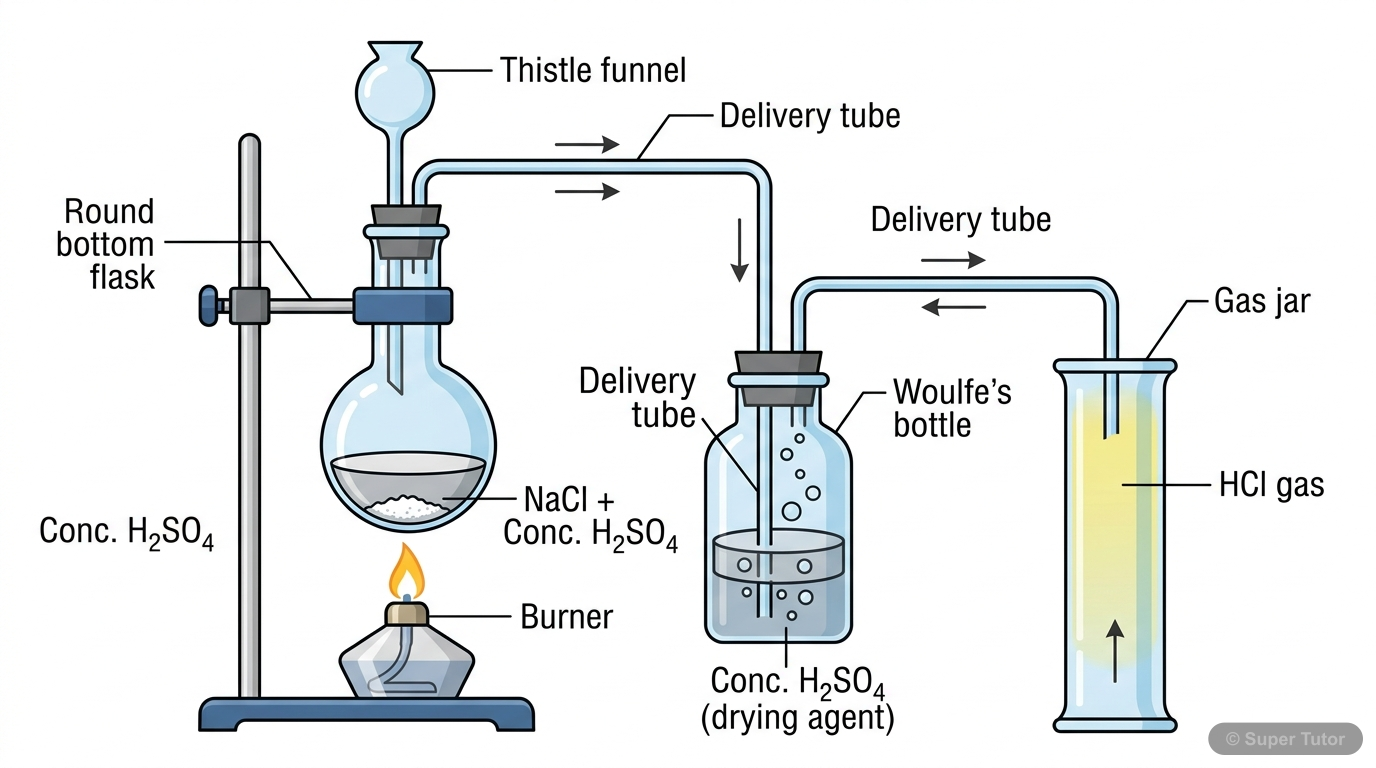
One of 18 illustrations for Study of Compounds in Super Tutor — alongside flashcards, concept maps and practice questions.
See them allWhat is hydrogen chloride gas and how is it different from hydrochloric acid?
Answer
Hydrogen chloride gas is HCl in gaseous form. It is a covalent gas compound, 1.27 times heavier than air, and highly soluble in water. It becomes acidic only when dissolved in water. Hydrochloric acid…
Write the laboratory preparation equation for hydrogen chloride gas.
Answer
Laboratory preparation of HCl gas: NaCl(s) + H2SO4(conc.) -> NaHSO4(s) + HCl(g) Sodium chloride is heated with concentrated sulphuric acid. Hydrogen chloride gas is released.
Why is concentrated sulphuric acid used to dry hydrogen chloride gas?
Answer
Concentrated sulphuric acid is used because it removes moisture without reacting with hydrogen chloride gas. Other drying agents like CaO and P2O5 cannot be used because they react with HCl. Quick l…
How is hydrogen chloride gas collected in the laboratory?
Answer
HCl gas is collected by upward displacement of air because it is heavier than air. It cannot be collected over water because it is highly soluble in water.
What observation confirms the presence of hydrogen chloride gas?
Answer
When a glass rod dipped in ammonium hydroxide is brought near HCl gas, dense white fumes of ammonium chloride are formed. HCl(g) + NH3(g) -> NH4Cl(s) The white fumes confirm HCl gas.
Why does dry hydrogen chloride gas not show acidic properties?
Answer
Dry HCl gas does not show acidic properties because it has no free H+ ions. It shows acidic nature only when dissolved in water, where ions are formed.
What happens when hydrochloric acid reacts with silver nitrate solution?
Answer
A curdy white precipitate of silver chloride is formed. HCl(aq) + AgNO3(aq) -> AgCl(s) + HNO3(aq) Silver chloride is white and can be used as a test for hydrochloric acid.
What happens when hydrochloric acid reacts with sodium carbonate?
Answer
Hydrochloric acid reacts with sodium carbonate to form sodium chloride, water, and carbon dioxide. Na2CO3(aq) + 2HCl(aq) -> 2NaCl(aq) + H2O(l) + CO2(g) This is an acid-carbonate reaction.
+32 more flashcards
Practise AllFrequently Asked Questions
What are the important topics in Study of Compounds for ICSE Class 10 Chemistry?
How many flashcards are available for Study of Compounds?
How should I revise Study of Compounds for the ICSE Class 10 board exam?
Sources & Official References
Content is aligned to the official syllabus. Refer to the board website for the latest curriculum.
More resources for Study of Compounds
Practice Quiz
Test yourself with a quick quiz
Important Questions
Exam-style questions with answers
Revision Notes
Key points for last-minute revision
Formula Sheet
The chapter's formulas in one place
Chapter Summary
Understand the chapter at a glance
Concept Maps
See how topics connect
Study Plan
Step-by-step plan for this chapter
Syllabus
What topics to cover
For serious students
Get the full Study of Compounds chapter — start free.
Quizzes, flashcards, an AI doubt solver and a study plan for ICSE Class 10 Chemistry. Free to start, no card needed.