Study of Compounds
ICSE · Class 10 · Chemistry
Summary of Study of Compounds for ICSE Class 10 Chemistry. Key concepts, important points, and chapter overview.
Interactive on Super Tutor
Studying Study of Compounds? Get the full interactive chapter.
Quizzes, flashcards, AI doubt-solver and a step-by-step study plan — built for chapter summary and more.
1,000+ Class 10 students started this chapter today
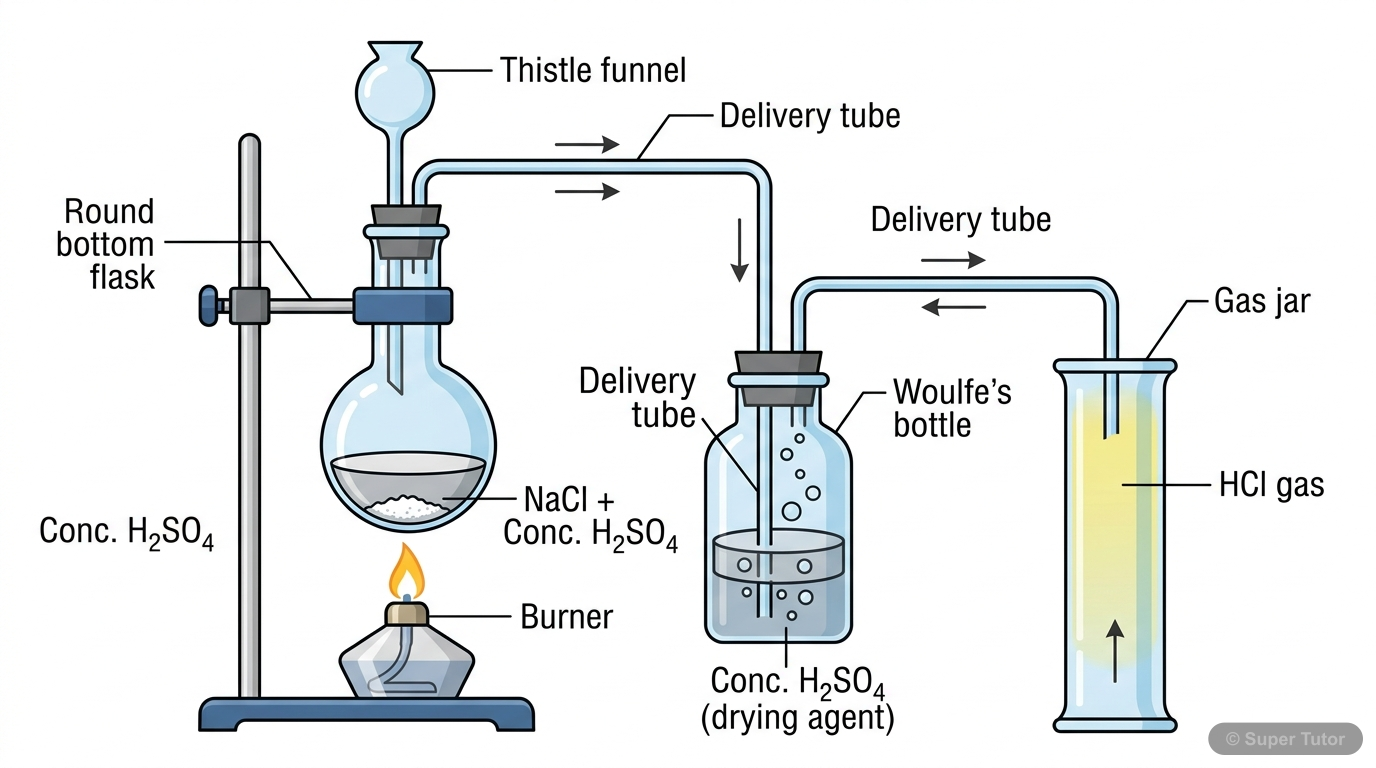
This is just one of 18+ visuals inside Super Tutor's Study of Compounds chapter
Explore the full setOverview
Hydrogen chloride, ammonia, nitric acid and sulphuric acid are four important inorganic compounds. Hydrogen chloride is a covalent gas that becomes acidic only in water, while hydrochloric acid is its aqueous solution and a strong monobasic acid. Ammonia is a covalent gas that is highly soluble in w
Key Concepts
Hydrogen chloride is a covalent gas
Hydrogen chloride is a covalent gas, 1.27 times heavier than air, and very soluble in water. It cannot be collected over water because of its high sol
Hydrogen chloride is prepared in
Hydrogen chloride is prepared in the laboratory by heating sodium chloride with concentrated sulphuric acid: NaCl + H2SO4 →Heat NaHSO4 + HCl(g). It gi
Ammonia is a covalent gas
Ammonia is a covalent gas, lighter than air, highly soluble in water and a weak base in aqueous solution. It cannot be collected over water. It is dri
Ammonia is prepared in the laboratory
Ammonia is prepared in the laboratory from ammonium chloride and calcium hydroxide: 2NH4Cl + Ca(OH)2 →Heat CaCl2 + 2H2O + 2NH3↑. It can also be obtain
Ammonia burns in oxygen but does
Ammonia burns in oxygen but does not burn in air. It undergoes catalytic oxidation with platinum at 800°C to form nitric oxide and water. It reduces h
Learning Objectives
- Understand the preparation, collection, drying and identification of hydrogen chloride and ammonia.
- Explain why hydrogen chloride gas and ammonia cannot be collected over water.
- Write balanced equations for the laboratory preparation and important reactions of HCl, NH3, HNO3 and H2SO4.
- Distinguish between dry hydrogen chloride gas and hydrochloric acid, and between dry ammonia and aqueous ammonia.
- Explain the laboratory preparation and large-scale manufacture of nitric acid and sulphuric acid.
Frequently Asked Questions
What are the important topics in Study of Compounds for ICSE Class 10 Chemistry?
How to score full marks in Study of Compounds — ICSE Class 10 Chemistry?
Sources & Official References
Content is aligned to the official syllabus. Refer to the board website for the latest curriculum.
More resources for Study of Compounds
Practice Quiz
Test yourself with a quick quiz
Important Questions
Practice with board exam-style questions
Revision Notes
Key points for last-minute revision
Formula Sheet
All formulas in one place
Concept Maps
See how topics connect visually
Study Plan
Step-by-step plan to ace this chapter
Flashcards
Quick-fire cards for active recall
Syllabus
What topics to cover
NCERT Solutions
Every textbook question solved step by step
For serious students
Get the full Study of Compounds chapter — for free.
Quizzes, flashcards, AI doubt-solver and a step-by-step study plan for ICSE Class 10 Chemistry.