Adverbs: Position and Order
ICSE · Class 10 · English Language - Archer
Most important questions from Adverbs: Position and Order for ICSE Class 10 English Language - Archer board exam 2026. MCQs, short answer, and long answer questions with marks.
Interactive on Super Tutor
Studying Adverbs: Position and Order? Get the full interactive chapter.
Quizzes, flashcards, AI doubt-solver and a step-by-step study plan — built for important questions and more.
1,000+ Class 10 students started this chapter today
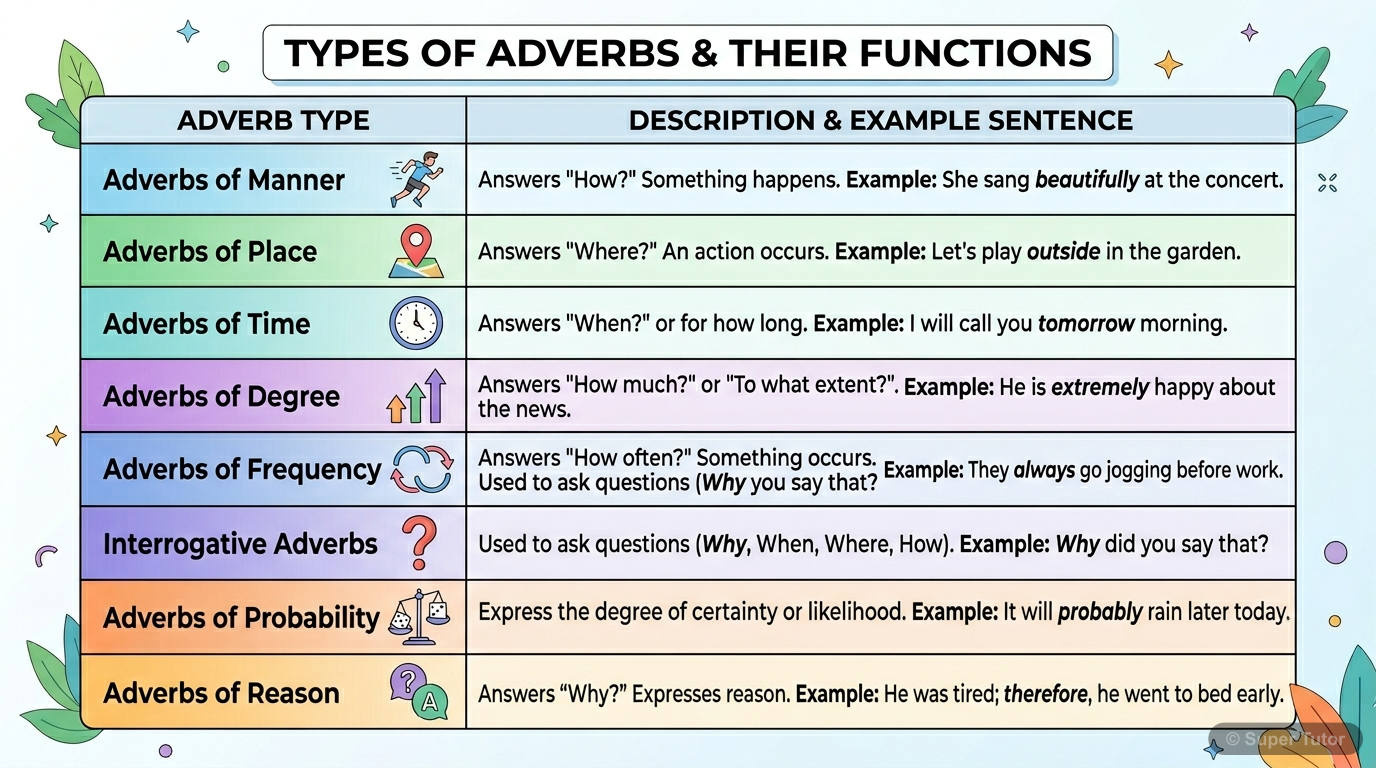
Learn better with visuals Super Tutor has hundreds of illustrations like this across every chapter — all free to try.
Get startedSample Questions
In the sentence 'I have often walked home from work', where is the adverb 'often' placed?
Show answer
After the auxiliary verb 'have'
Step 1: Identify the verb structure - 'have walked' is a present perfect tense with auxiliary 'have' + past participle 'walked'. Step 2: For adverbs of frequency with two-part verbs, the adverb goes after the first auxiliary verb. Step 3: 'Often' is placed between 'have' (auxiliary) and 'walked' (main verb). Step 4: This follows the pattern: subject + auxiliary + adverb of frequency + main verb. Step 5: This rule helps maintain clarity and follows standard English grammar conventions.
Which sentence correctly shows the order: Manner + Place + Time?
Show answer
I walk briskly in the park after dinner.
Step 1: Identify each adverb type - 'briskly' (manner - how?), 'in the park' (place - where?), 'after dinner' (time - when?). Step 2: The standard order is: Manner + Place + Time. Step 3: 'Briskly' (manner) comes first, then 'in the park' (place), then 'after dinner' (time). Step 4: This order follows the natural flow from how the action is done, to where, to when. Step 5: Other options either mix up the order or emphasize time by placing it at the beginning.
What type of adverb is 'extremely' in 'Parijat is extremely scared of heights'?
Show answer
Adverb of degree
Step 1: Identify what 'extremely' modifies - it modifies the adjective 'scared'. Step 2: Ask the question 'To what degree is Parijat scared?' - Extremely scared. Step 3: 'Extremely' tells us the intensity or degree of fear. Step 4: Adverbs of degree answer 'How much?' or 'To what degree?' and modify adjectives or other adverbs. Step 5: Other examples include 'very', 'quite', 'rather', 'absolutely' - all showing intensity or degree.
In which position can adverbs of time and place be placed for emphasis?
Show answer
At the beginning of the sentence
Step 1: Adverbs of time and place are flexible and can be moved for emphasis. Step 2: When placed at the beginning, they receive special attention and emphasis. Step 3: Example: 'Tomorrow, I am leaving for Delhi' emphasizes when the action will happen. Step 4: Similarly, 'Here are the shoes I lost' emphasizes the location. Step 5: This fronting technique is used to highlight the time or place aspect of the sentence.
+40 more questions available
Practice AllFrequently Asked Questions
What are the important topics in Adverbs: Position and Order for ICSE Class 10 English Language - Archer?
How to score full marks in Adverbs: Position and Order — ICSE Class 10 English Language - Archer?
How many important questions are there in Adverbs: Position and Order?
Sources & Official References
Content is aligned to the official syllabus. Refer to the board website for the latest curriculum.
More resources for Adverbs: Position and Order
Practice Quiz
Test yourself with a quick quiz
Revision Notes
Key points for last-minute revision
Formula Sheet
All formulas in one place
Chapter Summary
Understand the chapter at a glance
Concept Maps
See how topics connect visually
Study Plan
Step-by-step plan to ace this chapter
Flashcards
Quick-fire cards for active recall
Syllabus
What topics to cover
NCERT Solutions
Every textbook question solved step by step
For serious students
Get the full Adverbs: Position and Order chapter — for free.
Quizzes, flashcards, AI doubt-solver and a step-by-step study plan for ICSE Class 10 English Language - Archer.