Conditionals
ICSE · Class 10 · English Language - Archer
Most important questions from Conditionals for ICSE Class 10 English Language - Archer board exam 2026. MCQs, short answer, and long answer questions with marks.
Interactive on Super Tutor
Studying Conditionals? Get the full interactive chapter.
Quizzes, flashcards, AI doubt-solver and a step-by-step study plan — built for important questions and more.
1,000+ Class 10 students started this chapter today
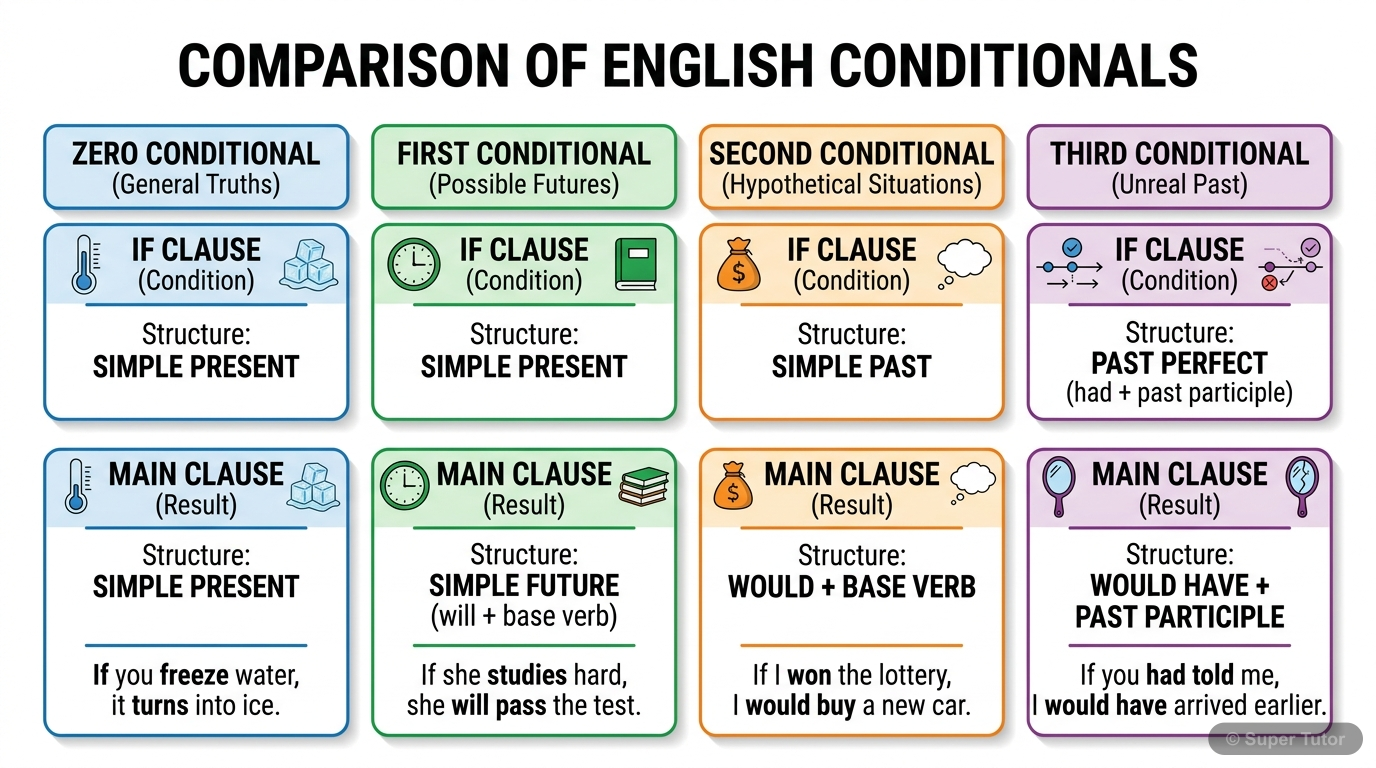
This is just one of 5+ visuals inside Super Tutor's Conditionals chapter
Explore the full setSample Questions
What word can replace 'if' in this sentence: 'If you don't hurry, you will be late'?
Show answer
Unless
Step 1: Understand that 'unless' means 'if not'. Step 2: The original sentence means 'If you don't hurry, you will be late'. Step 3: Using 'unless': 'Unless you hurry, you will be late' (same meaning). Step 4: 'Although' shows contrast, 'because' shows cause, 'while' shows time/contrast. Step 5: Only 'unless' maintains the conditional meaning while replacing 'if not' structure.
In the sentence 'If I were you, I would apologize', why do we use 'were' instead of 'was'?
Show answer
Because it's an imaginary situation
Step 1: Recognize this as second conditional expressing an impossible/imaginary situation. Step 2: In purely imaginary statements, we use 'were' for all persons (I, he, she, it). Step 3: This is called the subjunctive mood, used for hypothetical situations. Step 4: 'If I were you' is a common idiom meaning 'in your position'. Step 5: 'Were' here doesn't relate to plurality, questions, or simple past tense - it's specifically for imaginary conditions.
Which sentence structure represents zero conditional?
Show answer
If + simple present, simple present
Step 1: Zero conditional uses simple present tense in both clauses. Step 2: It expresses general truths, facts, or automatic results. Step 3: Example: 'If you heat water to 100°C, it boils.' Step 4: Other structures represent: first conditional (If + present, will + base), second conditional (If + past, would + base), third conditional (If + past perfect, would have + past participle). Step 5: Zero conditional shows cause-and-effect relationships that are always true.
What does first conditional typically express?
Show answer
Possible future situations
Step 1: First conditional structure is If + simple present, will + base verb. Step 2: It expresses situations that might happen in the future. Step 3: The condition is realistic and achievable. Step 4: Example: 'If it rains, we will stay inside.' Step 5: Other options describe: second conditional (imaginary present), third conditional (past unrealized events), and zero conditional (general facts).
+38 more questions available
Practice AllFrequently Asked Questions
What are the important topics in Conditionals for ICSE Class 10 English Language - Archer?
How to score full marks in Conditionals — ICSE Class 10 English Language - Archer?
How many important questions are there in Conditionals?
Sources & Official References
Content is aligned to the official syllabus. Refer to the board website for the latest curriculum.
More resources for Conditionals
Practice Quiz
Test yourself with a quick quiz
Revision Notes
Key points for last-minute revision
Formula Sheet
All formulas in one place
Chapter Summary
Understand the chapter at a glance
Concept Maps
See how topics connect visually
Study Plan
Step-by-step plan to ace this chapter
Flashcards
Quick-fire cards for active recall
Syllabus
What topics to cover
NCERT Solutions
Every textbook question solved step by step
For serious students
Get the full Conditionals chapter — for free.
Quizzes, flashcards, AI doubt-solver and a step-by-step study plan for ICSE Class 10 English Language - Archer.