Transformation of Sentences
ICSE · Class 10 · English Language - Archer
Most important questions from Transformation of Sentences for ICSE Class 10 English Language - Archer board exam 2026. MCQs, short answer, and long answer questions with marks.
Interactive on Super Tutor
Studying Transformation of Sentences? Get the full interactive chapter.
Quizzes, flashcards, AI doubt-solver and a step-by-step study plan — built for important questions and more.
1,000+ Class 10 students started this chapter today
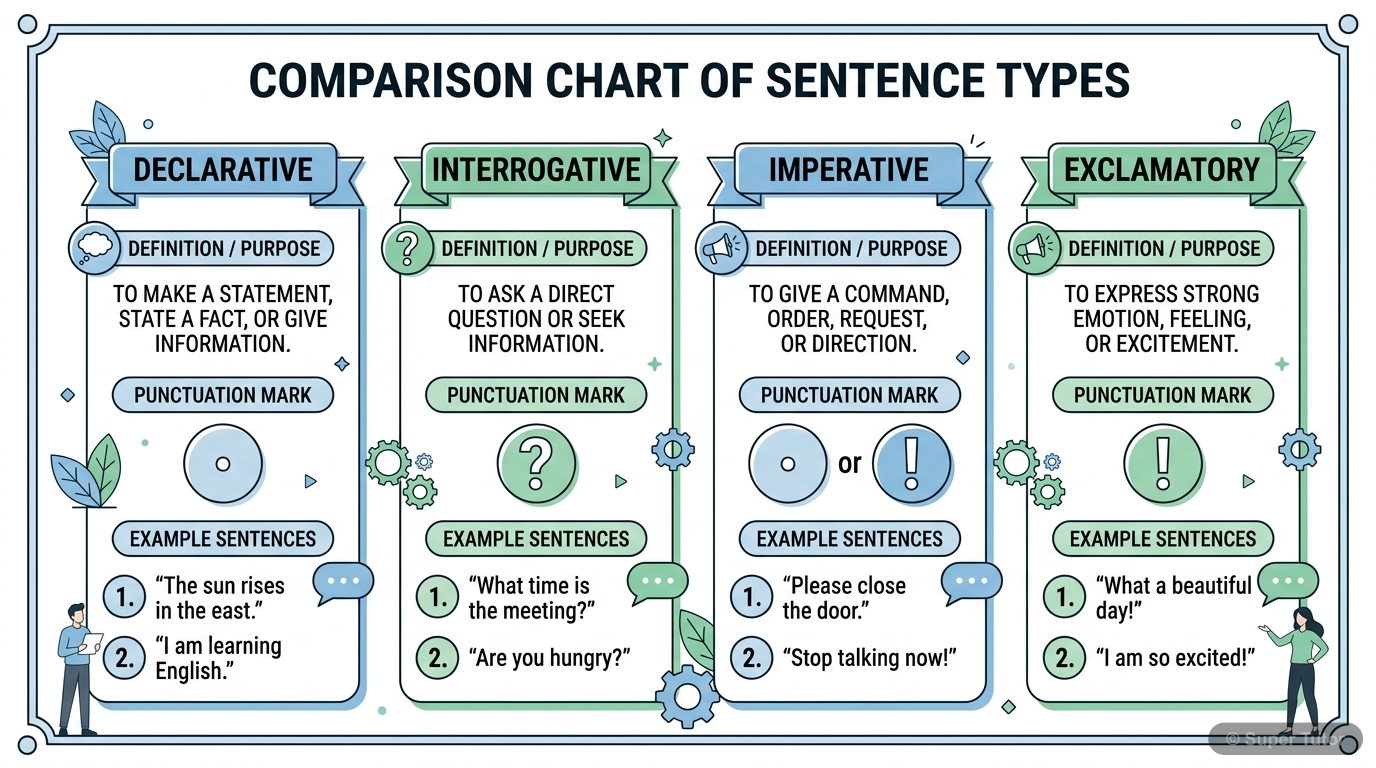
This is just one of 5+ visuals inside Super Tutor's Transformation of Sentences chapter
Explore the full setSample Questions
What is a subordinate clause?
Show answer
A clause that does not make complete sense by itself
A subordinate clause (also called dependent clause) is a clause that does not make complete sense by itself. It needs to be connected with the main clause by a subordinating conjunction to make complete sense. For example, in 'When it rains, I stay indoors,' the clause 'When it rains' is subordinate because it doesn't express a complete thought alone.
Which sentence is compound?
Show answer
She finished her homework and played games.
A compound sentence has two or more independent clauses joined by coordinating conjunctions. 'She finished her homework and played games' has two independent clauses: 'She finished her homework' and '[she] played games' joined by 'and'. The other options are either simple sentences with phrases or complex sentences with dependent clauses.
Transform to simple sentence: 'Ram studied hard, so he passed the exam.' What should replace 'so he passed'?
Show answer
and passed
To convert a compound sentence to simple, we combine the clauses into one by removing the coordinating conjunction and subject repetition. 'Ram studied hard, so he passed the exam' becomes 'Ram studied hard and passed the exam.' We use 'and' to connect the two actions performed by the same subject. The cause-effect relationship is maintained through the sequence of actions.
What do noun clauses usually begin with?
Show answer
How, that, if, what, who, where, why
Noun clauses usually begin with words like how, that, if, what, whatever, when, where, whether, which, whichever, who, whoever, whom, whomever, why. These clauses act as nouns in the sentence. For example: 'What you said is true' - here 'What you said' is a noun clause acting as the subject. The other options are either coordinating conjunctions or subordinating conjunctions that introduce adverb clauses.
+40 more questions available
Practice AllFrequently Asked Questions
What are the important topics in Transformation of Sentences for ICSE Class 10 English Language - Archer?
How to score full marks in Transformation of Sentences — ICSE Class 10 English Language - Archer?
How many important questions are there in Transformation of Sentences?
Sources & Official References
Content is aligned to the official syllabus. Refer to the board website for the latest curriculum.
More resources for Transformation of Sentences
Practice Quiz
Test yourself with a quick quiz
Revision Notes
Key points for last-minute revision
Formula Sheet
All formulas in one place
Chapter Summary
Understand the chapter at a glance
Concept Maps
See how topics connect visually
Study Plan
Step-by-step plan to ace this chapter
Flashcards
Quick-fire cards for active recall
Syllabus
What topics to cover
NCERT Solutions
Every textbook question solved step by step
For serious students
Get the full Transformation of Sentences chapter — for free.
Quizzes, flashcards, AI doubt-solver and a step-by-step study plan for ICSE Class 10 English Language - Archer.