Formal Letter — Important Questions
ICSE · Class 10 · English Language - Archer
36 important questions from Formal Letter for ICSE Class 10 English Language - Archer, with answers. Written for the board exams 2027.
Interactive on Super Tutor
Studying Formal Letter? Get the full interactive chapter.
Quizzes, flashcards, AI doubt-solver and a step-by-step study plan — built for important questions and more.
Free trial, no card needed.
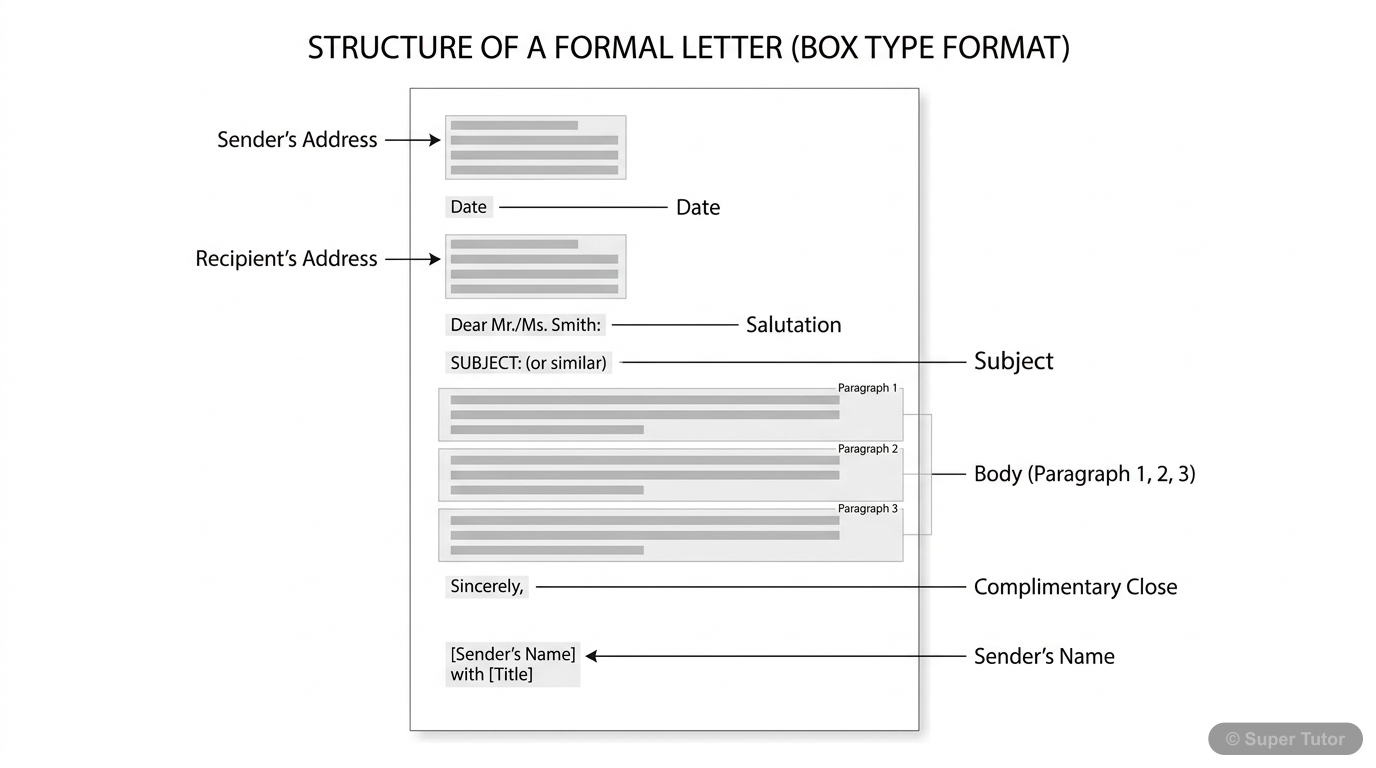
Learn better with visuals Super Tutor pairs illustrations like this with notes and quizzes for Formal Letter.
Get startedImportant Questions from Formal Letter
What should be avoided when writing the recipient's address?
Show answer
Abbreviations
Abbreviations should be avoided in formal letters. The address should be spelled out in full for proper formal presentation. Option A (full spelling) is actually required, not avoided. Option B (complete address) is necessary for proper delivery and formality. Option D (PIN code) may or may not be included but is not something to avoid. Only abbreviations like 'M. G. Road' instead of 'Mahatma Gandhi Road' or 'DCP' instead of 'Deputy Commissioner of Police' should be avoided in formal writing.
How many main sections should the body of a formal letter ideally have?
Show answer
Three sections
The body of a formal letter should ideally be divided into three sections: 1) stating the problems/complaints, raising concerns, or making a request, 2) making suggestions or providing reasons for the request, and 3) conclusion/closing statements. This structure ensures logical organization and complete coverage of the topic. Having fewer than three sections may leave out important elements, while having more may lead to unnecessary elaboration. The three-section format provides a clear beginning (problem statement), middle (suggestions/reasoning), and end (conclusion).
What tone should be maintained throughout a formal letter?
Show answer
Formal and professional
A formal letter must maintain a formal and professional tone throughout. This means using appropriate language, avoiding slang or colloquialisms, and presenting information in a structured, respectful manner. Option A (casual and friendly) is inappropriate for formal correspondence. Option C (humorous and light) may undermine the seriousness of the communication. Option D (emotional and personal) can make the letter seem unprofessional. The formal tone ensures the letter is taken seriously and maintains professional standards.
Which of the following elements are essential components of a formal letter format? (Select all correct answers)
Show answer
Sender's address, Date, Recipient's designation and address, Salutation, Subscription
Essential components of a formal letter include: Sender's address (provides contact information), Date (establishes when the letter was written), Recipient's designation and address (ensures proper delivery and shows respect), Salutation (formal greeting), and Subscription (formal closing). Personal jokes are inappropriate in formal correspondence as they undermine the professional tone. Each essential component serves a specific purpose in maintaining the formal structure and ensuring effective communication. These elements together create the complete framework of a properly formatted formal
+32 more questions on Formal Letter (ICSE Class 10 English Language - Archer)
Practise AllFrequently Asked Questions
What are the important topics in Formal Letter for ICSE Class 10 English Language - Archer?
How many important questions are there in Formal Letter?
Sources & Official References
Content is aligned to the official syllabus. Refer to the board website for the latest curriculum.
More resources for Formal Letter
For serious students
Get the full Formal Letter chapter — start free.
Quizzes, flashcards, an AI doubt solver and a study plan for ICSE Class 10 English Language - Archer. Free to start, no card needed.