Direct and Indirect Speech
ICSE · Class 10 · English Language - Archer
Most important questions from Direct and Indirect Speech for ICSE Class 10 English Language - Archer board exam 2026. MCQs, short answer, and long answer questions with marks.
Interactive on Super Tutor
Studying Direct and Indirect Speech? Get the full interactive chapter.
Quizzes, flashcards, AI doubt-solver and a step-by-step study plan — built for important questions and more.
1,000+ Class 10 students started this chapter today
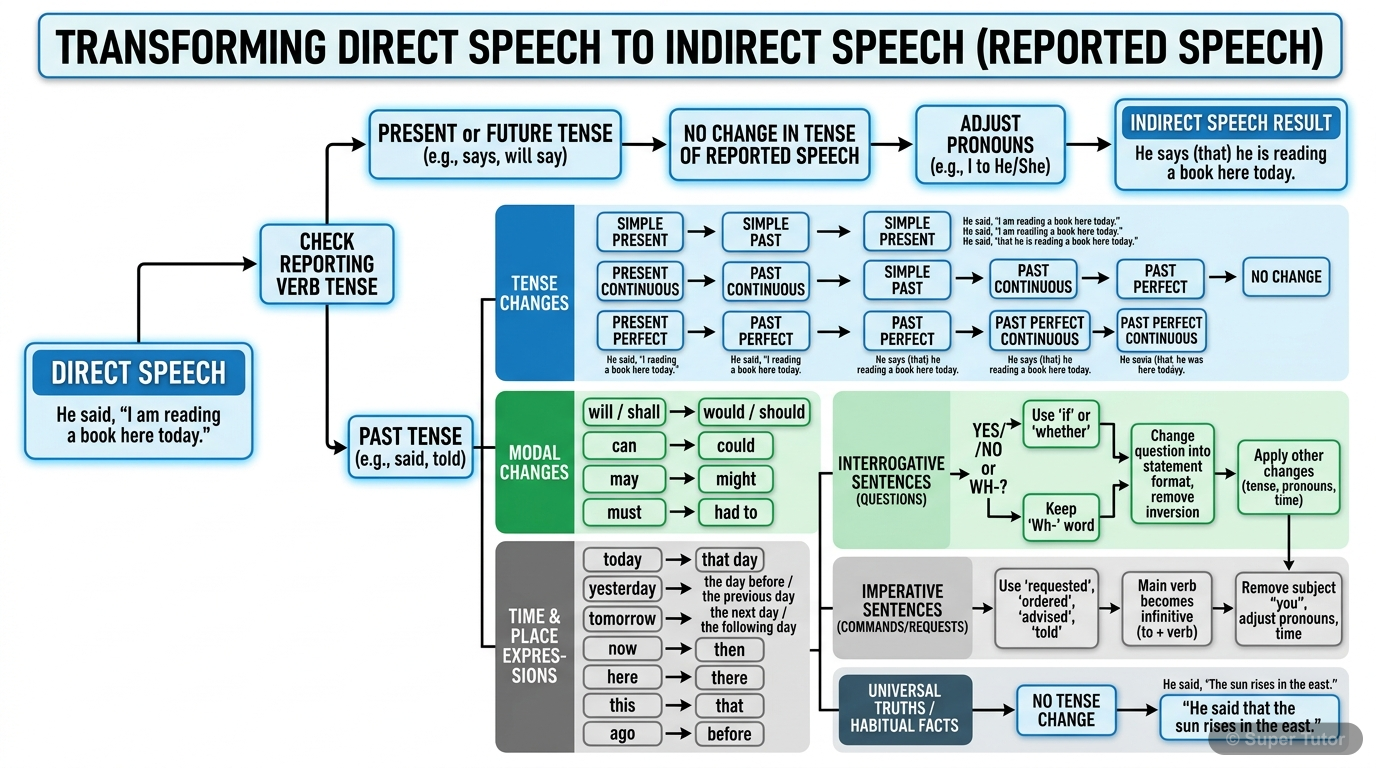
Learn better with visuals Super Tutor has hundreds of illustrations like this across every chapter — all free to try.
Get startedSample Questions
What is the correct conversion: 'Can you swim?' he asked.
Show answer
He asked if I could swim.
Step 1: This is a yes/no question, so we use 'if' or 'whether'. Step 2: 'Can' changes to 'could' in indirect speech. Step 3: 'You' changes to 'I' from the reporter's perspective. Step 4: Remove quotation marks and question mark. Step 5: The structure is: reporting verb + if/whether + statement form. Option B keeps direct question form. Option C incorrectly uses 'that'. Option D doesn't change 'can' to 'could'.
Convert: 'Please help me,' she said to him.
Show answer
She requested him to help her.
Step 1: This is an imperative sentence with 'please', showing a polite request. Step 2: 'Said' changes to 'requested' for polite commands. Step 3: Use the structure: subject + requested + object + to + verb. Step 4: Change 'me' to 'her' (third person perspective). Step 5: Remove 'please' as it's implied in 'requested'. Option B keeps direct speech format. Option C misses 'to' and uses wrong reporting verb. Option D is grammatically incorrect.
Which sentence correctly converts: 'Don't make noise,' the teacher said.
Show answer
The teacher told us not to make noise.
Step 1: This is a negative imperative sentence. Step 2: 'Said' changes to 'told' for commands. Step 3: The structure for negative imperatives is: told + object + not to + base verb. Step 4: Add 'us' as the implied object (students). Step 5: Place 'not' before 'to', not after. Option B keeps direct speech form. Option C places 'not' incorrectly. Option D misses the object 'us'.
What is the indirect form of: 'I have finished my work,' said John.
Show answer
John said that he had finished his work.
Step 1: The reporting verb 'said' is in past tense. Step 2: Present perfect 'have finished' changes to past perfect 'had finished'. Step 3: The pronoun 'I' changes to 'he' (third person). Step 4: 'My' changes to 'his'. Step 5: Add 'that' after the reporting verb. Option B doesn't change the tense. Option C keeps the wrong pronoun. Option D uses simple past instead of past perfect.
+40 more questions available
Practice AllFrequently Asked Questions
What are the important topics in Direct and Indirect Speech for ICSE Class 10 English Language - Archer?
How to score full marks in Direct and Indirect Speech — ICSE Class 10 English Language - Archer?
How many important questions are there in Direct and Indirect Speech?
Sources & Official References
Content is aligned to the official syllabus. Refer to the board website for the latest curriculum.
More resources for Direct and Indirect Speech
Practice Quiz
Test yourself with a quick quiz
Revision Notes
Key points for last-minute revision
Formula Sheet
All formulas in one place
Chapter Summary
Understand the chapter at a glance
Concept Maps
See how topics connect visually
Study Plan
Step-by-step plan to ace this chapter
Flashcards
Quick-fire cards for active recall
Syllabus
What topics to cover
NCERT Solutions
Every textbook question solved step by step
For serious students
Get the full Direct and Indirect Speech chapter — for free.
Quizzes, flashcards, AI doubt-solver and a step-by-step study plan for ICSE Class 10 English Language - Archer.