The Last Phase-Independence and Partition of India ( 1942-47) — Revision Notes
ICSE · Class 10 · History & Civics
The Last Phase-Independence and Partition of India ( 1942-47) revision notes for ICSE Class 10 History & Civics: 4 topics in quick points.
Interactive on Super Tutor
Studying The Last Phase-Independence and Partition of India ( 1942-47)? Get the full interactive chapter.
Quizzes, flashcards, AI doubt-solver and a step-by-step study plan — built for revision notes and more.
Free trial, no card needed.
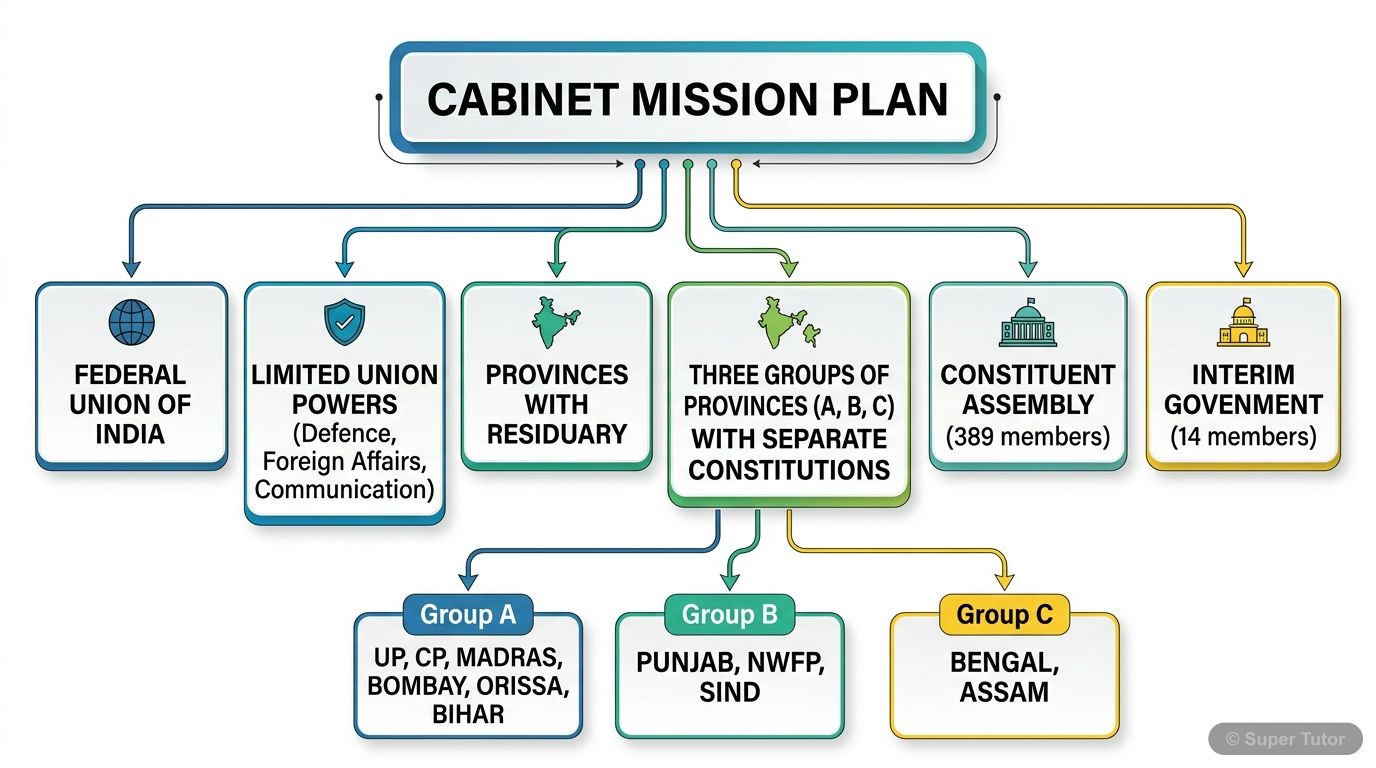
Learn better with visuals Super Tutor pairs illustrations like this with notes and quizzes for The Last Phase-Independence and Partition of India ( 1942-47).
Get startedKey Topics to Revise
Why Britain Changed Its Policy After 1945
- The Labour Party came to power in England in 1945 and was sympathetic to granting self-government to India.
- The Second World War weakened British power and changed global politics.
- The USA and the Soviet Union became new world powers and supported India's demand for independence.
Cabinet Mission and Its Proposals
- Clement Attlee sent the Cabinet Mission in February 1946.
- The three members were Lord Pethick-Lawrence, Sir Stafford Cripps and AV Alexander.
- The mission discussed the transfer of power with Indian leaders.
Reaction of Political Parties to the Cabinet Mission Plan
- The Muslim League accepted the Cabinet Mission Plan in its entirety on June 6, 1946.
- The Congress accepted only the Constitution-making part of the scheme.
- The Congress rejected the Interim Government scheme because of its limited status and powers and because it was given parity with the Muslim League.
Interim Government and Direct Action Day
- The Viceroy invited Pt. Nehru on August 14, 1946 to form the Interim Government.
- Jinnah decided to resort to Direct Action to achieve Pakistan.
- August 16, 1946 was fixed as Direct Action Day.
Get complete notes with diagrams and examples
Full NotesKey Concepts
Frequently Asked Questions
What are the important topics in The Last Phase-Independence and Partition of India ( 1942-47) for ICSE Class 10 History & Civics?
How should I revise The Last Phase-Independence and Partition of India ( 1942-47) for the ICSE Class 10 board exam?
Sources & Official References
Content is aligned to the official syllabus. Refer to the board website for the latest curriculum.
More resources for The Last Phase-Independence and Partition of India ( 1942-47)
For serious students
Get the full The Last Phase-Independence and Partition of India ( 1942-47) chapter — start free.
Quizzes, flashcards, an AI doubt solver and a study plan for ICSE Class 10 History & Civics. Free to start, no card needed.