The National Movement (1935-42)-The Quit India Movement and the INA
ICSE · Class 10 · History & Civics
Quick revision notes for The National Movement (1935-42)-The Quit India Movement and the INA — ICSE Class 10 History & Civics. Key concepts, formulas, and definitions for last-minute revision.
Interactive on Super Tutor
Studying The National Movement (1935-42)-The Quit India Movement and the INA? Get the full interactive chapter.
Quizzes, flashcards, AI doubt-solver and a step-by-step study plan — built for revision notes and more.
1,000+ Class 10 students started this chapter today
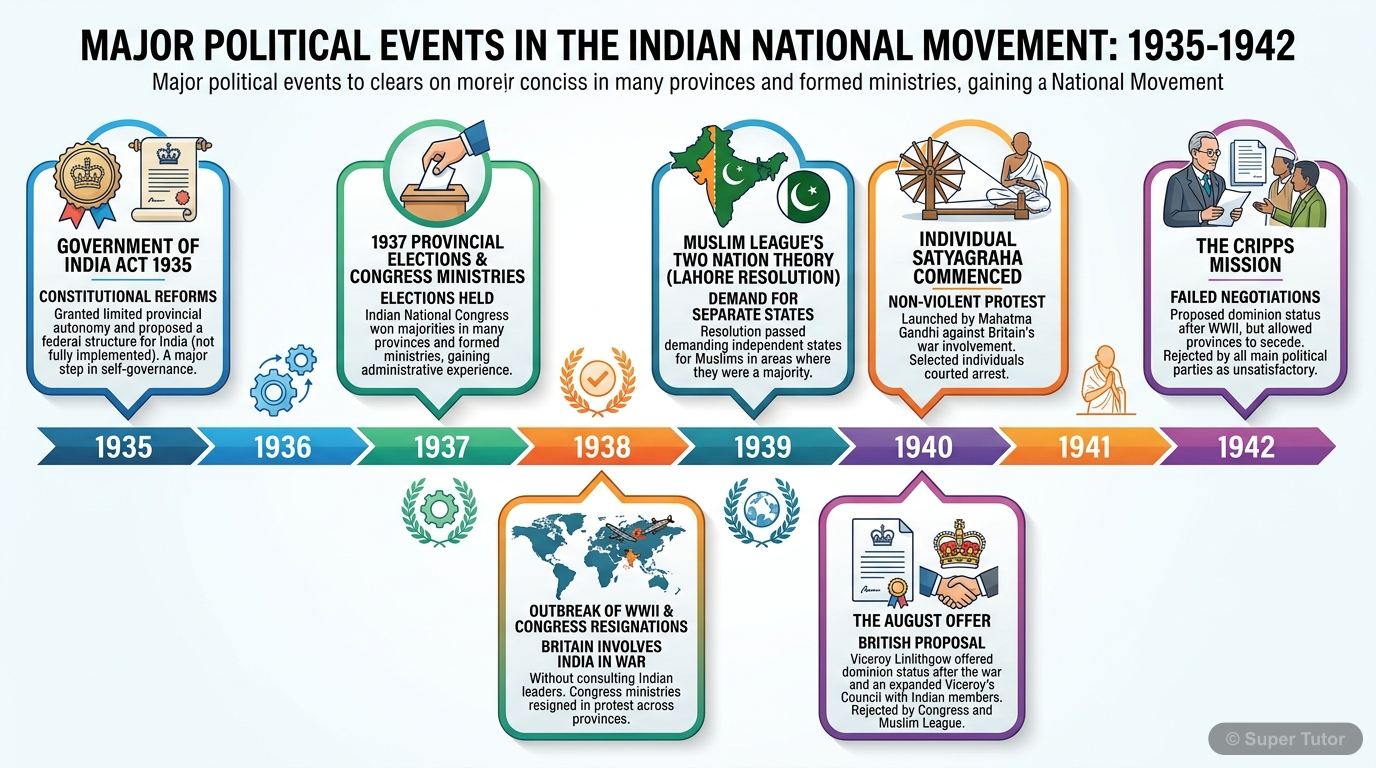
This is just one of 5+ visuals inside Super Tutor's The National Movement (1935-42)-The Quit India Movement and the INA chapter
Explore the full setKey Topics to Revise
Political Changes from 1935 to 1939
- The Government of India Act 1935 was the result of the Third Round Table Conference discussions.
- Elections were held in February 1937.
- Congress ministries were formed in July 1937 in seven out of eleven provinces.
World War II, August Offer, and Cripps Mission
- The Second World War broke out in 1939.
- The British involved India in the war without consulting the Provincial or Central Legislatures.
- The Congress ministries resigned in protest.
The Quit India Movement
- The Quit India Movement started in 1942 after the failure of the Cripps Mission and growing fear of Japanese invasion.
- The AICC met at Bombay on August 8, 1942 and passed the Quit India resolution.
- Gandhiji gave the call of Do or Die.
Subhas Chandra Bose and the Forward Bloc
- Subhas Chandra Bose was born on January 23, 1897 in a Bengali family settled at Cuttack in Orissa.
- He passed the ICS Examination in 1920 and got 4th position, but resigned his job.
- He became a strong leader of the younger Congressmen and supported socialist ideas.
Get complete notes with diagrams and examples
Full NotesKey Concepts
Frequently Asked Questions
What are the important topics in The National Movement (1935-42)-The Quit India Movement and the INA for ICSE Class 10 History & Civics?
How to score full marks in The National Movement (1935-42)-The Quit India Movement and the INA — ICSE Class 10 History & Civics?
Sources & Official References
Content is aligned to the official syllabus. Refer to the board website for the latest curriculum.
More resources for The National Movement (1935-42)-The Quit India Movement and the INA
Practice Quiz
Test yourself with a quick quiz
Important Questions
Practice with board exam-style questions
Formula Sheet
All formulas in one place
Chapter Summary
Understand the chapter at a glance
Concept Maps
See how topics connect visually
Study Plan
Step-by-step plan to ace this chapter
Flashcards
Quick-fire cards for active recall
Syllabus
What topics to cover
NCERT Solutions
Every textbook question solved step by step
For serious students
Get the full The National Movement (1935-42)-The Quit India Movement and the INA chapter — for free.
Quizzes, flashcards, AI doubt-solver and a step-by-step study plan for ICSE Class 10 History & Civics.