The First War of Independence ( The Great Uprising of 1857)
ICSE · Class 10 · History & Civics
Quick revision notes for The First War of Independence ( The Great Uprising of 1857) — ICSE Class 10 History & Civics. Key concepts, formulas, and definitions for last-minute revision.
Interactive on Super Tutor
Studying The First War of Independence ( The Great Uprising of 1857)? Get the full interactive chapter.
Quizzes, flashcards, AI doubt-solver and a step-by-step study plan — built for revision notes and more.
1,000+ Class 10 students started this chapter today
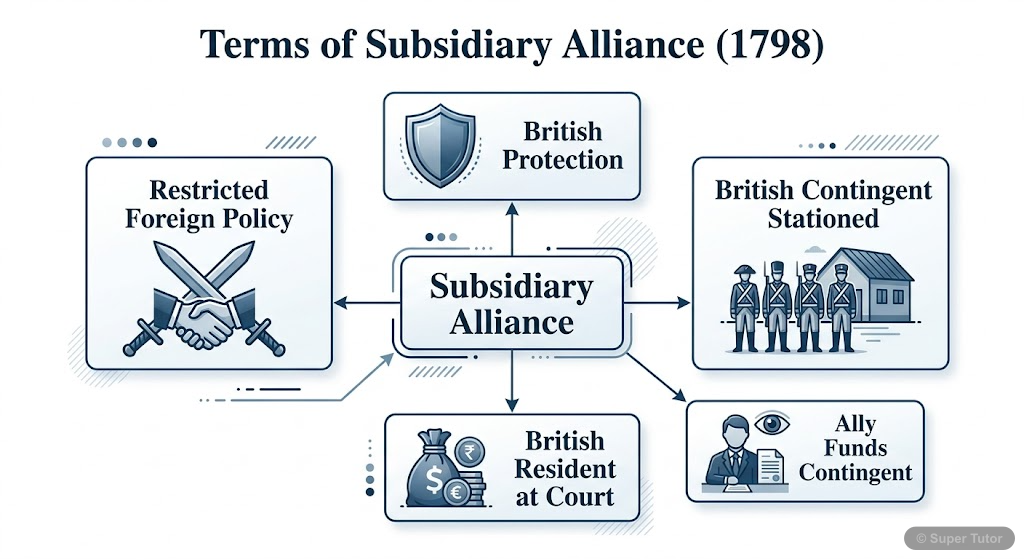
Super Tutor has 5+ illustrations like this for The First War of Independence ( The Great Uprising of 1857) alone — flashcards, concept maps, and step-by-step visuals.
See them allKey Topics to Revise
1. Background and Nature of the Uprising
- The Great Uprising of 1857 was not the first revolt against British rule. Between 1763 and 1856, there were forty major rebellions in different parts of India.
- Earlier uprisings were mostly localised and were usually suppressed easily by the British.
- The Sanyasis or Fakirs of Bengal organised peasants into an army of 50,000 soldiers and harassed the British for 30 years.
2. Political Causes
- The East India Company began as a trading company but gradually tried to gain political control over Indian states.
- The Company used methods such as the Subsidiary Alliance and the Doctrine of Lapse to expand its rule.
- The Doctrine of Lapse meant an adopted heir could not become ruler of a lapsed state.
3. Social and Religious Causes
- The British interfered in the social and religious life of Indians, which created fear and anger.
- The Abolition of Sati Act of 1829 was seen as interference in religion.
- The Widow Remarriage Act of 1856 offended many Indians.
4. Economic Causes
- British economic policies weakened Indian agriculture, industry, and trade.
- The British reduced agricultural India to an economic colony that served industrial England.
- Indian textiles faced heavy restrictions, and Indian handicrafts and cottage industries declined.
Get complete notes with diagrams and examples
Full NotesKey Concepts
Frequently Asked Questions
What are the important topics in The First War of Independence ( The Great Uprising of 1857) for ICSE Class 10 History & Civics?
How to score full marks in The First War of Independence ( The Great Uprising of 1857) — ICSE Class 10 History & Civics?
Sources & Official References
Content is aligned to the official syllabus. Refer to the board website for the latest curriculum.
More resources for The First War of Independence ( The Great Uprising of 1857)
Practice Quiz
Test yourself with a quick quiz
Important Questions
Practice with board exam-style questions
Formula Sheet
All formulas in one place
Chapter Summary
Understand the chapter at a glance
Concept Maps
See how topics connect visually
Study Plan
Step-by-step plan to ace this chapter
Flashcards
Quick-fire cards for active recall
Syllabus
What topics to cover
NCERT Solutions
Every textbook question solved step by step
For serious students
Get the full The First War of Independence ( The Great Uprising of 1857) chapter — for free.
Quizzes, flashcards, AI doubt-solver and a step-by-step study plan for ICSE Class 10 History & Civics.