The Union Judiciary The Supreme Court
ICSE · Class 10 · History & Civics
Quick revision notes for The Union Judiciary The Supreme Court — ICSE Class 10 History & Civics. Key concepts, formulas, and definitions for last-minute revision.
Interactive on Super Tutor
Studying The Union Judiciary The Supreme Court? Get the full interactive chapter.
Quizzes, flashcards, AI doubt-solver and a step-by-step study plan — built for revision notes and more.
1,000+ Class 10 students started this chapter today
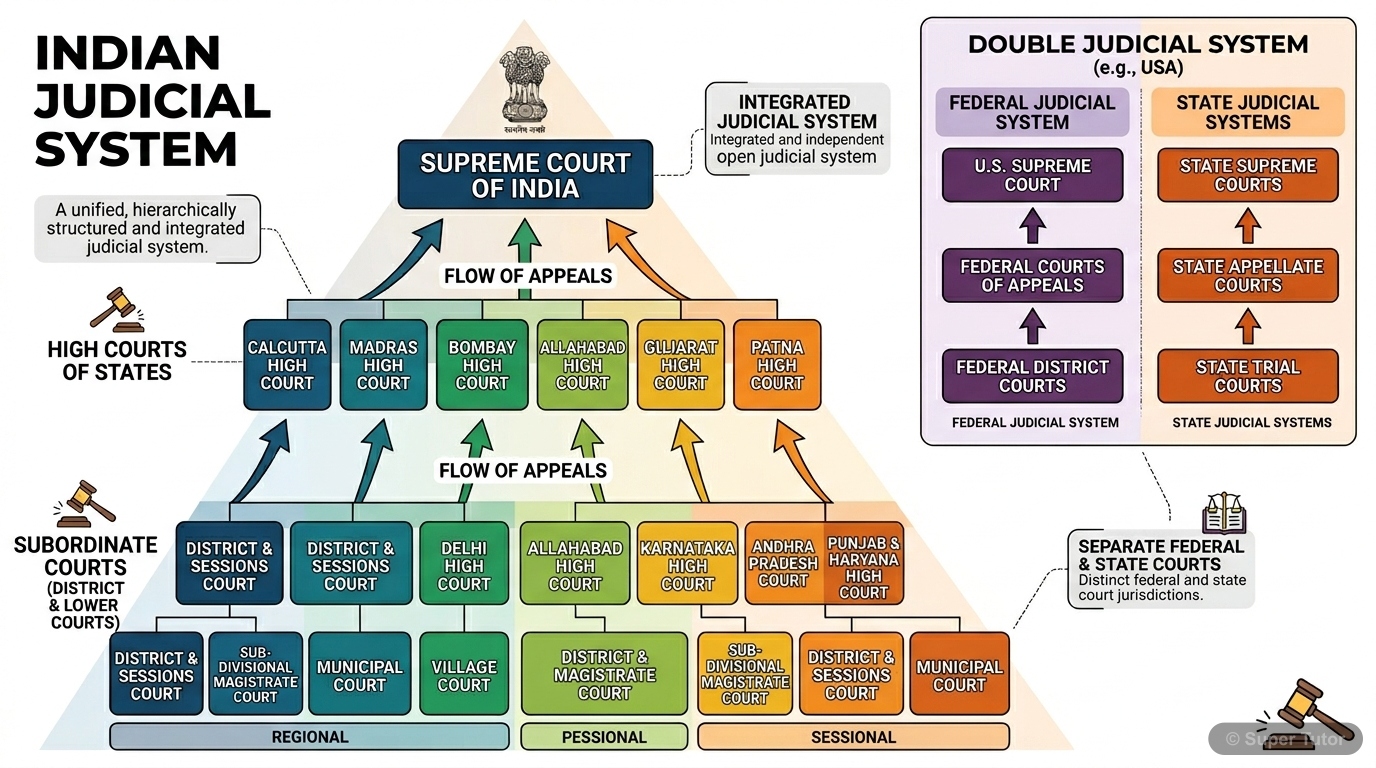
Learn better with visuals Super Tutor has hundreds of illustrations like this across every chapter — all free to try.
Get startedKey Topics to Revise
1. Need for an Independent Judiciary
- An independent judiciary is essential in a federation because it gives a fair interpretation of the Constitution.
- It also settles disputes between the Union and the states, and among states.
- India has a single integrated judicial hierarchy for the whole country.
2. Origin, Position and Composition of the Supreme Court
- The Supreme Court of India is a legacy of the Federal Court of India under the Government of India Act of 1935.
- Earlier, decisions of the Federal Court could be appealed to the Privy Council of the UK.
- Now the Supreme Court is the highest court of appeal in India.
3. Appointment, Collegium System and NJAC
- Every Judge of the Supreme Court is appointed by the President after consultation with judges of the Supreme Court and High Courts.
- While appointing judges other than the Chief Justice, the Chief Justice of India must be consulted.
- The CJI consults the four seniormost Judges of the Supreme Court before recommending appointments.
4. Removal and Independence of Judges
- Supreme Court judges cannot be removed by the President even though they are appointed by the President.
- A judge can be removed only by impeachment.
- Removal is based on proved misbehaviour or incapacity.
Get complete notes with diagrams and examples
Full NotesKey Concepts
Frequently Asked Questions
What are the important topics in The Union Judiciary The Supreme Court for ICSE Class 10 History & Civics?
How to score full marks in The Union Judiciary The Supreme Court — ICSE Class 10 History & Civics?
Sources & Official References
Content is aligned to the official syllabus. Refer to the board website for the latest curriculum.
More resources for The Union Judiciary The Supreme Court
Practice Quiz
Test yourself with a quick quiz
Important Questions
Practice with board exam-style questions
Formula Sheet
All formulas in one place
Chapter Summary
Understand the chapter at a glance
Concept Maps
See how topics connect visually
Study Plan
Step-by-step plan to ace this chapter
Flashcards
Quick-fire cards for active recall
Syllabus
What topics to cover
NCERT Solutions
Every textbook question solved step by step
For serious students
Get the full The Union Judiciary The Supreme Court chapter — for free.
Quizzes, flashcards, AI doubt-solver and a step-by-step study plan for ICSE Class 10 History & Civics.