The Last Phase-Independence and Partition of India ( 1942-47)
ICSE · Class 10 · History & Civics
Summary of The Last Phase-Independence and Partition of India ( 1942-47) for ICSE Class 10 History & Civics. Key concepts, important points, and chapter overview.
Interactive on Super Tutor
Studying The Last Phase-Independence and Partition of India ( 1942-47)? Get the full interactive chapter.
Quizzes, flashcards, AI doubt-solver and a step-by-step study plan — built for chapter summary and more.
1,000+ Class 10 students started this chapter today
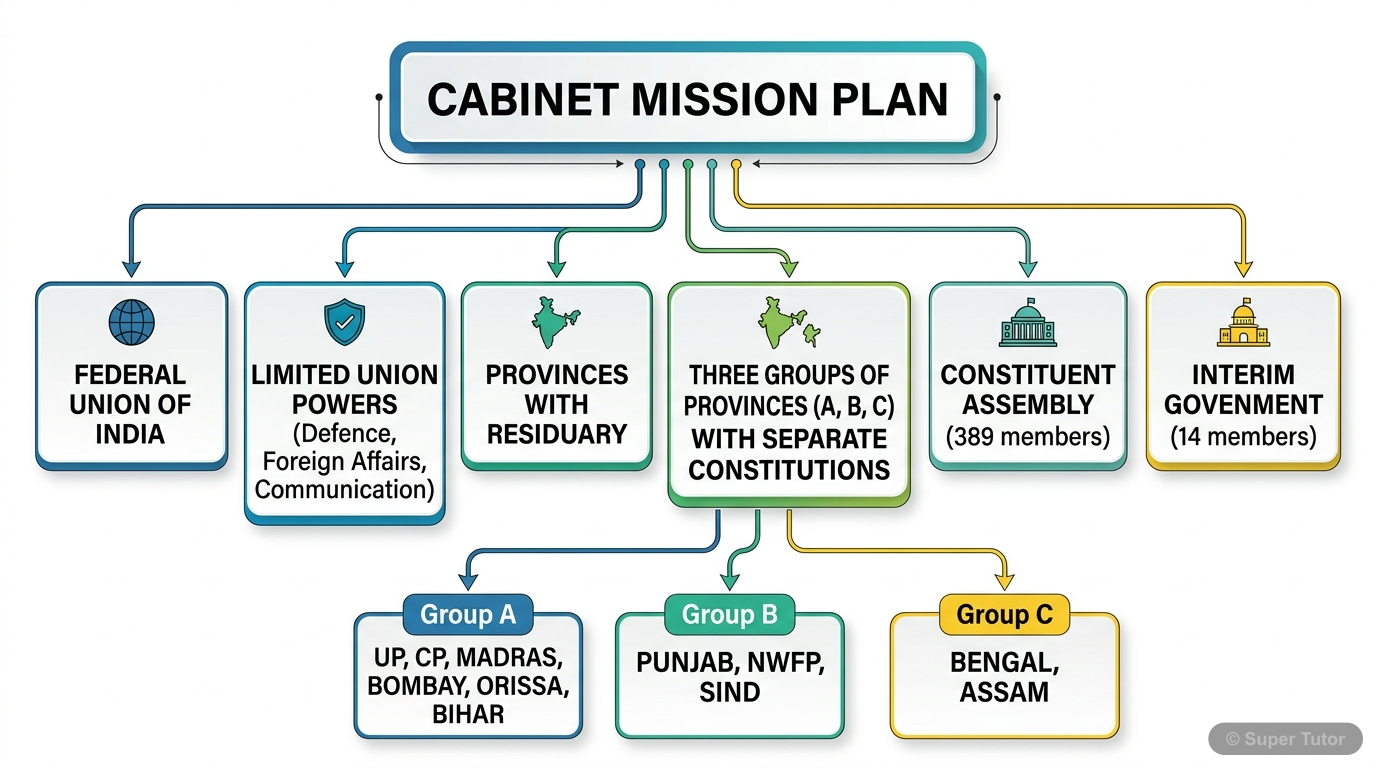
Super Tutor has 6+ illustrations like this for The Last Phase-Independence and Partition of India ( 1942-47) alone — flashcards, concept maps, and step-by-step visuals.
See them allOverview
The final phase of India’s freedom struggle was shaped by wartime weakness in Britain, rising Indian pressure for self-rule, growing tension between the Congress and the Muslim League, and the move from negotiation to partition. The Cabinet Mission tried to keep India united through a federation, bu
Key Concepts
A three
A three-member mission sent by Clement Attlee in February 1946 to consult Indian leaders on the transfer of power and suggest a constitutional solutio
A plan for a federation
A plan for a federation of all provinces and states of India, with the Centre controlling only defence, foreign affairs, and communication, and with t
An elected body of 389 members
An elected body of 389 members meant to draft India’s future Constitution.
A temporary government to function until
A temporary government to function until the Constitution was ready; under the Cabinet Mission Plan it was to have 14 members.
August 16
August 16, 1946 was fixed by the Muslim League for Direct Action after rejecting the Cabinet Mission Plan.
Learning Objectives
- Understand why Britain changed its policy towards India after 1945.
- Explain the Cabinet Mission Plan and its main provisions.
- Describe the different responses of the Congress, Muslim League, Sikhs, and Hindu Mahasabha to the plan.
- Trace the conflict around the Interim Government, Direct Action Day, and the Calcutta riots.
- Explain the ideas of Sir Muhammad Iqbal and Rahamat Ali on a Muslim state and Pakistan.
Frequently Asked Questions
What are the important topics in The Last Phase-Independence and Partition of India ( 1942-47) for ICSE Class 10 History & Civics?
How to score full marks in The Last Phase-Independence and Partition of India ( 1942-47) — ICSE Class 10 History & Civics?
Sources & Official References
Content is aligned to the official syllabus. Refer to the board website for the latest curriculum.
More resources for The Last Phase-Independence and Partition of India ( 1942-47)
Practice Quiz
Test yourself with a quick quiz
Important Questions
Practice with board exam-style questions
Revision Notes
Key points for last-minute revision
Formula Sheet
All formulas in one place
Concept Maps
See how topics connect visually
Study Plan
Step-by-step plan to ace this chapter
Flashcards
Quick-fire cards for active recall
Syllabus
What topics to cover
NCERT Solutions
Every textbook question solved step by step
For serious students
Get the full The Last Phase-Independence and Partition of India ( 1942-47) chapter — for free.
Quizzes, flashcards, AI doubt-solver and a step-by-step study plan for ICSE Class 10 History & Civics.