The First War of Independence ( The Great Uprising of 1857)
ICSE · Class 10 · History & Civics
Step-by-step guide to study The First War of Independence ( The Great Uprising of 1857) in ICSE Class 10 History & Civics. Topics to cover, practice strategy, and time allocation.
Interactive on Super Tutor
Studying The First War of Independence ( The Great Uprising of 1857)? Get the full interactive chapter.
Quizzes, flashcards, AI doubt-solver and a step-by-step study plan — built for study plan and more.
1,000+ Class 10 students started this chapter today
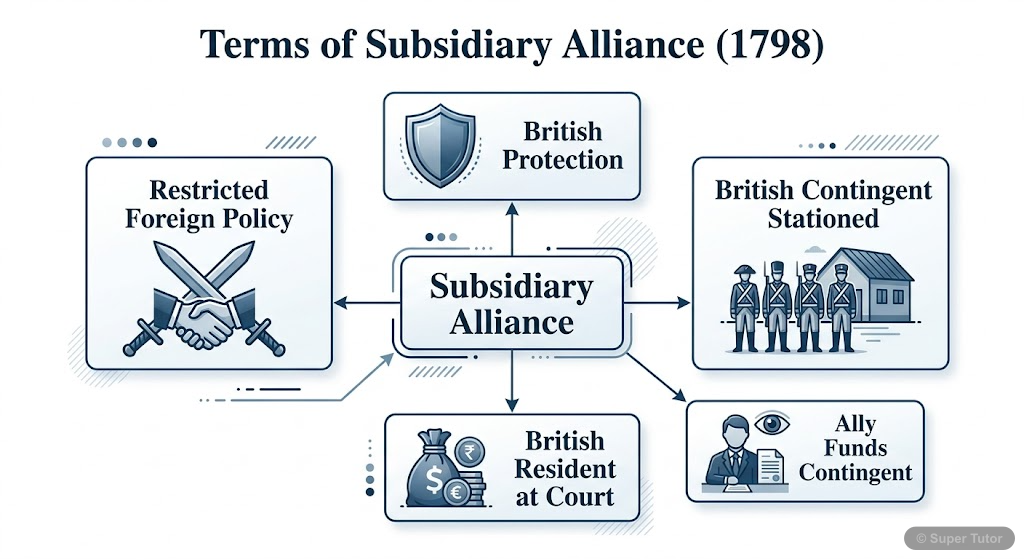
Super Tutor has 5+ illustrations like this for The First War of Independence ( The Great Uprising of 1857) alone — flashcards, concept maps, and step-by-step visuals.
See them allStudy Plan
Learn the Theory
Read the textbook chapter carefully. Note down definitions, formulas, and key concepts.
Practice Problems
Solve textbook exercises and additional practice questions. There are 45 questions available for this chapter.
Revise & Test
Revise key formulas and concepts without looking at notes. Take a practice quiz to test your understanding. Mark weak areas for re-revision.
Spaced Revision
Revisit The First War of Independence ( The Great Uprising of 1857) after a week. Use flashcards for quick recall. Solve previous year questions from this chapter.
What to Focus On
- The uprising began as a sepoy mutiny at Meerut on 10 May 1857.
- Earlier revolts existed, but most were localised.
- The uprising spread widely and shook British rule in India.
- Doctrine of Lapse caused annexation of Indian states.
- Awadh was annexed in 1856 after Wazid Ali Shah was deposed.
- The British confiscated the estates of taluqdars and zamindars in Awadh.
- Abolition of Sati was viewed as interference in religion.
- The Widow Remarriage Act of 1856 was unpopular.
- Laws of 1832 and 1850 on Christian converts' inheritance were disliked.
Common Mistakes to Avoid
The Revolt of 1857 started at Meerut on 10 May 1857.
Mangal Pandey started the whole revolt at Meerut.
The greased cartridges were the only cause of the Great Uprising of 1857.
Memory Tips
Immediate cause: greased cartridges
Political causes: Doctrine of Lapse, annexation of Awadh, disrespect to Bahadur Shah, ill-treatment of Nana Sahib and Rani of Jhansi
Doctrine of Lapse meaning
Annexation of Awadh and Dalhousie’s attitude
Want a personalised study plan?
Super Tutor creates a day-by-day plan for ICSE Class 10 History & Civics that adapts to your exam date and pace.
Create My Study Plan — FreeFrequently Asked Questions
What are the important topics in The First War of Independence ( The Great Uprising of 1857) for ICSE Class 10 History & Civics?
How to score full marks in The First War of Independence ( The Great Uprising of 1857) — ICSE Class 10 History & Civics?
Sources & Official References
Content is aligned to the official syllabus. Refer to the board website for the latest curriculum.
More resources for The First War of Independence ( The Great Uprising of 1857)
Practice Quiz
Test yourself with a quick quiz
Important Questions
Practice with board exam-style questions
Revision Notes
Key points for last-minute revision
Formula Sheet
All formulas in one place
Chapter Summary
Understand the chapter at a glance
Concept Maps
See how topics connect visually
Flashcards
Quick-fire cards for active recall
Syllabus
What topics to cover
NCERT Solutions
Every textbook question solved step by step
For serious students
Get the full The First War of Independence ( The Great Uprising of 1857) chapter — for free.
Quizzes, flashcards, AI doubt-solver and a step-by-step study plan for ICSE Class 10 History & Civics.