The First War of Independence ( The Great Uprising of 1857)
ICSE · Class 10 · History & Civics
Flashcards for The First War of Independence ( The Great Uprising of 1857) — ICSE Class 10 History & Civics. Quick Q&A cards covering key concepts, definitions, and formulas.
Interactive on Super Tutor
Studying The First War of Independence ( The Great Uprising of 1857)? Get the full interactive chapter.
Quizzes, flashcards, AI doubt-solver and a step-by-step study plan — built for flashcards and more.
1,000+ Class 10 students started this chapter today
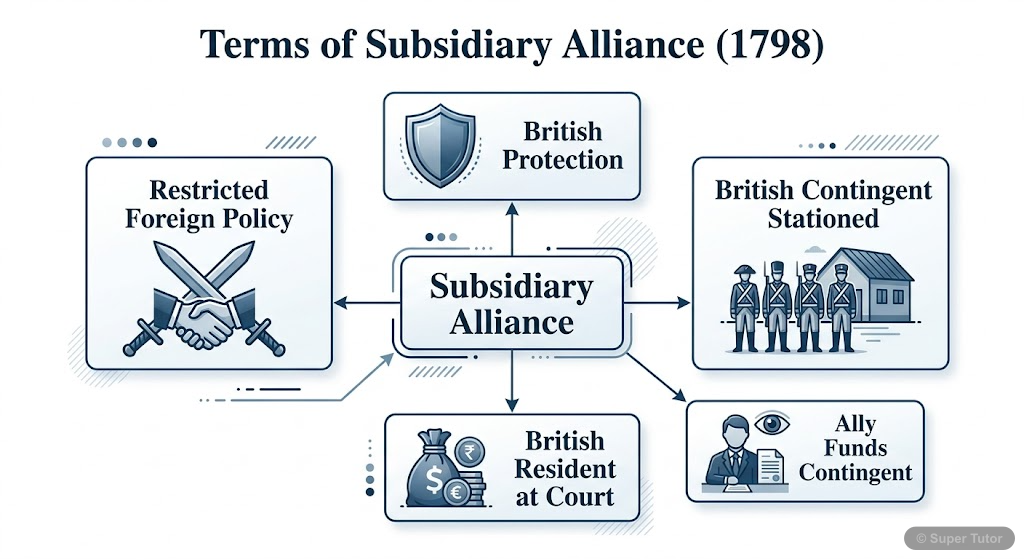
Super Tutor has 5+ illustrations like this for The First War of Independence ( The Great Uprising of 1857) alone — flashcards, concept maps, and step-by-step visuals.
See them allWhat was the Great Uprising of 1857, and why is it important in Indian history?
Answer
The Great Uprising of 1857 was a large revolt against British rule that began as a sepoy mutiny at Meerut on 10 May 1857 and soon spread across North India. It is important because it shook British po…
What was the immediate cause of the Great Uprising of 1857?
Answer
The immediate cause was the issue of greased cartridges for the Enfield rifle. A rumour spread that the cartridges were greased with cow and pig fat. Hindu and Muslim sepoys were offended, because bit…
Who was Mangal Pandey, and why is he remembered?
Answer
Mangal Pandey was a Brahmin sepoy at Barrackpore who refused to use the greased cartridges on 29 March 1857. He killed two English officers and was hanged on 8 April 1857. He is remembered as the firs…
Why did the revolt begin at Meerut on 10 May 1857?
Answer
At Meerut, about 86 sepoys refused to use the greased cartridges. They were dismissed and sentenced to 10 years imprisonment. On 10 May 1857, their companions revolted, killed the officers, attacked t…
Why did the rebels declare Bahadur Shah II the Emperor of India at Delhi?
Answer
Bahadur Shah II was the last Mughal emperor and had symbolic importance for Indian unity. The rebels declared him Emperor of India because they wanted a common leader against the British. His name hel…
Who was Bahadur Shah II, and what happened to him after the revolt?
Answer
Bahadur Shah II, also called Bahadur Shah Zafar, was the last Mughal Emperor. He was declared Emperor of India by the rebels at Delhi. Later, he was captured, sentenced to life imprisonment, and depor…
What role did Nana Sahib play in the uprising at Kanpur?
Answer
Nana Sahib, the adopted son of Peshwa Baji Rao II, led the uprising at Kanpur. He captured the fort, proclaimed himself Peshwa, and acknowledged Bahadur Shah as Emperor. After defeat by General Havelo…
Who was Tantia Tope, and why was he important in the revolt?
Answer
Tantia Tope was a trusted general of Nana Sahib and later of Rani Laxmi Bai. He helped recapture Kanpur and fought at Gwalior. After the uprising, he was caught, tried, and hanged.
+32 more flashcards available
Practice AllFrequently Asked Questions
What are the important topics in The First War of Independence ( The Great Uprising of 1857) for ICSE Class 10 History & Civics?
How to score full marks in The First War of Independence ( The Great Uprising of 1857) — ICSE Class 10 History & Civics?
How many flashcards are available for The First War of Independence ( The Great Uprising of 1857)?
Sources & Official References
Content is aligned to the official syllabus. Refer to the board website for the latest curriculum.
More resources for The First War of Independence ( The Great Uprising of 1857)
Practice Quiz
Test yourself with a quick quiz
Important Questions
Practice with board exam-style questions
Revision Notes
Key points for last-minute revision
Formula Sheet
All formulas in one place
Chapter Summary
Understand the chapter at a glance
Concept Maps
See how topics connect visually
Study Plan
Step-by-step plan to ace this chapter
Syllabus
What topics to cover
NCERT Solutions
Every textbook question solved step by step
For serious students
Get the full The First War of Independence ( The Great Uprising of 1857) chapter — for free.
Quizzes, flashcards, AI doubt-solver and a step-by-step study plan for ICSE Class 10 History & Civics.