The First War of Independence ( The Great Uprising of 1857)
ICSE · Class 10 · History & Civics
Most important questions from The First War of Independence ( The Great Uprising of 1857) for ICSE Class 10 History & Civics board exam 2026. MCQs, short answer, and long answer questions with marks.
Interactive on Super Tutor
Studying The First War of Independence ( The Great Uprising of 1857)? Get the full interactive chapter.
Quizzes, flashcards, AI doubt-solver and a step-by-step study plan — built for important questions and more.
1,000+ Class 10 students started this chapter today
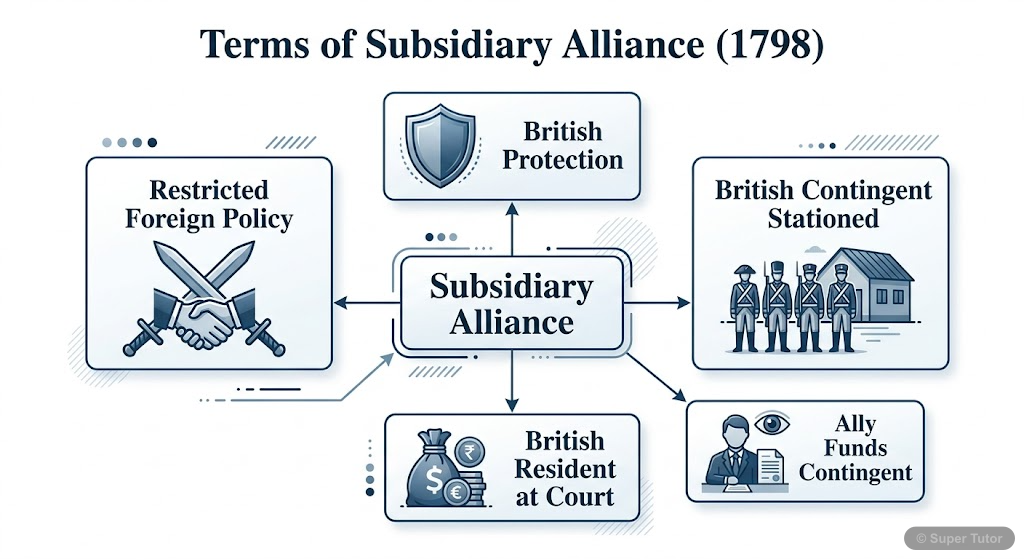
Super Tutor has 5+ illustrations like this for The First War of Independence ( The Great Uprising of 1857) alone — flashcards, concept maps, and step-by-step visuals.
See them allSample Questions
Which of the following were economic causes of the 1857 uprising?
Show answer
Drain of wealth from India to England, Collapse of Indian handicrafts and cottage industries, Heavy land revenue and additional taxes, Unemployment due to annexation of native states
The economic causes included the systematic drain of wealth where India's resources were exploited for Britain's benefit. Indian handicrafts collapsed due to British manufactured goods flooding the market with heavy duties on Indian exports. Land revenue was doubled compared to Mughal times, and additional taxes were imposed. Annexations led to unemployment as armies were disbanded and administrative posts were lost. Railways and telegraphs were actually seen as social-religious threats by orthodox people, not economic causes.
The Great Uprising of 1857 started at Meerut on May 10, 1857.
Show answer
True
The statement is true. The Great Uprising of 1857 officially started at Meerut on May 10, 1857, when sepoys revolted after 86 of their colleagues were dismissed and imprisoned for refusing to use greased cartridges. The revolting sepoys killed officers, attacked the jail, released prisoners, and then marched to Delhi. While Mangal Pandey had revolted earlier in March at Barrackpore, the systematic uprising began at Meerut.
What was the immediate trigger for the Great Uprising of 1857?
Show answer
Greased cartridges controversy
The immediate cause of the Great Uprising was the greased cartridges controversy. New Enfield rifles required cartridges greased with cow and pig fat. Before loading, sepoys had to bite off the cartridge tips with their teeth. This offended both Hindu sepoys (cow was sacred) and Muslim sepoys (pig was forbidden). While annexation of Awadh, abolition of Sati, and Doctrine of Lapse were important underlying causes, the cartridge issue was the spark that ignited the revolt.
Which social and religious factors contributed to the 1857 uprising?
Show answer
Missionary activities and forced conversions, Abolition of Sati system, Introduction of Western education, Tax on religious properties
The chapter lists missionary activities aimed at conversion, the 1829 Act abolishing Sati, the shift towards Western education, and taxes imposed on temple and mosque properties as social and religious grievances that hurt Indian sentiments before 1857. Railways, though they caused suspicion, are classified separately as part of 'other factors' relating to modern innovations rather than a core social-religious cause listed here, and construction of railways alone is not treated as a direct religious grievance. Hence the four selected options correctly represent the social and religious causes.
+41 more questions available
Practice AllFrequently Asked Questions
What are the important topics in The First War of Independence ( The Great Uprising of 1857) for ICSE Class 10 History & Civics?
How to score full marks in The First War of Independence ( The Great Uprising of 1857) — ICSE Class 10 History & Civics?
How many important questions are there in The First War of Independence ( The Great Uprising of 1857)?
Sources & Official References
Content is aligned to the official syllabus. Refer to the board website for the latest curriculum.
More resources for The First War of Independence ( The Great Uprising of 1857)
Practice Quiz
Test yourself with a quick quiz
Revision Notes
Key points for last-minute revision
Formula Sheet
All formulas in one place
Chapter Summary
Understand the chapter at a glance
Concept Maps
See how topics connect visually
Study Plan
Step-by-step plan to ace this chapter
Flashcards
Quick-fire cards for active recall
Syllabus
What topics to cover
NCERT Solutions
Every textbook question solved step by step
For serious students
Get the full The First War of Independence ( The Great Uprising of 1857) chapter — for free.
Quizzes, flashcards, AI doubt-solver and a step-by-step study plan for ICSE Class 10 History & Civics.